Nail Dust Collector: A Complete Guide to Cleaner, Safer Nail Work
If you regularly do acrylic nails, gel nails, builder gel, or nail extensions, you probably know how quickly nail dust can take over your workspace. One minute your nail table looks clean, and the next minute there is a layer of fine powder around your hands, tools, table, and even clothes.
This is where a nail dust collector can make a noticeable difference.
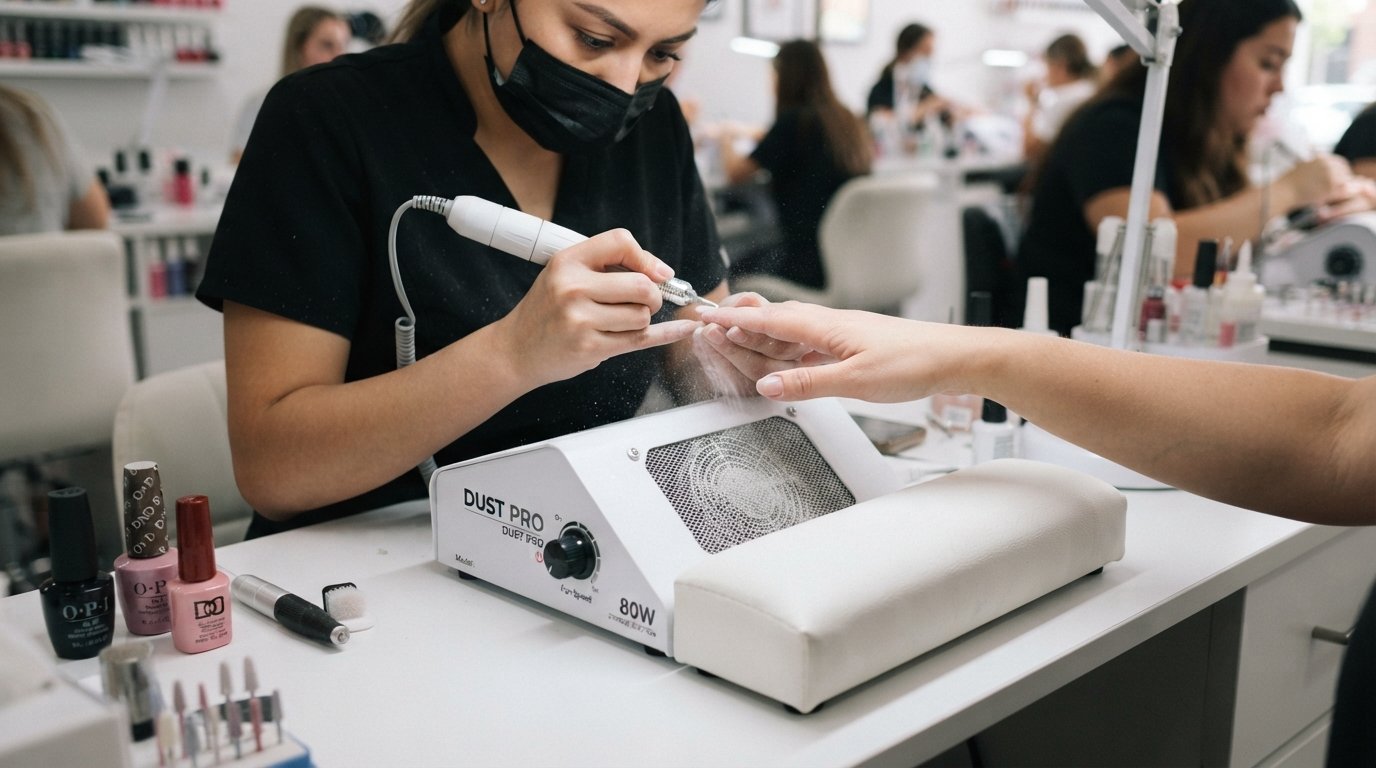
A nail dust collector is a small extraction device designed to collect dust created while filing, shaping, buffing, and removing artificial nails. Instead of allowing the dust to spread around your workspace, the machine pulls much of it toward a dust filter or collection area.
For nail technicians, salon owners, and people who regularly do their nails at home, this can make the manicure process much cleaner and more comfortable.
OSHA notes that nail salon workers can be exposed to dust and chemical products during nail services, particularly during activities such as buffing and filing. Good ventilation, work practices, and appropriate protective equipment are part of a broader approach to reducing exposure.
So, is a nail dust collector worth buying?
For anyone who files or shapes artificial nails regularly, it can be a very practical addition to a nail setup.
What Is a Nail Dust Collector?
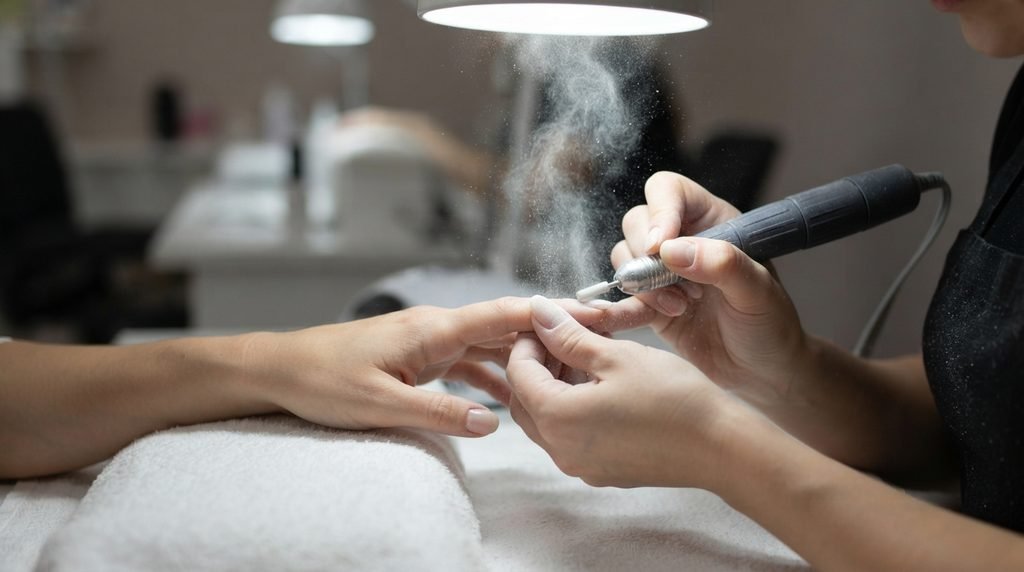
A nail dust collector is a compact device that uses suction to pull nail dust away from the working area.
When you file an acrylic, gel, dip powder, or extension nail, tiny particles are released into the air. A nail dust extractor helps capture these particles before they spread across your nail table and surrounding area.
Most models contain:
- A built-in dust collection fan
- A removable or replaceable dust filter
- A collection compartment or filter bag
- A flat surface where the client’s hand can rest
- Different suction or fan-speed settings on some models
The basic idea is simple: file the nail, create dust, and let the collector capture it.
This is different from simply wiping the table after your manicure. Cleaning afterward removes dust that has already settled, while a nail dust vacuum works during the filing process.
OSHA defines a dust collector generally as equipment used to separate dust from air handled by an exhaust ventilation system.
Why Does Nail Dust Matter?
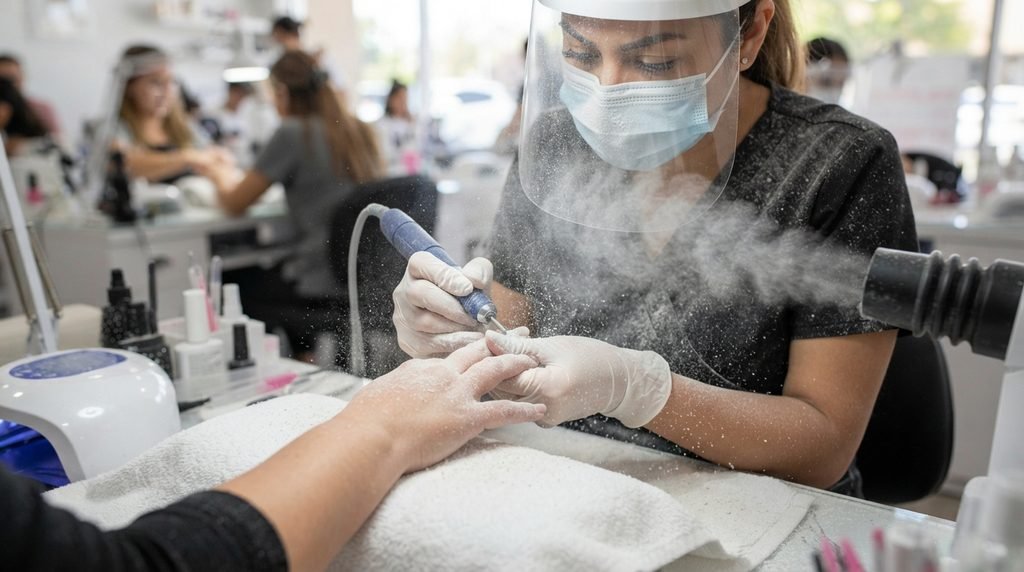
Nail dust may seem like nothing more than a messy inconvenience. However, frequent filing can create a lot of fine particles, especially when working with acrylic powder, artificial nails, or other enhancement materials.
OSHA explains that nail salon workers may breathe in dusts, vapors, or mists from products used during nail services. Repeated workplace exposure is one reason nail professionals should take ventilation and exposure-control practices seriously.
That does not mean a nail dust collector makes your workspace completely dust-free or replaces every other safety measure.
Instead, think of it as one useful part of a cleaner nail workstation.
A good setup may include:
- A nail dust collector
- Suitable ventilation
- Regular cleaning
- Properly maintained nail tools
- Appropriate personal protective equipment when necessary
- Good hand hygiene
For professional salons, local workplace and cosmetology requirements should also be followed.
What Types of Nail Dust Can a Collector Help With?

A good nail dust collector can be useful for several common nail services.
1. Acrylic Nail Dust
Acrylic nails often require significant filing and shaping. As the nail technician refines the shape, acrylic particles can quickly spread across the table.
A nail dust vacuum for acrylic nails can help collect much of this material at the source.
2. Gel Nail Dust
Even though gel products are applied as liquids or gels, cured gel can create fine dust when it is filed or removed.
A gel nail dust collector can therefore be useful during:
- Gel removal
- Gel shaping
- Gel extensions
- Builder gel filing
- Hard gel filing
3. Dip Powder Dust
Dip powder nails involve powdered nail products, and filing or shaping the finished enhancement can create additional dust.
A collector can help keep that dust from spreading around the workstation.
4. Nail Extension Dust
Whether you use tips, forms, acrylic extensions, or gel extensions, shaping the finished nail can create particles.
This is one reason many professional nail technicians consider a nail dust extractor an important workstation accessory.
Nail Dust Collector vs. Regular Vacuum
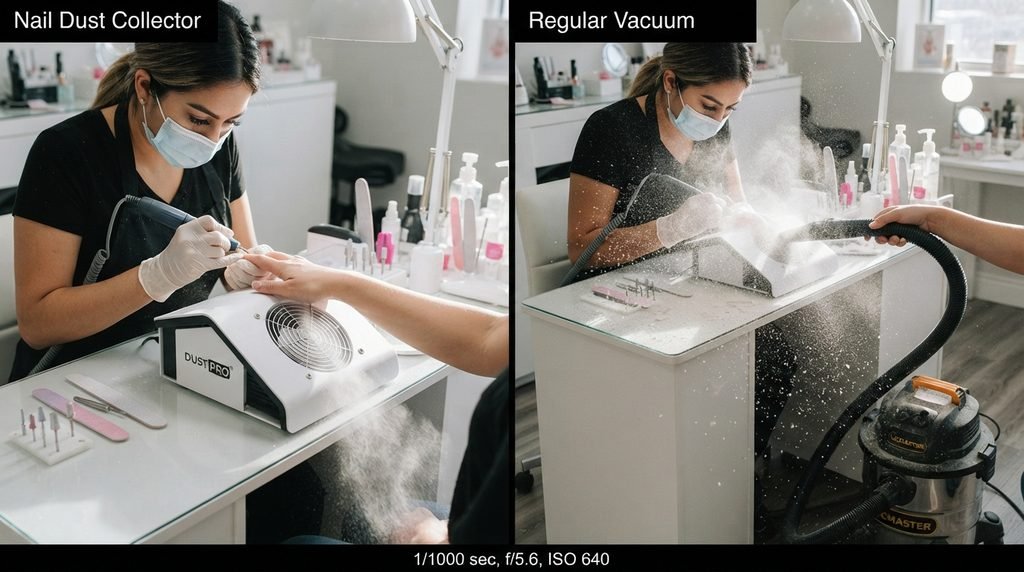
At first, you might wonder:
“Why can’t I just use a normal vacuum?”
A household vacuum and a nail dust collector are designed for different jobs.
A regular vacuum is usually designed for floors, carpets, furniture, and larger debris. A nail dust collector is designed around the much smaller working area of a manicure table.
A dedicated collector typically sits directly under or near the client’s hand.
That positioning matters because the closer the collection point is to where dust is produced, the less opportunity the dust has to spread around the workspace.
For example, imagine filing an acrylic nail with your hand several inches away from the suction opening. Some dust may still escape before reaching the collector.
Therefore, collector placement matters almost as much as suction power.
Benefits of Using a Nail Dust Collector
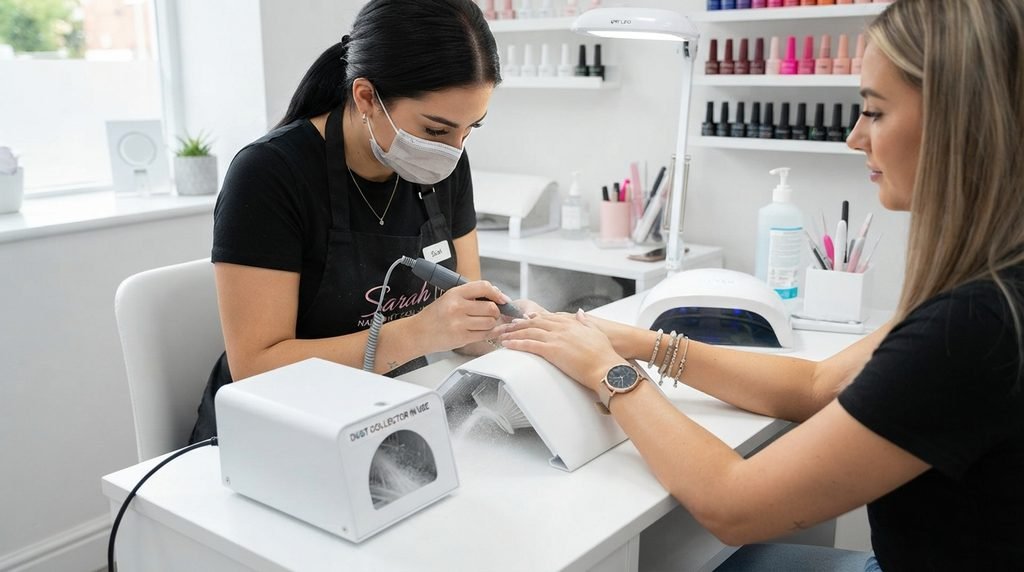
There are several practical reasons to add a nail dust collector to your nail station.
Cleaner Nail Table
The most obvious benefit is less mess.
Instead of allowing nail dust to settle everywhere, the collector captures a significant portion while you work.
This can reduce the amount of cleaning required after each service.
More Comfortable Working Environment
Nobody enjoys sitting in a cloud of nail dust.
A cleaner workstation can make long nail sessions more comfortable, particularly for nail technicians who work with artificial nails every day.
Less Dust Around Your Equipment
Nail dust can settle around:
- UV/LED nail lamps
- Nail drills
- Brushes
- Files
- Bottles
- Desk surfaces
- Keyboard and phone
- Storage containers
Using a nail dust vacuum can help reduce the amount of dust reaching these areas.
More Professional Workstation
A clean nail table creates a better impression for clients.
Imagine a customer sitting down for an appointment and seeing a tidy, organized workstation rather than a table covered in leftover acrylic dust.
A professional nail dust collector can become part of a more organized salon setup.
Saves Cleaning Time
If you’re a busy nail technician, even a few minutes of extra cleaning after every client can add up.
Capturing dust while you work means there may be less debris to clean afterward.
How Does a Nail Dust Collector Work?
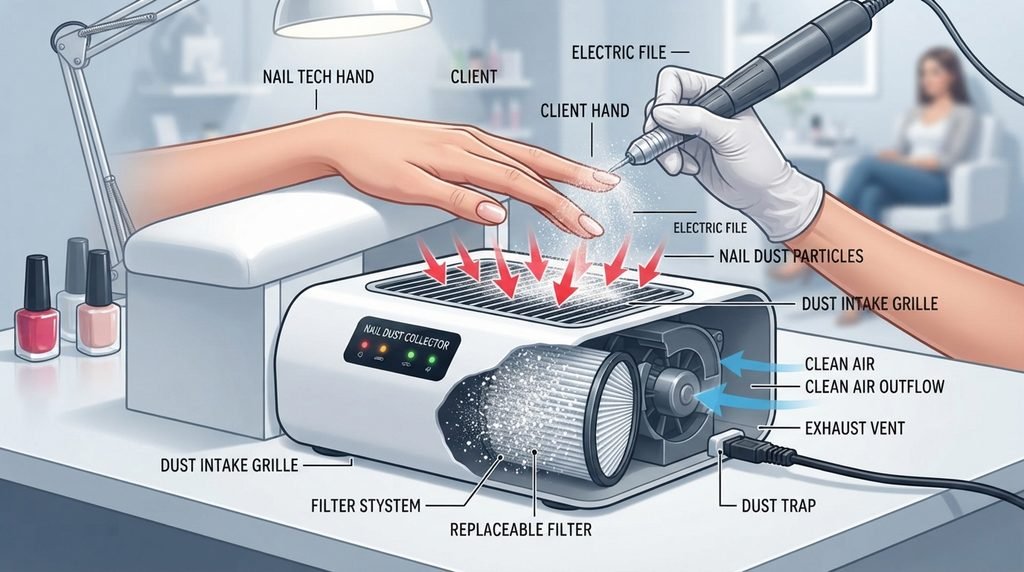
The process is straightforward.
A small fan creates suction beneath or around the client’s hand. As you file the nail, the airflow pulls loose particles toward the collection system.
The dust then enters a filter, where particles are trapped.
Depending on the design, the collector may use:
- Disposable filters
- Reusable filters
- Filter bags
- Multi-layer filters
- Replaceable dust collection pads
Before purchasing, always check the manufacturer’s instructions for the correct filter type and replacement schedule.
A collector that is full of dust or has a clogged filter may not perform as effectively as it did when new.
How to Use a Nail Dust Collector: Step-by-Step
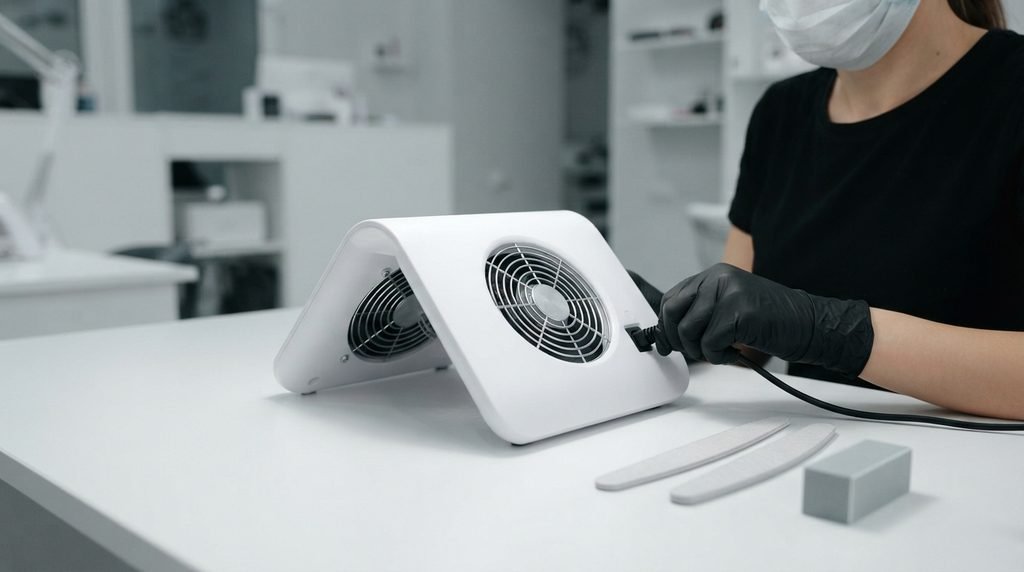
Using a nail dust collector is usually easy.
Step 1: Place the Collector Correctly
Put the machine on a stable surface and position the suction area directly beneath the client’s hand.
Try to keep the filing area reasonably close to the collection opening.
Step 2: Check the Filter
Before starting, make sure the dust filter is properly installed.
If the filter is already packed with dust, replace or clean it according to the manufacturer’s instructions.
Step 3: Turn on the Collector
Switch the machine on before you begin filing.
If your model has multiple speeds, start with an appropriate setting and adjust it according to the manufacturer’s guidance and the amount of dust being produced.
Step 4: File as Normal
Continue your normal nail filing technique.
You don’t need to change the entire manicure process simply because you’re using a collector.
However, keeping the nail close to the suction area can help the collector capture more dust.
Step 5: Check the Work Area
After filing, look around the workstation.
You may still see some dust. A nail dust collector is designed to reduce airborne and surface dust, not magically eliminate every particle.
Step 6: Clean and Maintain the Collector
After your session, follow the manufacturer’s cleaning instructions.
Remove accumulated dust from the appropriate collection area and replace the filter when required.
Regular maintenance is important because a clogged filter can reduce airflow.
What to Look for When Buying a Nail Dust Collector
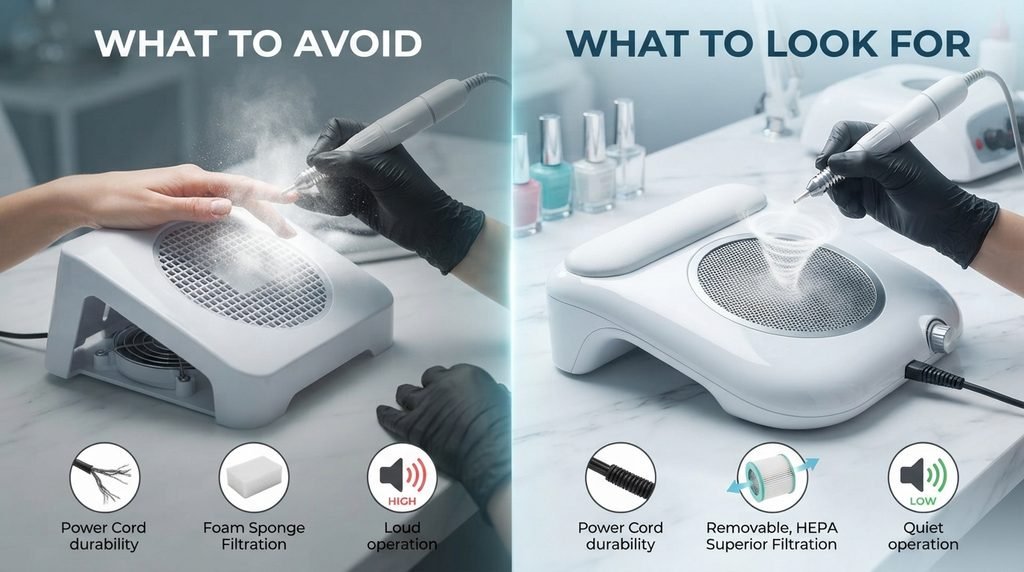
Not every nail dust collector is the same.
If you’re shopping for one, consider these features before making a purchase.
1. Suction Power
Suction is one of the most important features.
A collector needs enough airflow to pull dust toward the filter without becoming unnecessarily loud or uncomfortable.
However, don’t automatically assume that the machine with the highest advertised number is the right choice.
Look at the overall design, suction opening, filter system, noise level, and user reviews.
2. Filter Quality
A good nail dust filter is essential.
Look for a model with a well-designed filtration system and easily replaceable filters.
Also check how frequently the manufacturer recommends cleaning or replacing the filter.
3. Replaceable Filters
Before purchasing, check whether replacement filters are easy to find.
A cheap machine can become inconvenient if its replacement filters are difficult to purchase.
4. Noise Level
If you work with clients for several hours a day, noise matters.
A loud fan running throughout every appointment can become irritating.
If possible, look for a quiet nail dust collector designed for salon use.
5. Size
Your nail table probably has limited space.
A compact portable nail dust collector can be useful for home nail stations, mobile nail technicians, or smaller workspaces.
6. Easy Cleaning
Choose a machine that can be opened and cleaned without a complicated process.
Remember, nail dust collectors are designed to collect dust. That means they themselves will eventually become dusty.
7. Build Quality
If you’re a professional nail technician, the machine may be used repeatedly every day.
In that case, look beyond the cheapest option and consider:
- Construction quality
- Motor reliability
- Filter availability
- Warranty
- Replacement parts
- Customer reviews
A slightly higher initial price can make more sense if the product is built for regular professional use.
Is a Nail Dust Collector Worth It for Home Use?
Yes, it can be useful even if you don’t work in a salon.
If you only do your nails occasionally, you may not need an expensive professional machine.
However, a small nail dust collector for home use can be particularly useful if you regularly do:
- Acrylic extensions
- Gel extensions
- Builder gel
- Hard gel
- Dip powder
- Nail art requiring extensive filing
For occasional users, a compact model may provide the convenience you need without taking over your workspace.
Is a Nail Dust Collector Enough for Nail Safety?
This is an important question.
A nail dust collector can help control dust, but it should not be treated as your only safety measure.
OSHA recommends considering ventilation, safe work practices, and appropriate protective measures in nail salon environments. Its guidance also explains that exposure can come from both dust and chemical vapors.
In other words, a collector deals mainly with the dust-control part of the problem.
It does not automatically remove chemical vapors from products such as removers, polishes, glues, or other salon chemicals.
For that reason, a well-designed workspace should also consider ventilation.
If you work professionally, check the requirements that apply in your location.
Do You Still Need a Mask With a Nail Dust Collector?
A collector can reduce dust, but it doesn’t necessarily capture every particle.
OSHA’s nail salon guidance discusses the use of appropriate respiratory protection for situations involving dust, including filing artificial nails and working with acrylic powders. It also explains that ordinary medical or cloth masks are not equivalent to properly designed filtering respirators.
The right approach depends on your work environment, exposure, and applicable requirements.
For professional use, don’t assume that buying a nail dust vacuum means you no longer need other protective measures.
Think of the collector as one layer of protection and cleanliness, not the entire solution.
Common Mistakes to Avoid
Even a high-quality collector won’t work properly if you use it incorrectly.
Mistake 1: Putting It Too Far Away
If the suction opening is far from the filing area, more dust can escape before reaching it.
Keep the working area positioned appropriately over the collector.
Mistake 2: Ignoring the Filter
A clogged filter can reduce airflow.
Check the filter regularly and follow the manufacturer’s cleaning or replacement instructions.
Mistake 3: Expecting Zero Dust
No small desktop collector should be expected to capture absolutely every particle.
Continue cleaning your workstation and use suitable ventilation and protective practices.
Mistake 4: Buying Only Based on Price
The cheapest nail dust collector isn’t necessarily the best value.
A better purchase decision considers suction, filtration, noise, replacement filters, durability, and warranty.
Mistake 5: Forgetting About Ventilation
A dust collector focuses primarily on dust.
It isn’t automatically a substitute for proper ventilation when you’re working with products that release vapors.
How to Keep Your Nail Dust Collector Working Properly
Once you buy a collector, take care of it.
A simple maintenance routine can help extend its useful life.
After Each Session
Remove visible dust from the collection area.
Regularly
Inspect the filter for buildup.
When Required
Replace disposable filters according to the manufacturer’s instructions.
Avoid
Don’t wash or reuse a filter unless the manufacturer specifically says it is washable.
Also avoid operating the machine without the required filter installed.
Nail Dust Collector Buying Checklist
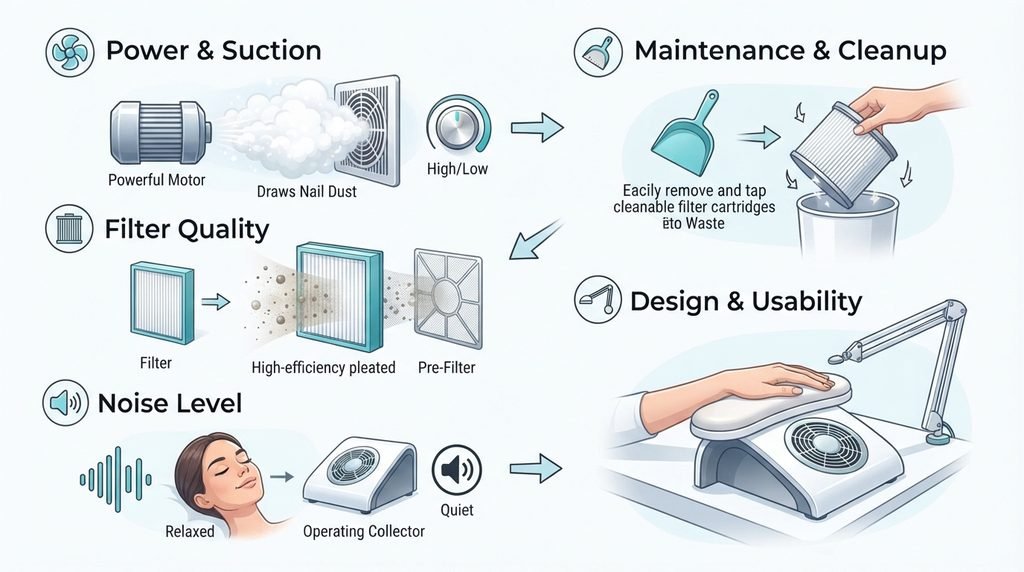
Before you click the Buy button, run through this quick checklist:
- Does it have sufficient suction for my nail services?
- Is the filter easy to replace?
- Can I buy replacement filters?
- Is the noise level acceptable?
- Does it fit my nail table?
- Is it easy to clean?
- Is it designed for acrylic and gel filing?
- Does it have good customer feedback?
- Is there a warranty?
- Is it suitable for home or professional use?
- Does the manufacturer provide clear maintenance instructions?
If most of these answers are yes, you’re much more likely to end up with a product that you’ll actually enjoy using.
Who Should Buy a Nail Dust Collector?
A nail dust collector makes the most sense for people who regularly create nail dust.
You should consider one if you’re:
- A professional nail technician
- A salon owner
- A nail student
- A home nail enthusiast
- An acrylic nail user
- A gel nail user
- A nail extension specialist
- Someone who regularly uses an electric nail drill
For someone who only applies regular nail polish occasionally, it may not be necessary.
However, once you start regularly filing artificial or enhanced nails, the convenience becomes much easier to appreciate.
A Quick Real-Life Example
Imagine you’re doing a full set of acrylic extensions.
You finish applying the product and start shaping the nails. After ten minutes, there’s dust on the table, dust around your files, and a fine layer on your hands.
Now imagine doing the same service with a nail dust collector positioned directly beneath the client’s hand.
As you file, the suction pulls a large portion of the dust downward instead of allowing it to spread across the workstation.
You still need to clean afterward, but the cleanup can be much more manageable.
That difference becomes even more noticeable when you’re doing several clients in one day.
Final Thoughts: Is a Nail Dust Collector Worth Buying?
If you’re serious about keeping your nail workstation cleaner, a nail dust collector is a practical investment.
It won’t eliminate every particle, and it shouldn’t be viewed as a replacement for proper ventilation, cleaning, or appropriate protective equipment. However, it can significantly improve the day-to-day experience of filing and shaping artificial nails.
The key is choosing the right model.
Look for strong and practical suction, a reliable dust filtration system, easily available replacement filters, manageable noise, and a size that works with your nail table.
Most importantly, choose a collector based on how you actually work.
If you’re a professional nail technician doing acrylic and gel services every day, prioritize durability and filter availability. If you’re a home user, a compact and easy-to-maintain portable nail dust collector may be enough.
The best purchase isn’t necessarily the biggest or most expensive machine. It’s the one that fits your workspace, captures dust effectively, is easy to maintain, and makes your nail routine cleaner and more comfortable.
And when you’re spending hours filing nails, that convenience can make a surprisingly big difference.
Frequently Asked Questions
What is a nail dust collector used for?
A nail dust collector is used to capture dust produced while filing, shaping, and removing acrylic, gel, dip powder, and other artificial nail enhancements.
Does a nail dust collector remove all nail dust?
No. A good collector can reduce the amount of dust that spreads around your workstation, but it should not be expected to capture every particle.
Do I need a nail dust collector for acrylic nails?
If you regularly work with acrylic nails, a collector can be very useful because acrylic filing can create a noticeable amount of dust.
Can I use a nail dust collector at home?
Yes. Compact home nail dust collectors are available and can be useful for people who regularly do acrylic, gel, builder gel, or extension nails at home.
How often should I replace the filter?
It depends on the specific machine and how frequently you use it. Always follow the manufacturer’s cleaning and replacement instructions.
Is a nail dust collector the same as ventilation?
No. A collector primarily helps control dust near the nail workstation. Ventilation addresses broader air-quality concerns, including vapors and airborne contaminants. OSHA’s nail salon guidance recommends considering ventilation and other exposure-control measures rather than relying on a single method.
Can a nail dust collector replace a mask?
Not necessarily. A collector can reduce dust, but it does not automatically replace appropriate respiratory protection where it is needed. OSHA specifically discusses suitable respiratory protection for certain nail-salon dust exposures.
What should I look for in a nail dust collector?
Focus on suction performance, filtration, noise level, filter availability, ease of cleaning, size, durability, and warranty. Most importantly, make sure replacement filters are readily available.
Helpful Resource
For additional information about workplace safety in nail salons, see the official OSHA Nail Salon Health & Safety guidance.