How to Remove Nail Glue From Skin: Safe and Easy Methods That Actually Work
If you love press-on nails, artificial nails, or DIY manicures, you have probably experienced that annoying moment when nail glue gets on your skin. One tiny drop can stick your fingers together, leave a hard white patch around the nail, or make your fingertips feel rough and uncomfortable.
The good news is that you usually do not need to panic. With patience and the right method, nail glue can often be removed from skin without harsh scrubbing or pulling.
The most important rule is simple: do not rip or peel dried glue aggressively from your skin. Cyanoacrylate adhesives can bond strongly to skin, and forcing bonded areas apart can cause irritation or even remove the top layer of skin. Poison Control recommends methods such as warm soapy water, oil or petroleum jelly, and, in suitable situations, acetone to help loosen the adhesive. (Poison)
In this guide, we will explain how to remove nail glue from skin, which methods are gentle, when acetone may help, what you should avoid, and how to look after your skin afterward.


What Is Nail Glue?
Before learning how to remove nail glue from skin, it helps to understand what you are dealing with.
Many artificial nail adhesives contain cyanoacrylate, a fast-setting adhesive that forms a strong bond when it comes into contact with moisture. This is why nail glue can seem almost impossible to remove once it has dried.
Cyanoacrylate is also used in various instant adhesives. Poison Control explains that the main issue with these products is usually the strong bonding action rather than traditional poisoning. However, large amounts on skin can generate heat during the bonding reaction and can cause burns. (Poison)
This is also why you should not treat dried nail glue like ordinary nail polish.
Nail polish can often be wiped away. Nail glue needs to be loosened first.
Why Does Nail Glue Stick to Skin So Quickly?
Have you ever been applying a press-on nail and suddenly noticed that your fingertip is stuck to the artificial nail?
It happens because cyanoacrylate reacts rapidly with moisture. Even the small amount of moisture naturally present on your skin can help the adhesive bond.
That is useful when you want a false nail to stay attached, but it can be frustrating when the glue lands somewhere it should not.
For this reason, the goal is not to fight the glue. Instead, you want to soften or loosen the bond gradually.
How to Remove Nail Glue From Skin: The Safest First Step
If you only have a small amount of glue on your fingertip, start with the gentlest method.
You will need:
- Warm water
- Mild soap
- A clean towel
- Petroleum jelly or mineral/vegetable oil
- Moisturizer
You can find additional information about safe use of nail products in the FDA’s nail-care product guidance. (U.S. Food and Drug Administration)
Method 1: Warm Soapy Water
For many small areas of dried nail glue on skin, warm soapy water is an excellent place to start.
Step 1: Prepare warm water
Fill a small bowl with comfortably warm water.
It should not be painfully hot.
Step 2: Add mild soap
Add a small amount of gentle soap and mix it into the water.
Step 3: Soak the affected area
Place the glued finger or skin into the water.
Give the glue time to soften.
Do not expect it to disappear immediately.
Step 4: Gently massage the area
After soaking, gently rub the surrounding skin with your fingers.
If the glue begins to loosen, allow it to roll or flake away naturally.
Step 5: Repeat if necessary
If the glue remains, soak again rather than pulling harder.
Poison Control notes that soaking in warm soapy water can gradually loosen cyanoacrylate bonds and that removal may take time. (Poison)
Why this method is useful
Warm soapy water is simple, inexpensive, and does not require a strong solvent.
It is especially useful when you are dealing with a small amount of adhesive and want to avoid unnecessary exposure to acetone.
Method 2: Use Oil or Petroleum Jelly
If warm water is not enough, try an oil-based approach.
You can use:
- Mineral oil
- Vegetable oil
- Petroleum jelly
- Another suitable oily skin product
Poison Control specifically lists mineral oil, vegetable oil, and petroleum jelly as options that may help loosen cyanoacrylate adhesive from skin. (Poison)
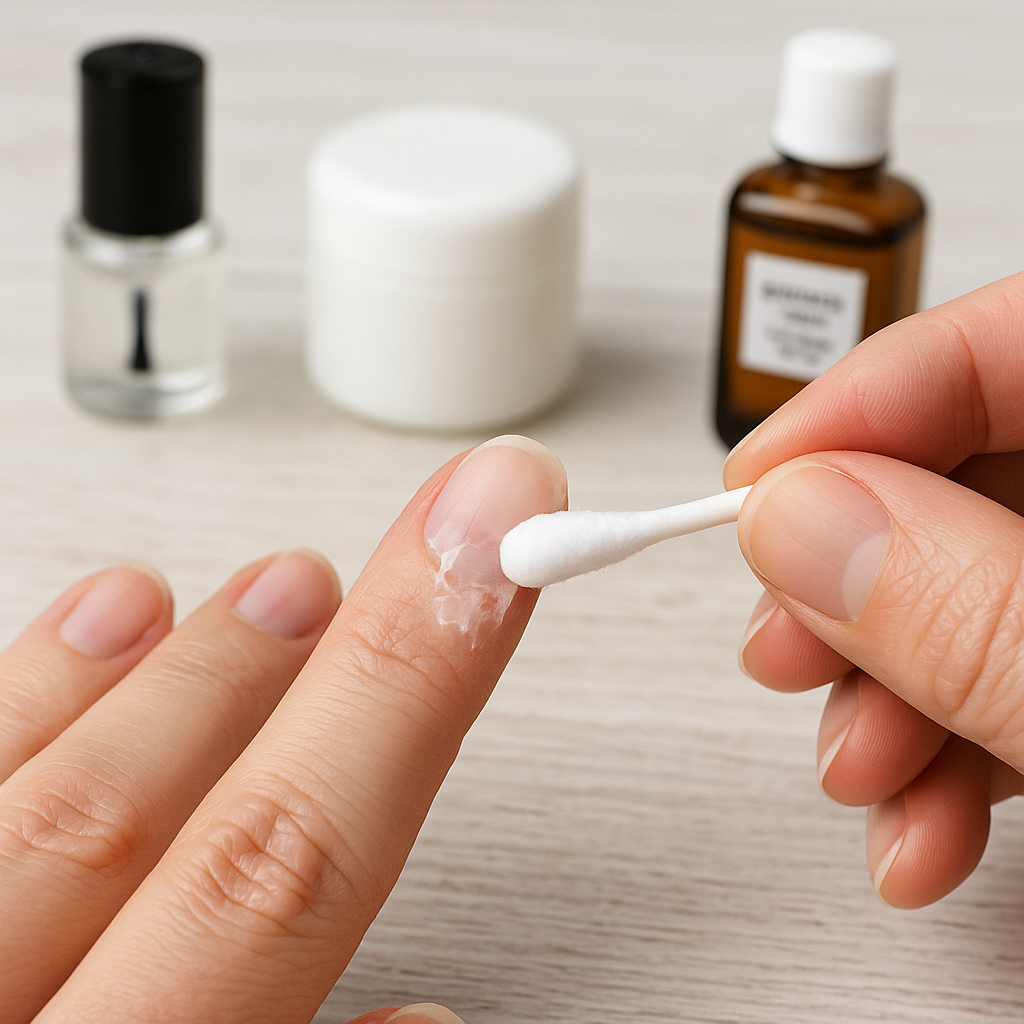
Step-by-step:
- Apply a small amount of oil or petroleum jelly around the dried glue.
- Massage it gently into the area.
- Leave it for several minutes.
- Slowly work the softened glue with your fingertips.
- Stop if the skin becomes painful or irritated.
- Wash the area afterward.
The key here is patience.
If you immediately start scraping, you may damage the skin before the glue has had time to loosen.
Method 3: Try Acetone Carefully
One of the most commonly discussed answers to how to remove nail glue from skin is acetone.
Acetone can help dissolve or loosen certain cyanoacrylate adhesives. Poison Control lists acetone as one possible method for separating skin bonded by super glue. (Poison)
However, there is an important warning:
Acetone can irritate and dry the skin.
Poison Control notes that acetone may cause redness, itching, burning, peeling, and dryness. (Poison)
Therefore, do not treat acetone as your first choice for every small spot of glue.
If you choose to use acetone:
- Read the product label first.
- Work in a well-ventilated area.
- Keep acetone away from your eyes and mouth.
- Use only a small amount.
- Apply it carefully to the affected glue.
- Allow the adhesive to loosen rather than aggressively scraping.
- Wash the skin afterward.
- Apply a moisturizer or petroleum jelly.
The FDA also recommends reading nail-product labels carefully, following warnings, and using nail products with good ventilation. (U.S. Food and Drug Administration)
Important: Do Not Use Acetone Near Your Eyes
This deserves its own section.
If nail glue is close to your eyes, do not use acetone around the eye area.
Acetone can irritate the eyes, and trying to force glued eyelids apart can cause injury.
If cyanoacrylate gets into an eye, Poison Control recommends flushing the eye with water and not forcing the eyelids open. (Poison)
If you have an eye exposure, significant pain, vision changes, or persistent irritation, seek urgent medical advice.
Method 4: Let the Glue Wear Off Naturally
This may sound strange, but sometimes the best answer to how to remove nail glue from skin is simply to give it time.
If there is only a thin layer of dried adhesive and it is not causing discomfort, you may not need to remove every tiny piece immediately.
Dried cyanoacrylate can eventually wear away naturally.
Poison Control notes that dried adhesive on skin may loosen over time and advises against forcibly pulling bonded skin apart. (Poison)
So, if you have a tiny dry patch on your fingertip, you can:
- Keep washing your hands normally.
- Moisturize the skin.
- Avoid picking at the glue.
- Let the adhesive gradually loosen.
Sometimes, this is much kinder to your skin than aggressive removal.
Method 5: Use a Nail Glue Remover
If you regularly use press-on nails, investing in a nail glue remover can make your routine easier.
Some nail glue removers are designed specifically to loosen adhesive rather than forcing you to scrape it away.
When choosing one, look for:
- Clear ingredient information
- Detailed instructions
- Appropriate warnings
- A product designed specifically for nail adhesive
- Packaging that is easy to use
- A reputable manufacturer
The FDA advises consumers to read nail-product labels carefully and follow directions and warning statements. (U.S. Food and Drug Administration)
One important buying tip
Do not automatically choose the strongest-looking product.
A product marketed as “extra strong” or “instant removal” is not necessarily the right choice for your skin.
For home use, a remover with clear instructions and appropriate safety information is more important than flashy marketing.
A Quick Story Every Press-On Nail Lover Will Understand
Imagine this.
You have chosen the perfect set of press-on nails. The shape is beautiful, the color matches your outfit, and you are almost finished.
Then one little drop of glue lands beside your nail.
You wipe it.
It gets worse.
You try to rub it away.
Now there is an even larger sticky patch.
You start thinking, “Why did I even do this?”
This is exactly where patience makes a difference.
Instead of scraping the skin, you soak the finger in warm soapy water. After a while, the glue starts feeling softer. You add a little petroleum jelly and gently massage the area.
Eventually, the adhesive begins to loosen.
The lesson?
Do not panic when nail glue gets on your skin.
Give the adhesive time to loosen instead of fighting it.
How to Remove Nail Glue From Fingers That Are Stuck Together
This is slightly different from simply having glue on your skin.
If two fingers have become stuck together, do not pull them apart forcefully.
Pulling can injure the skin.
Poison Control specifically advises against forcing bonded skin apart. (Poison)
Follow these steps:
- Stay calm.
- Place the fingers in warm, soapy water.
- Let them soak.
- Gently move the fingers back and forth.
- Add mineral oil, vegetable oil, or petroleum jelly if needed.
- Continue slowly.
- Stop if there is significant pain.
It may take considerable time for the adhesive to loosen.
If the fingers remain firmly bonded or you develop significant pain, burns, swelling, or other concerning symptoms, seek medical help.
What If Nail Glue Has Dried Completely?
Dried glue can look intimidating because it becomes hard and solid.
However, hard does not mean impossible to remove.
The mistake is trying to attack the hardened patch immediately with a sharp object.
Instead:
First soften it.
Use warm soapy water.
Then lubricate it.
Try petroleum jelly or an appropriate oil.
Then gently loosen it.
Use your fingertips rather than sharp metal tools.
Finally, repeat.
Several gentle attempts are usually preferable to one aggressive attemp
Should You Scrape Nail Glue Off Skin?
Generally, avoid aggressive scraping.
It can be tempting to grab a nail file, cuticle pusher, tweezers, or another sharp tool and simply scrape the glue away.
But your skin is underneath the adhesive.
If you scrape too deeply, you can damage the skin.
The same principle applies to picking. Removing artificial nail products aggressively can contribute to nail and surrounding-skin damage. The American Academy of Dermatology warns that artificial nail products and their removal can irritate surrounding skin and damage natural nails. (AAD)
Can You Use a Nail File on Nail Glue?
A nail file can sometimes help with adhesive on the nail surface, but using abrasive tools directly on your skin is a different matter.
If the glue is on your skin, prioritize soaking and lubrication.
If you are removing adhesive residue from an artificial nail or nail surface, follow the instructions for that specific nail system.
Do not confuse removing glue from a nail with removing glue from skin.
Why You Should Never Pull Dried Nail Glue Off
This is one of the most important points in this entire guide.
Imagine dried glue as a tiny hard layer attached to your skin.
When you pull it aggressively, you are not necessarily separating glue from skin.
You may be pulling the skin along with it.
Poison Control specifically warns that pulling bonded areas apart can cause irritation, pain, and skin injury. (Poison)
So remember:
Soften → lubricate → loosen → repeat.
That simple sequence is much better than:
Pull → scrape → panic.
How to Protect Your Skin After Removing Nail Glue
Once you have successfully removed the adhesive, your job is not quite finished.
Your skin may feel dry, tight, or slightly irritated, particularly if you used acetone.
Try this simple aftercare routine:
1. Wash gently
Use mild soap and water to remove leftover remover, oil, or adhesive.
2. Dry carefully
Pat your hands dry rather than rubbing aggressively.
3. Moisturize
Apply a good hand cream or moisturizer.
4. Pay attention to the nail area
Apply moisturizer around the cuticles and surrounding skin.
5. Give irritated skin a break
If your skin is already red or sore, avoid immediately applying more nail glue to the same area.
Acetone can dry and irritate skin, which is why aftercare becomes particularly important when acetone has been used. (Poison)
How to Prevent Nail Glue From Getting on Your Skin
Of course, the easiest way to remove nail glue is to avoid getting it on your skin in the first place.
This becomes easier with practice.
Use Less Glue
One of the most common mistakes beginners make is using too much adhesive.
You generally do not need a huge blob.
A controlled, small amount is easier to manage.
Work Slowly
Do not rush because you want to finish your manicure quickly.
Place the artificial nail carefully.
Keep Your Workspace Organized
Have everything ready before opening the glue:
- Press-on nails
- Nail file
- Nail glue
- Tissue
- Remover
- Hand cream
This reduces the chance of knocking the glue bottle over.
Keep the Glue Bottle Upright
When the bottle is lying on its side, accidental spills are much easier.
Keep it upright and close it properly after use.
Read the Instructions
The FDA recommends following nail-product directions and paying attention to warnings. (U.S. Food and Drug Administration)
What Not to Do When Removing Nail Glue
Here are some common mistakes worth remembering.
❌ Do not force stuck fingers apart
This can injure the skin. (Poison)
❌ Do not use acetone near your eyes
Acetone can cause eye irritation.
❌ Do not scrape aggressively
Sharp tools can damage your skin.
❌ Do not keep applying solvent repeatedly
If your skin becomes irritated, stop.
❌ Do not ignore a burn
Large amounts of cyanoacrylate can generate heat and cause burns. (Poison)
❌ Do not use random industrial solvents
A nail adhesive remover should be designed for its intended use. Follow the product label rather than experimenting with household chemicals.
Can Nail Glue Cause a Burn?
It can, particularly when a large amount of cyanoacrylate comes into contact with certain materials or skin.
Poison Control explains that large amounts of super glue on skin can cause chemical burns because the polymerization reaction releases heat. (Poison)
This is one reason to take accidental spills seriously.
If you experience significant burning, blistering, severe pain, or a large affected area, do not continue experimenting with home-removal methods. Seek medical attention.
What About Cotton and Nail Glue?
Here is a lesser-known safety point.
Cyanoacrylate can react strongly with certain fabrics, including cotton and wool, and can release enough heat to cause burns. Poison Control specifically warns against using cotton materials with cyanoacrylate exposure in certain situations. (Poison)
Therefore, if you are dealing with a significant spill of liquid cyanoacrylate, be careful about applying cotton directly to it.
Always check the adhesive’s label and safety instructions.
When Should You Seek Medical Help?
Most small amounts of nail glue on intact skin can be managed with patience.
However, seek professional medical advice if:
- The glue causes a significant burn.
- Your skin blisters.
- You have severe or increasing pain.
- A large area of skin is covered.
- Your fingers remain firmly bonded and cannot be separated safely.
- Glue gets into your eye.
- You experience vision changes.
- You have significant swelling or an unusual reaction.
- You are unsure what chemical product was involved.
If nail glue enters an eye, do not force the eye open. Poison Control recommends rinsing with water and obtaining appropriate medical guidance. (Poison)
Choosing a Nail Glue Remover With Confidence
If you regularly wear press-on nails, keeping a suitable nail glue remover at home can be a smart addition to your manicure kit.
However, shopping for one should not be about buying the most expensive bottle.
Instead, look for a product with:
Clear instructions
You should know exactly how it is intended to be used.
Full ingredient information
The label should clearly identify the ingredients and warnings.
Suitable packaging
A secure bottle helps reduce accidental spills.
A reputable source
Buy from a trustworthy beauty retailer or manufacturer.
Skin-use directions
A product designed specifically for nail adhesive is preferable to experimenting with unrelated solvents.
The FDA emphasizes reading labels, following warnings, and using nail products according to their directions. (U.S. Food and Drug Administration)
Also, be cautious about questionable nail-remover products. The FDA has previously warned about cosmetic products containing prohibited ingredients, including methylene chloride, which has appeared in some products marketed as gel nail polish removers. (U.S. Food and Drug Administration)
So, buying a proper nail glue remover from a reputable source can be worthwhile, particularly if you frequently use artificial nails. The goal is convenience and responsible product use.
Nail Glue Remover vs. Acetone
You may wonder which option is better.
The answer depends on the situation and the product.
| Feature | Nail Glue Remover | Acetone |
|---|---|---|
| Designed for nail adhesive | Often | Not necessarily |
| Can loosen adhesive | Yes, depending on formula | Yes, for suitable adhesives |
| Can dry skin | Depends on ingredients | Yes |
| Requires ventilation | Follow label | Yes |
| Suitable around eyes | Generally avoid | Avoid |
| Best approach | Follow product directions | Use cautiously |
There is no reason to use a stronger chemical than necessary.
For a tiny spot of glue, warm soapy water or petroleum jelly may be enough. For stubborn adhesive, a suitable remover may be more convenient.
A Simple Nail Glue Removal Routine
If you want a quick routine to remember, use this:
1. Don’t panic
Nail glue on skin is a common accident.
2. Don’t pull
Never aggressively rip dried adhesive from your skin.
3. Soak
Use warm soapy water.
4. Lubricate
Try petroleum jelly or mineral/vegetable oil.
5. Wait
Give the adhesive time to loosen.
6. Consider a suitable remover
If necessary, follow the label directions carefully.
7. Wash
Clean your skin afterward.
8. Moisturize
Apply hand cream or petroleum jelly.
9. Check your skin
Stop if you notice significant irritation, pain, or burning.
This approach keeps the process simple and avoids unnecessary aggression.
Frequently Asked Questions
How do I remove nail glue from skin quickly?
Start with warm soapy water and gently massage the area. Petroleum jelly or mineral/vegetable oil can also help loosen adhesive. For stubborn cyanoacrylate, acetone may help, but it can irritate and dry skin, so use it cautiously and according to the product instructions. (Poison)
Can I use nail polish remover to remove nail glue from skin?
Some nail polish removers contain acetone, which can help loosen certain adhesives. However, acetone can irritate and dry skin, so it should be used carefully and kept away from eyes and mucous membranes. (Poison)
How do I remove nail glue without acetone?
Try soaking the area in warm soapy water, followed by gentle application of petroleum jelly or mineral/vegetable oil. These methods may take longer but can be useful when you want to avoid acetone. (Poison)
Can I peel dried nail glue off?
It is better not to forcefully peel or pull dried glue. Doing so can remove or injure the top layer of skin. Let the glue soften and loosen gradually instead. (Poison)
How long does nail glue stay on skin?
It varies depending on the amount of glue, the location, and the removal method. Small amounts can gradually wear away naturally if you leave them alone.
Can oil remove nail glue from skin?
Oil may help loosen cyanoacrylate adhesive. Poison Control lists mineral oil and vegetable oil among options that can help separate bonded skin. (Poison)
Can petroleum jelly remove nail glue?
Petroleum jelly can help lubricate the area and loosen adhesive. Apply it gently and give it time to work rather than immediately scraping the glue.
Is acetone bad for skin?
Acetone can cause dryness, redness, itching, burning, peeling, and irritation, especially with repeated or prolonged exposure. (Poison)
What should I do if nail glue gets in my eye?
Do not force your eyelids open. Rinse the eye with water and seek appropriate medical or poison-control guidance, especially if pain or visual symptoms persist. (Poison)
Final Thoughts: How to Remove Nail Glue From Skin Safely
Learning how to remove nail glue from skin does not have to be complicated.
The biggest mistake is rushing.
When glue gets onto your finger, your first instinct might be to pull, scrape, or reach for the strongest remover you can find. Instead, take a breath and remember that patience is usually your best tool.
Start with warm soapy water. If necessary, try petroleum jelly or an appropriate oil. For stubborn adhesive, a suitable nail glue remover or carefully used acetone may be an option, provided the product is appropriate and you follow its directions. (Poison)
And if you regularly use press-on nails, keeping a quality nail glue remover in your manicure kit can make those little accidents much less stressful. Look for clearly labeled products from reputable sources and follow the instructions rather than choosing a product simply because it promises the fastest removal.
Most importantly, remember:
Never force bonded skin apart. Never use acetone near your eyes. Never ignore significant burning or pain.
With the right technique, you can deal with a little nail-glue accident without turning your manicure into a major problem.