BIAB Nails: The Complete Guide to Stronger, Natural-Looking Nails
If you love having neat, glossy nails but your natural nails seem to break the moment they finally start growing, BIAB nails may be worth trying. This nail trend has become a favorite for people who want stronger-looking natural nails without committing to very long acrylic extensions.
The idea is simple: BIAB, short for Builder in a Bottle, is a type of builder gel designed to add structure and strength to the natural nail. It can be used as a natural nail overlay, and depending on the specific formula, it can also be used for certain extensions and nail repairs.
What makes BIAB especially appealing is the finished look. Instead of extremely thick or obviously artificial nails, a well-applied BIAB manicure can look clean, smooth, glossy, and surprisingly natural.
But there is more to BIAB than simply painting a thick layer of gel onto your nails.
In this guide, we will cover what BIAB nails are, how they work, the benefits and drawbacks, BIAB vs gel polish and acrylics, how to apply BIAB step by step, how long it lasts, how to remove it safely, which BIAB formula may suit you, and what to look for before buying a BIAB product.
What Are BIAB Nails?
BIAB nails are natural nails that have been reinforced with a builder gel product commonly known as Builder in a Bottle.
Unlike ordinary gel polish, which is mainly used to add color and shine, builder gel is designed to provide additional structure. It can create a stronger coating over the natural nail and can be shaped to support areas that are more likely to bend or break.
The term BIAB originally became associated with The GelBottle’s Builder In A Bottle system, although the phrase is now commonly used more broadly for similar builder-gel services and products.
A typical BIAB manicure may include:
- Natural nail preparation
- Cuticle and surface preparation
- A suitable base or bonding layer, depending on the product
- Builder gel
- Structural shaping
- UV or LED curing
- Filing and refining
- Gel polish or nail art, if desired
- A glossy top coat
The result is usually a smooth, structured nail that still looks much closer to a natural nail than a traditional long extension.
The GelBottle’s official BIAB guide
Why Are BIAB Nails So Popular?
There is a reason BIAB manicures have become so popular among people who prefer natural-looking nails.
Imagine someone who has spent months trying to grow her nails. Every time they reach a decent length, one nail snaps while opening a drawer, washing dishes, or simply catching on clothing.
That is frustrating.
BIAB can provide a protective layer over the natural nail, allowing the nail to have more structure while it grows. The GelBottle describes BIAB as a flexible builder system that can help reinforce natural nails and reduce snapping.
For many people, the attraction is not about having extremely long nails. It is about having healthy-looking, tidy, strong-looking nails that are easier to maintain.
Some common reasons people choose BIAB include:
- Natural-looking nails
- Added structure
- Protection against everyday bending
- A glossy salon finish
- Nude and pink shades that can be worn alone
- The option to add gel color
- The ability to grow natural nails underneath
- A versatile base for certain nail designs
- Less bulky-looking results compared with some traditional extensions
Of course, the exact result depends on the formula, nail condition, preparation, application technique, and curing system.
BIAB Nails vs Gel Polish
One of the most common questions is:
Are BIAB nails the same as gel polish?
No.
They are related because both use gel technology and need curing, but they have different jobs.
Gel polish is primarily a color product. It creates a thin, durable layer of color over the nail.
BIAB is a builder product. Its purpose is to create structure and reinforcement as well as provide a finished appearance.
Think of it this way:
Gel polish is like the paint on a wall. BIAB is more like adding a stronger layer underneath the paint.
A BIAB manicure can also be finished with gel polish, which means you do not necessarily have to choose between the two.
For example, you could have a nude BIAB base, followed by a soft pink gel color and a glossy top coat.
The result can look polished without making the nails appear overly thick.
Learn more about the difference between BIAB and gel from The GelBottle
BIAB Nails vs Acrylic Nails
Acrylic nails and BIAB nails can both add strength and structure, but they are different systems.
Traditional acrylic enhancements are created using liquid monomer and powder polymer. They are generally known for creating strong, structured artificial nails and can be used for significant length.
BIAB is a gel-based system and is commonly used as a natural nail overlay.
The difference becomes particularly obvious when you look at the final appearance.
BIAB tends to suit people who want:
- Short to medium natural nails
- A clean manicure
- A natural shape
- A flexible enhancement
- Natural-looking nude or pink nails
- Help growing their own nails
Acrylic may be more appropriate when someone wants substantial length or a different type of extension system.
Dermatologists also point out that artificial nail systems can contribute to nail damage when preparation, removal, or repeated maintenance is too aggressive.
That does not mean acrylic or gel products are automatically bad. It means technique and maintenance matter.
The Main Benefits of BIAB Nails
1. They Can Add Strength
The biggest reason people try BIAB gel is reinforcement.
A properly structured builder-gel overlay can help support the natural nail and make it less vulnerable to everyday bending and snapping.
The GelBottle describes BIAB as a flexible builder designed to reinforce natural nails and support growth.
However, it is worth being realistic.
BIAB does not magically repair a damaged nail from the inside. It creates a protective enhancement over the nail. Your natural nail still grows underneath it.
2. They Look Natural
If you dislike the thick appearance sometimes associated with extensions, natural BIAB nails can be a great alternative.
A soft nude, milky pink, beige, or sheer peach BIAB shade can look like your nails, only cleaner and more polished.
This is one reason the style works so well for:
- Office manicures
- Weddings
- Minimalist nail designs
- French tips
- Everyday wear
- Short nails
- Clean-girl nail looks
You can leave the BIAB shade alone or use it as a base for additional nail art.
3. You Can Grow Your Natural Nails
This is where many people become fans of BIAB.
Suppose your natural nails usually break at the same point. Adding structure may help protect them while they grow.
One person may start with very short nails and gradually see more length as the natural nail grows underneath the enhancement.
That is also why BIAB for nail growth is such a popular search topic.
Just remember that BIAB does not speed up the biological growth rate of your nails. Instead, the protective enhancement may help you retain the length you are already growing by reducing everyday breakage.
4. It Works Beautifully With Minimal Nail Art
You do not need complicated designs to make BIAB nail ideas look good.
Try:
- Classic French tips
- Micro French
- Chrome accents
- Small flowers
- Pearl details
- Glazed finishes
- Simple nude shades
- Soft pinks
- Brown tips
- Minimal line art
The smooth builder-gel base gives nail art a clean surface to work with.
Are BIAB Nails Good for Short Nails?
Yes, short nails are actually one of the most popular uses for BIAB.
If your nails are short because they break easily, a BIAB overlay can add structure without requiring long extensions.
For example, you can keep your nails close to their natural length and use a nude BIAB shade.
After several appointments, your natural nails may gradually appear longer simply because you are retaining more of the length as they grow.
For short nails, the goal should usually be balanced structure, not excessive thickness.
A good nail technician will consider your nail length, shape, lifestyle, and the specific builder-gel formula rather than applying the same amount of product to every client.
How to Apply BIAB Nails Step by Step
If you are a beginner, this section is especially important.
Professional gel products should be used according to the manufacturer’s instructions. Different BIAB formulas can have different requirements for preparation, base coats, curing, removal, and application thickness.
Here is the general process.
Step 1: Clean and Prepare the Nails
Start with clean, dry nails.
Remove any existing polish or product and gently prepare the nail surface according to the instructions for your chosen system.
Do not aggressively file the natural nail.
The goal is preparation, not thinning the nail plate.
Step 2: Prepare the Cuticle Area
Gently push back the cuticle area if appropriate and remove only loose non-living tissue according to professional nail-preparation practices.
Avoid unnecessary cutting of the living cuticle.
The American Academy of Dermatology’s manicure guidance recommends avoiding cuticle cutting because the cuticle helps protect the surrounding area from infection.
Step 3: Apply the Correct Base or Bonding Layer
This depends entirely on the BIAB formula.
Some products contain their own base and primer components, while other formulas require a separate base.
For example, The GelBottle states that some of its Cover Nude BIAB products contain primer and base components, while certain clear, white, and milky formulas have different requirements.
So do not assume that every builder gel works the same way.
Always check the manufacturer’s instructions.
Step 4: Apply a Thin Layer
Apply a controlled layer of builder gel.
This first layer should not be unnecessarily thick.
One of the biggest mistakes beginners make is thinking:
“More product means stronger nails.”
That is not necessarily true.
According to NailKnowledge, excessive thickness can increase the chance of under-curing and heat spikes. Correct application depends on the product and proper training.
Step 5: Build the Structure
This is the part that separates builder-gel application from simply painting gel onto a nail.
A small amount of builder gel can be used to create the appropriate structure, including support around the nail’s stress area.
The raised structural area is commonly called the apex.
The goal is not to create a huge bump. Instead, the structure should be balanced and appropriate for the nail’s length and shape.
The GelBottle describes the BIAB bead as a controlled amount of builder gel used to build structure and reinforce the apex.
Step 6: Cure the Product
Place the nail under the correct LED or UV nail lamp according to the manufacturer’s curing instructions.
Do not guess the curing time.
The product, lamp, application thickness, and system compatibility all matter.
A product that looks hard on the surface is not automatically proof that it has been correctly cured throughout.
Step 7: Refine the Shape
Once the product has cured, the nail can be refined where required.
The aim is a smooth, balanced shape with no unnecessary bulk.
Common nail shapes include:
- Almond
- Oval
- Square
- Squoval
- Coffin
- Round
For short natural nails, round, oval, and squoval shapes can be particularly easy to maintain.
Step 8: Add Gel Color or Nail Art
Now you can leave the BIAB nude, add gel polish, create a French manicure, or add your favorite nail design.
A sheer pink BIAB with a thin white French tip is one of the easiest ways to get a polished but timeless result.
Step 9: Finish With a Top Coat
A quality gel top coat adds shine and helps complete the manicure.
Once cured, apply cuticle oil around the nail area to keep the surrounding skin comfortable and moisturized.
How Long Do BIAB Nails Last?
The exact wear time depends on the product, application, nail growth, lifestyle, and maintenance.
Some professional BIAB systems advertise wear of several weeks. For example, The GelBottle’s consumer material states that its BIAB system can last up to four weeks.
However, that does not mean you should simply leave the same set untouched for four weeks.
As your natural nail grows, the balance and structure of the enhancement change.
Regular professional maintenance is important.
If you notice:
- Lifting
- Cracking
- Pain
- Significant gaps
- Moisture trapped underneath
- Changes in nail color
- Damage to the natural nail
do not simply cover the problem with another layer.
Have the product assessed and removed appropriately.
How to Remove BIAB Nails Safely
Removal is just as important as application.
Never rip, peel, bite, or force the product away from the natural nail.
Depending on the formula, BIAB may be soak-off or file-off.
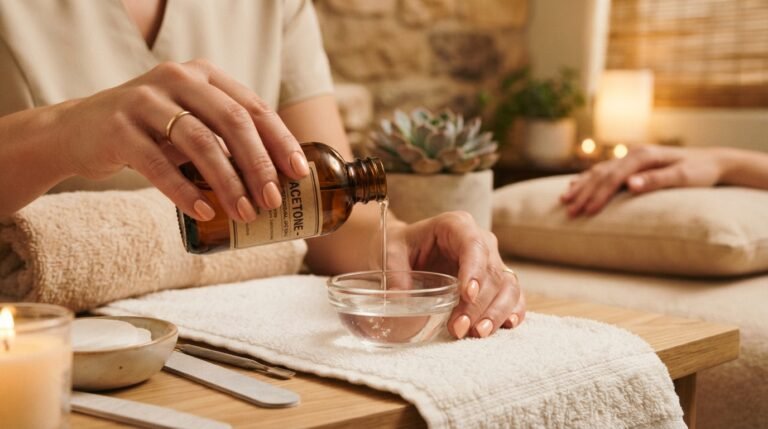
Some soft builder gels can be removed using acetone, while harder formulas may require filing and professional removal. The specific manufacturer’s instructions should always be followed.
A typical soak-off process may involve:
- Carefully reducing the bulk of the product.
- Applying acetone to the remaining gel as directed.
- Allowing sufficient time for the product to soften.
- Gently removing softened material.
- Avoiding force against the natural nail.
- Finishing with nail and cuticle care.
The American Academy of Dermatology also advises against picking gel polish and recommends proper removal instead.
How to Choose the Best BIAB for Your Nails
Not every builder gel is identical.
You may see products described as:
- Soft BIAB
- Hard BIAB
- Fibre BIAB
- HEMA-free BIAB
- TPO-free BIAB
- Clear BIAB
- Nude BIAB
- Milky BIAB
These formulas can differ in viscosity, flexibility, strength, curing behavior, and removal method.
For example, The GelBottle’s educational material explains that different BIAB formulas are designed for different nail lengths, extension requirements, and client needs.
Soft BIAB
Soft builder systems are generally suited to natural nail overlays where flexibility is useful.
Hard BIAB
Hard builder products are typically designed for greater structure, longer nails, extensions, or clients who need additional durability. Some hard BIAB products are file-off systems rather than soak-off products.
Fibre BIAB
Fibre formulas contain reinforcing fibers within the gel. The GelBottle’s Fibre BIAB, for example, uses microscopic fibers and is described as TPO and HEMA free.
The best choice depends on your nails and the exact product system.
What Does HEMA-Free BIAB Mean?
You may notice the phrase HEMA-free on some nail products.
HEMA stands for 2-Hydroxyethyl Methacrylate, an ingredient used in some gel and nail enhancement products.
Some people can become sensitized to acrylates and methacrylates used in nail products. Research has also highlighted concerns around labeling and acrylate exposure in artificial nail products.
However, HEMA-free does not mean allergy-proof.
A product can be HEMA-free and still contain other ingredients that may cause a reaction in a sensitized person.
If you have previously reacted to gel products, speak with a qualified professional and carefully check the ingredient information before using a new product.
Is BIAB Safe for Your Natural Nails?
This is one of the most important questions.
The answer is:
BIAB can be used successfully on natural nails, but safe use depends heavily on preparation, product selection, curing, application, maintenance, and removal.
BIAB should not be treated as a magic nail treatment.
It is still a cosmetic enhancement.
The FDA’s nail-product guidance recommends following product labels and warnings and notes that nail products can cause irritation or allergic reactions in some people.
The American Academy of Dermatology also warns that repeated gel manicures can contribute to brittleness, peeling, and cracking.
So the healthiest approach is not:
“BIAB is always safe.”
Instead, think:
“BIAB can be a useful enhancement when it is applied and removed correctly.”
That distinction matters.
How to Keep Your BIAB Nails Looking Good
Once you have your manicure, a little maintenance can make a big difference.
Use Cuticle Oil
Apply cuticle oil regularly to the nail and surrounding skin.
It can help keep the skin around the nails feeling moisturized.
Don’t Use Your Nails as Tools
Avoid using your nails to:
- Open cans
- Scratch labels
- Pry objects open
- Remove stickers
- Pick at hard surfaces
Even strong enhancements can break when used as tools.
Don’t Pick at Lifting Product
If the BIAB begins lifting, do not pull it off.
Picking can remove layers of the natural nail along with the product.
Protect Your Hands
If you frequently wash dishes or use cleaning products, gloves can help reduce exposure to water and chemicals.
Give Your Nails a Break When Needed
If your natural nails become thin, painful, peeling, or damaged, stop covering the problem and have them assessed.
The AAD recommends taking breaks from gel manicures and moisturizing the nails between treatments when appropriate.
Best BIAB Nail Ideas to Try
One of the best things about BIAB nails is their versatility.
1. Classic Nude BIAB
Choose a shade close to your natural skin tone for a clean everyday manicure.
2. Milky White BIAB
A soft milky finish gives your nails that fresh, polished appearance without looking too dramatic.
3. French BIAB Nails
Use a sheer nude or pink BIAB base and add a thin white tip.
4. Pink BIAB Nails
Soft pink remains one of the easiest choices for an elegant manicure.
5. Chrome BIAB Nails
Apply a subtle chrome finish over a neutral base for a more modern appearance.
6. BIAB With Minimal Nail Art
Small flowers, dots, hearts, stars, or thin lines can add personality without covering the entire nail.
7. Short BIAB Nails
If you prefer practical nails, keep them short and focus on shape, shine, and clean application.
Who Should Consider BIAB Nails?
BIAB may be worth considering if you:
- Prefer natural-looking nails
- Have nails that break easily
- Want to retain natural nail length
- Like nude or minimalist manicures
- Want a structured base for nail art
- Do not want very long extensions
- Prefer a flexible builder-gel system
- Want an alternative to traditional acrylic extensions
However, if your nails are currently damaged, infected, painful, or showing unusual changes, cosmetic enhancement should not be used simply to hide the problem.
The AAD specifically advises against covering damaged nails because doing so can make existing problems worse.
Should You Buy BIAB or Get It Done at a Salon?
If you are completely new to builder gel, professional application is usually the easier option.
A qualified nail technician already understands:
- Nail preparation
- Product viscosity
- Apex placement
- Application thickness
- Curing
- Filing
- Removal
- Product compatibility
For DIY users, the learning curve is greater.
If you decide to buy a BIAB nail kit, do not choose based only on the cheapest price.
Look for:
- A clearly identified manufacturer
- Full ingredient information
- Clear application instructions
- Compatible curing recommendations
- Proper removal instructions
- Reliable customer support
- Professional education or application guidance
- A lamp designed for the product system
A reputable product with clear instructions is a much better investment than a random builder gel simply because it is inexpensive.
The FDA recommends reading nail-product labels carefully and following safety warnings.
A Simple BIAB Shopping Checklist
Before buying, ask yourself:
Do I want natural nails or extensions?
For natural overlays, choose a formula intended for that purpose.
Do I need flexibility or maximum structure?
A softer builder may suit some natural nail overlays, while harder systems may be better for longer or more demanding enhancements.
Is the product soak-off or file-off?
This makes a major difference when it is time to remove the manicure.
Does it require a separate base?
Never assume.
Check the manufacturer’s instructions.
Which lamp should I use?
Use the curing system recommended by the manufacturer.
Does the product list its ingredients?
It should.
If you have ingredient sensitivities, carefully review the product information before purchasing.
Common BIAB Mistakes to Avoid
Mistake 1: Applying Too Much Product
Thicker does not automatically mean stronger.
Incorrect thickness can affect curing and structure.
Mistake 2: Getting Gel on the Skin
Avoid flooding the cuticle or surrounding skin with uncured gel.
Skin contact with certain nail-product ingredients can contribute to sensitization.
Mistake 3: Using the Wrong Lamp
The lamp needs to be compatible with the product system.
Mistake 4: Peeling BIAB Off
This can damage the natural nail.
Mistake 5: Ignoring Lifting
Lifting should be addressed rather than simply covered with more product.
Mistake 6: Choosing a Formula Only Because of Its Color
A beautiful nude shade means very little if the formula is not suitable for your nail type or service.
BIAB Nails: Are They Worth It?
For many people, yes.
If your goal is stronger-looking, natural-looking nails rather than dramatic extensions, BIAB offers an appealing middle ground.
You get the structure of a builder product while keeping the appearance relatively natural.
You can wear a simple nude shade, add gel polish, create a French manicure, or experiment with nail art. And if your natural nails tend to break before they reach the length you want, a properly maintained overlay may help you retain more of that natural growth.
But the quality of the result depends on more than the bottle.
Application matters.
Curing matters.
Removal matters.
Maintenance matters.
And choosing the right formula matters too.
That is why it is worth spending a little more time researching the product before buying.
Final Thoughts on BIAB Nails
BIAB nails have earned their popularity for a simple reason: they combine a polished appearance with added structure while still allowing you to keep the focus on your natural nails.
Whether you want short nude nails for everyday wear, a glossy French manicure for a wedding, or a stronger base while growing out your natural nails, BIAB can be a versatile option.
Just remember that no nail enhancement should be treated as a substitute for proper nail care.
Choose a reputable product, follow the manufacturer’s instructions, use the correct curing system, avoid unnecessary damage to the natural nail, and have the product removed properly.
If you are buying BIAB gel for home use, confidence should come from understanding exactly what you are purchasing, not simply from choosing the product with the most attractive packaging or the lowest price.
And if you are unsure, a qualified nail technician can help you choose a formula based on your nail length, lifestyle, desired look, and maintenance routine.
The best BIAB manicure is not necessarily the longest or thickest one.
It is the one that looks beautiful, feels comfortable, suits your natural nails, and is maintained correctly.
Quick Takeaway
BIAB nails are a builder-gel enhancement designed to add structure and strength to natural nails. They are especially popular for natural-looking manicures, short nails, nude shades, French tips, and people who want to retain more natural nail length.
If you choose the right product and use it correctly, BIAB can be a practical addition to your nail routine while giving you the clean, glossy finish that makes this trend so popular.