Types of Nail Enhancements: 12 Popular Artificial Nail Options, Benefits & How to Choose the Best One
Types of Nail Enhancements have become increasingly popular among people who want beautiful, longer, stronger-looking and well-shaped nails. Whether you love elegant nude manicures, glossy gel nails, long acrylic extensions or natural-looking BIAB nails, there is an enhancement style to suit almost every preference. However, with so many nail products and techniques available, choosing the right one can sometimes feel confusing.
In this complete guide, we will explore the most popular types of nail enhancements, including acrylic nails, hard gel, soft gel, BIAB, polygel, dip powder and press-on nails. You will learn how each enhancement works, its benefits and disadvantages, how long it may last, and what you should consider before buying nail products. We will also share a simple step-by-step guide to help you choose the best nail enhancement for your lifestyle, budget and natural nail condition.
1. What Are Nail Enhancements?
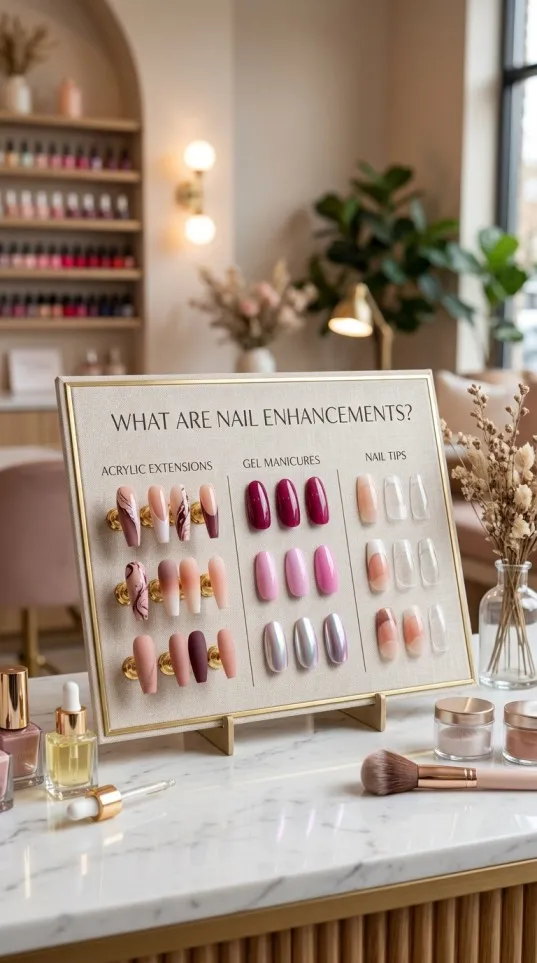
Nail enhancements are products or techniques used to improve the appearance, length, shape or structure of natural nails. They can be applied directly over your natural nails or used to create extensions when you want extra length.
For example, if your natural nails are short and break easily, you might choose a builder gel overlay or acrylic extensions. Similarly, if you want a quick manicure for a special occasion, press-on nails may be a convenient option.
Most nail enhancements fall into two main categories:
- Nail overlays: Products applied over your natural nail to add colour, thickness or structure without necessarily making it longer.
- Nail extensions: Artificial length added beyond your natural nail using tips, forms or pre-shaped artificial nails.
Some enhancements need professional application, while others are designed for home use. Therefore, it is important to understand how each system works before choosing one.
2. 12 Different Types of Nail Enhancements
There are many types of artificial nail enhancements available today. Each has its own application process, appearance, benefits and maintenance requirements.
Let’s look at the most popular options.
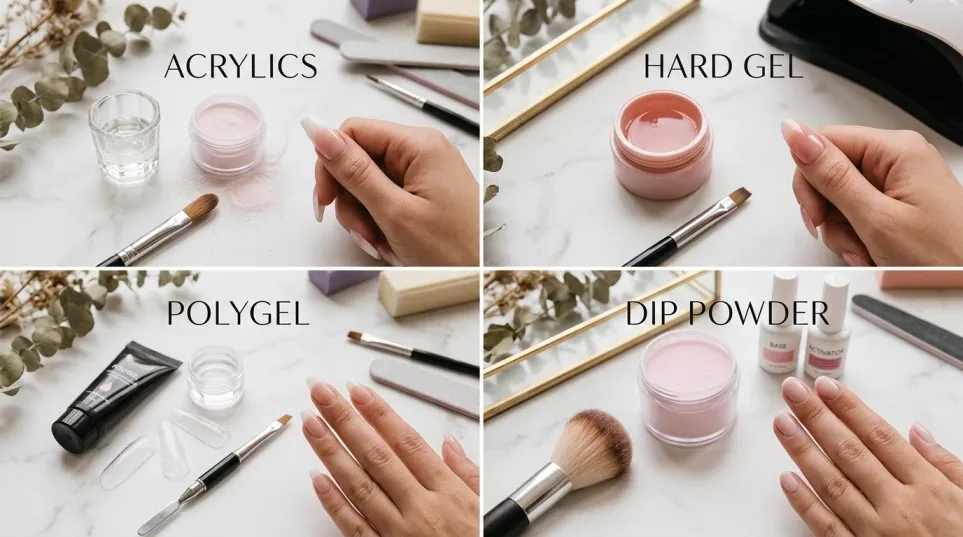
1. Acrylic Nail Enhancements
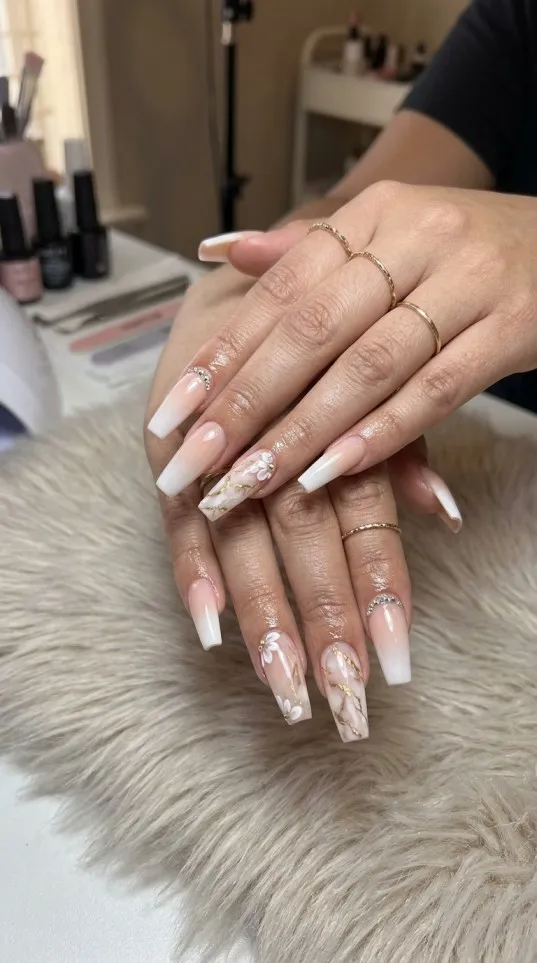
Acrylic nail enhancements are one of the oldest and most popular ways to create artificial nail length. They are made by mixing a liquid monomer with a powder polymer to create a workable product.
The nail technician applies this mixture over your natural nails, nail tips or forms. It then hardens in the air and can be filed into your preferred shape.
Acrylic nails are especially popular for people who enjoy long coffin, almond, square and stiletto designs.
Benefits of acrylic nails:
- They are suitable for creating long nail extensions.
- They offer a firm structure.
- They work well with detailed nail art.
- They are available in many colours and finishes.
- They can be maintained with regular infills.
Disadvantages:
- They can feel thicker than natural nails.
- Application involves strong-smelling chemicals.
- They need professional maintenance.
- Incorrect filing and removal can damage natural nails.
Best for: People who want long, strong-looking artificial nails and dramatic nail designs.
2. Hard Gel Nail Enhancements
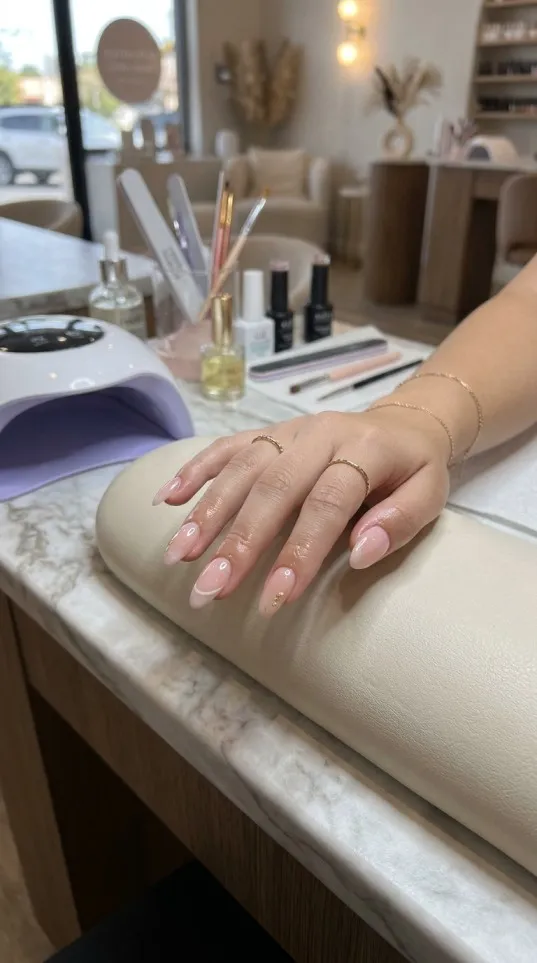
Hard gel nail enhancements use a thicker gel product that is applied to natural nails or nail extensions. Unlike ordinary gel polish, hard gel is designed to create structure and can be used to build additional length.
The product is shaped before being cured under a compatible UV or LED lamp.
One reason people choose hard gel is its smooth and glossy appearance. It can also be used to create elegant nail shapes without using traditional acrylic powder.
Benefits of hard gel nails:
- Suitable for sculpted nail extensions.
- Creates a smooth and glossy finish.
- Can be used for different nail shapes.
- Works well with nail art.
- Provides structure to the nail enhancement.
Disadvantages:
- Requires a suitable curing lamp.
- Application needs practice and experience.
- Usually requires filing for removal.
- Incorrect application can cause lifting or damage.
Best for: People who want customised extensions with a gel-based system.
3. Soft Gel Nail Enhancements
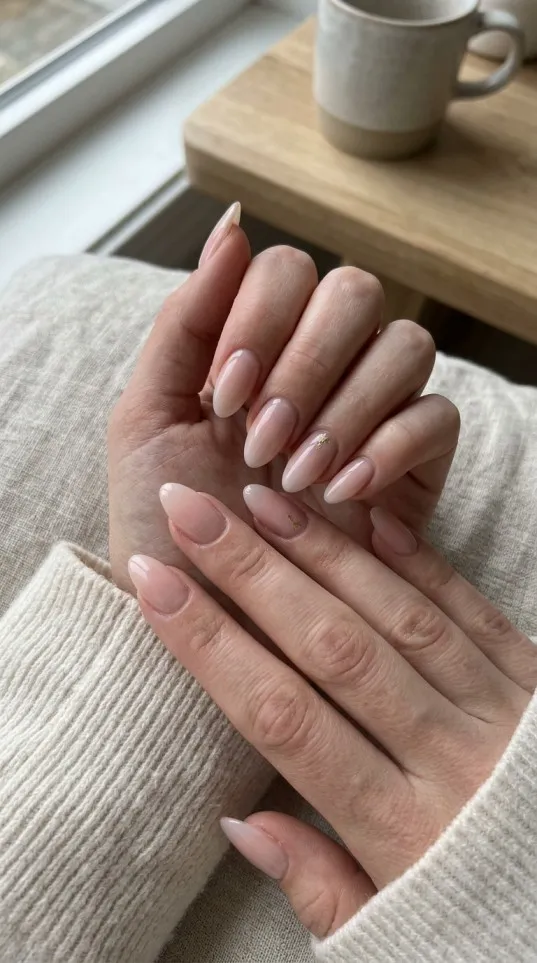
Soft gel nail enhancements are made using flexible gel products that can be applied as a colour coating or used in suitable extension systems.
Soft gel is generally easier to soak off than hard gel, although removal depends on the particular product.
It is a popular option for people who prefer a glossy, lightweight-looking manicure.
Benefits:
- Often offers a flexible finish.
- Available in many colours.
- Some systems can be removed by soaking.
- Suitable for natural-looking manicures.
- Can be used with full-cover extension tips.
Disadvantages:
- Not every soft gel product creates extensions.
- Requires correct curing.
- Incorrect removal can damage the nail plate.
- Some products may cause allergic reactions if they contact the skin.
Best for: People who want a flexible gel manicure or suitable soft-gel extensions.
4. BIAB Nail Enhancements (Builder in a Bottle)
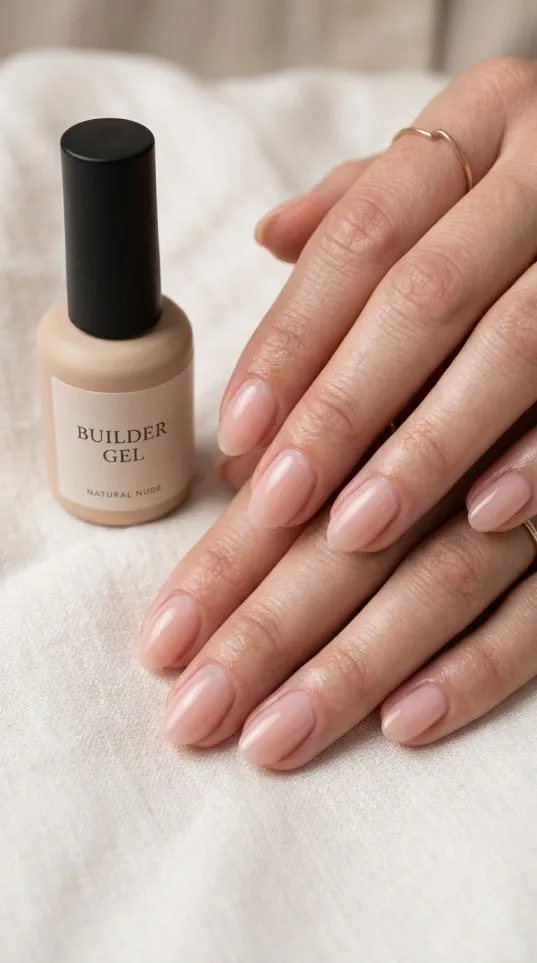
BIAB nail enhancements have become particularly popular among people who prefer a natural-looking manicure.
BIAB stands for Builder in a Bottle. It is a builder gel supplied in a bottle and designed to add structure over natural nails. Depending on the product system, it can also be used for limited extensions.
It is especially useful for creating a neat, smooth and polished appearance.
Imagine you have been trying to grow your natural nails for months, but the tips keep breaking. A suitable BIAB overlay may help provide additional structure while you maintain your natural nail length.
Benefits of BIAB nails:
- Adds structure to natural nails.
- Creates a smooth and glossy appearance.
- Available in beautiful nude and pink shades.
- Suitable for natural-looking manicures.
- Can be maintained as the natural nail grows.
Disadvantages:
- Requires correct lamp curing.
- Needs regular maintenance.
- Incorrect removal can damage natural nails.
- Not all BIAB products are suitable for extensions.
Best for: People who want natural-looking nails with added structure.
5. Polygel Nail Enhancements
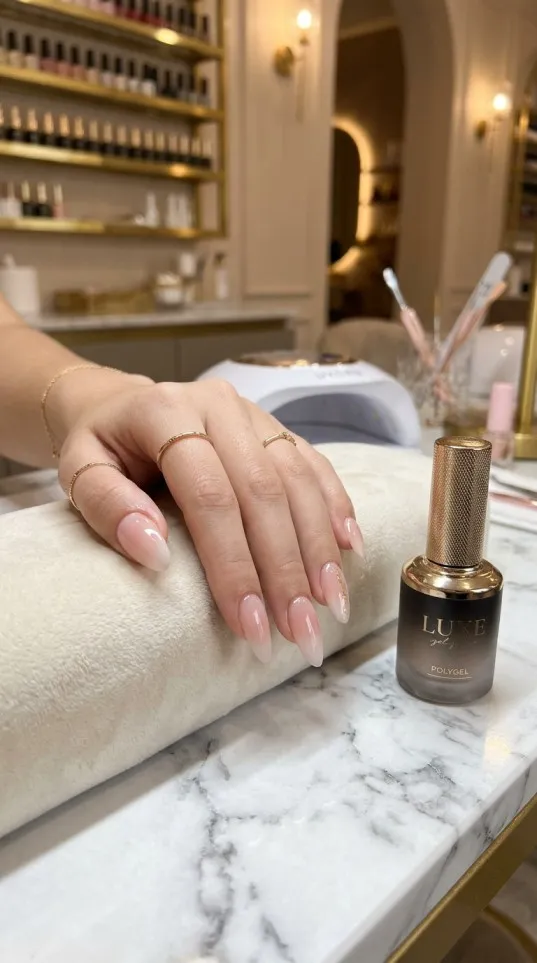
Polygel nail enhancements combine features of traditional acrylic and gel systems. Polygel is a thick, mouldable product that can be shaped before curing under a compatible lamp.
Unlike some liquid nail products, polygel stays in place while you work with it. This gives the nail technician more control over the shape and amount of product being applied.
It is often used with nail forms or dual forms to create extensions.
Benefits:
- Easy to control when using the correct technique.
- Suitable for different nail lengths.
- Creates smooth nail extensions.
- Works well with different nail designs.
- Offers an alternative to traditional acrylic systems.
Disadvantages:
- Requires a curing lamp.
- Needs careful application.
- Removal can require filing.
- Incorrect curing may create product-related problems.
Best for: People who want sculpted extensions using a mouldable gel-based product.
6. Dip Powder Nail Enhancements
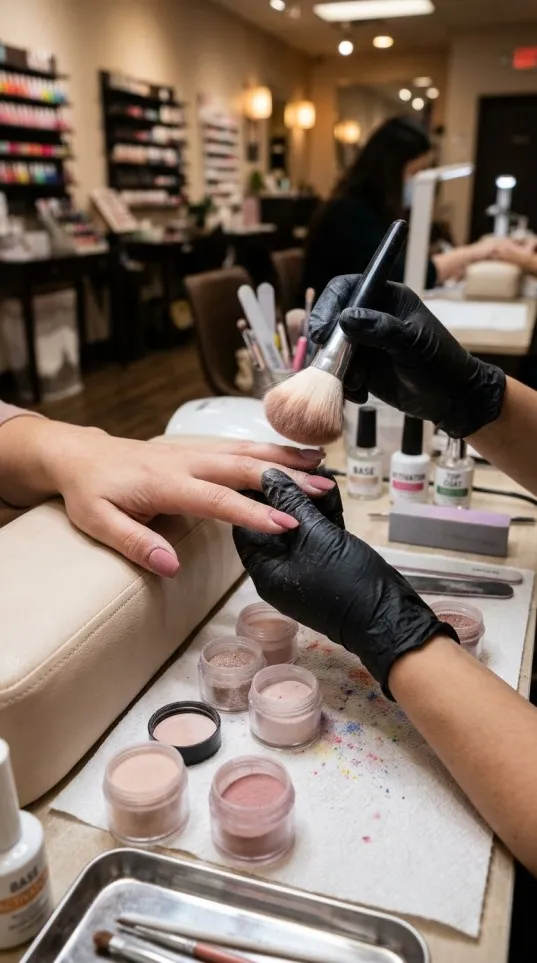
Dip powder nail enhancements use coloured powder and a special bonding liquid to create a hard, attractive coating over the natural nail.
The technician applies a base product and then adds the coloured powder. An activator and finishing products are used according to the system instructions.
Standard dip powder systems generally do not require a UV or LED lamp.
Benefits:
- Available in many attractive colours.
- Creates a durable-looking finish.
- Suitable for natural nail overlays.
- Does not normally need lamp curing.
- Can create beautiful ombre designs.
Disadvantages:
- Removal takes time.
- Incorrect removal can damage nails.
- Shared powder containers can create hygiene concerns.
- Poor application may cause lifting.
Best for: People who want colourful nail overlays without using a standard gel-curing system.
7. Press-On Nail Enhancements
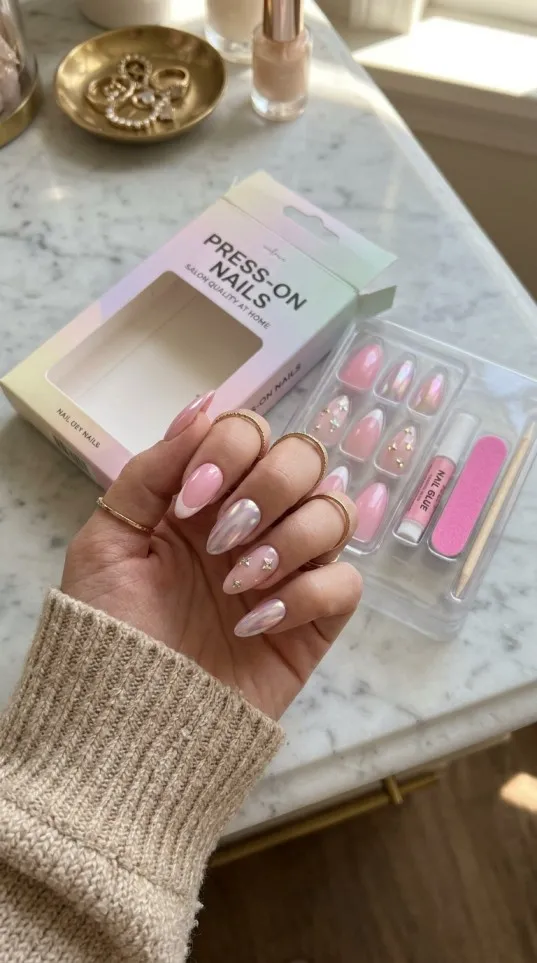
Press-on nail enhancements are ready-made artificial nails that attach to your natural nails using nail glue or adhesive tabs.
They are available in different lengths, shapes, colours and finishes. You can even find reusable press-on nail sets with detailed nail art.
Their biggest advantage is convenience. You do not always need a salon appointment or professional equipment to enjoy a fresh manicure.
Benefits:
- Quick and convenient application.
- Available in affordable designs.
- Suitable for special occasions.
- Easy to change your nail style.
- Some sets can be reused.
Disadvantages:
- Incorrect sizing can cause discomfort.
- Adhesive may irritate sensitive skin.
- They may lift if preparation is poor.
- They may not be suitable for every activity.
Best for: Beginners, busy people and anyone who enjoys changing their manicure regularly.
8. Full-Cover Gel-X Style Extensions
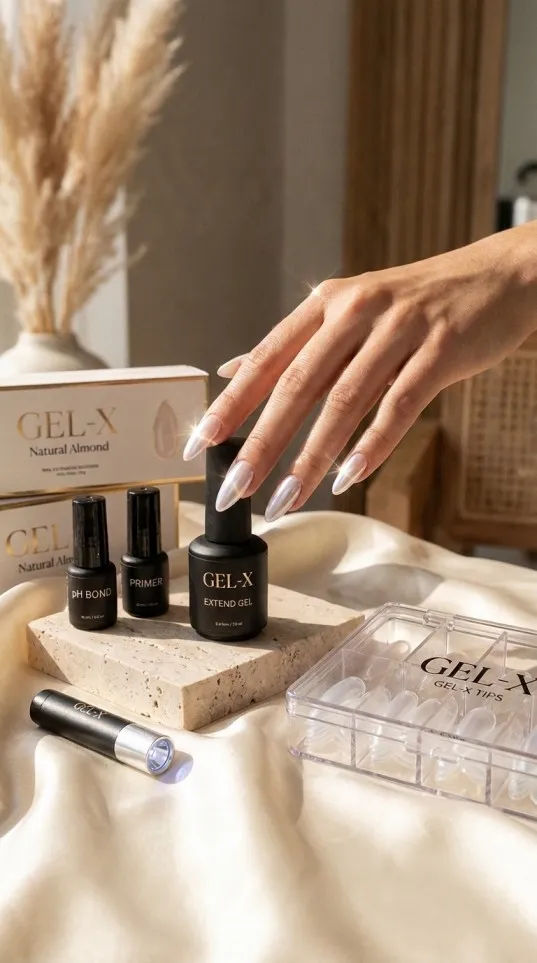
Full-cover gel extensions, commonly associated with Gel-X-style systems, use pre-shaped artificial nail tips that cover most or all of the natural nail.
A suitable soft gel adhesive is used to attach the extension, followed by curing under the recommended lamp.
These extensions are popular because they can create a consistent shape and length without sculpting every nail from scratch.
Benefits:
- Available in different shapes and lengths.
- Creates a consistent appearance.
- Application can be quicker than sculpting individual extensions.
- Suitable for nail art and French manicures.
- Offers a lightweight-looking extension option.
Disadvantages:
- Requires correct sizing and application.
- Needs a compatible gel adhesive and lamp.
- Incorrect curing can cause problems.
- Removal must follow the manufacturer’s instructions.
Best for: People who want pre-shaped gel extensions with a neat finish.
9. Fibreglass and Silk Wrap Enhancements
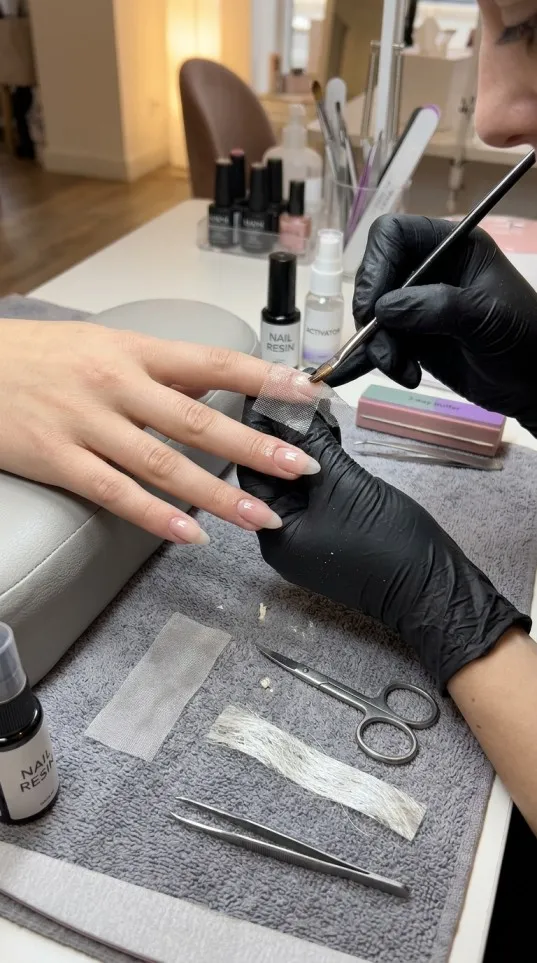
Fibreglass and silk wrap nail enhancements use thin pieces of fabric material placed over the natural nail with a suitable adhesive or resin.
They are sometimes used to repair small cracks, reinforce nail tips or create a lightweight enhancement.
These systems are not as popular as acrylic and gel today, but they can still be useful for certain nail-care needs.
Benefits:
- Lightweight appearance.
- Useful for small nail repairs.
- Can create a natural-looking finish.
- Suitable for reinforcing certain nail areas.
Disadvantages:
- Not ideal for very long extensions.
- Requires careful application.
- May need regular maintenance.
- Can become damaged with poor aftercare.
Best for: People looking for lightweight nail reinforcement or small repairs.
10. Acrylic-Dipped or French Acrylic Enhancements

French acrylic enhancements use an acrylic system to create a classic French manicure or other two-tone nail designs.
The most familiar version features a pink or nude nail bed with a white tip. However, modern versions include coloured French tips, glitter and ombre finishes.
Baby boomer nails are another popular style, blending pink and white shades softly instead of creating a sharp line.
Benefits:
- Creates a classic and elegant appearance.
- Suitable for long and short extensions.
- Offers many customisation options.
- Works well for weddings and special occasions.
Best for: People who love French manicures and elegant artificial nail designs.
11. Acrylic Nail Tips and Sculpted Extensions
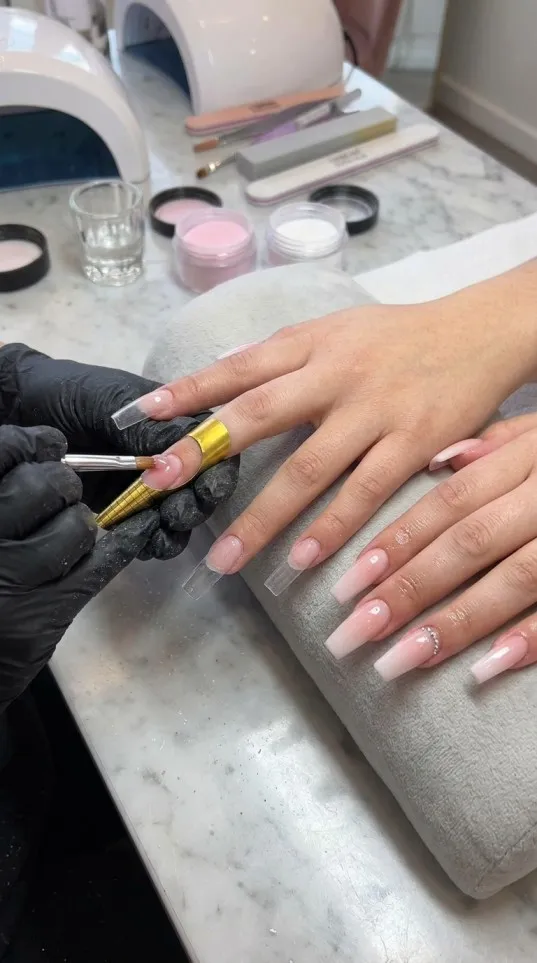
Nail tip extensions use artificial tips attached to the natural nail to create extra length. Acrylic or gel products can then be applied over the tips to build the desired structure.
Sculpted extensions use a temporary form placed under the natural nail. The enhancement product is built over the form to create the extension.
Both methods are used in professional nail salons.
Benefits:
- Helps create longer nails.
- Suitable for customised shapes.
- Works with different enhancement systems.
- Offers flexibility in choosing the final length.
Disadvantages:
- Requires careful application.
- Incorrect fitting can cause lifting.
- Excessive filing may weaken natural nails.
- Needs professional maintenance.
Best for: People who want customised artificial nail length and shape.
12. Nail Wrap and Sticker Enhancements
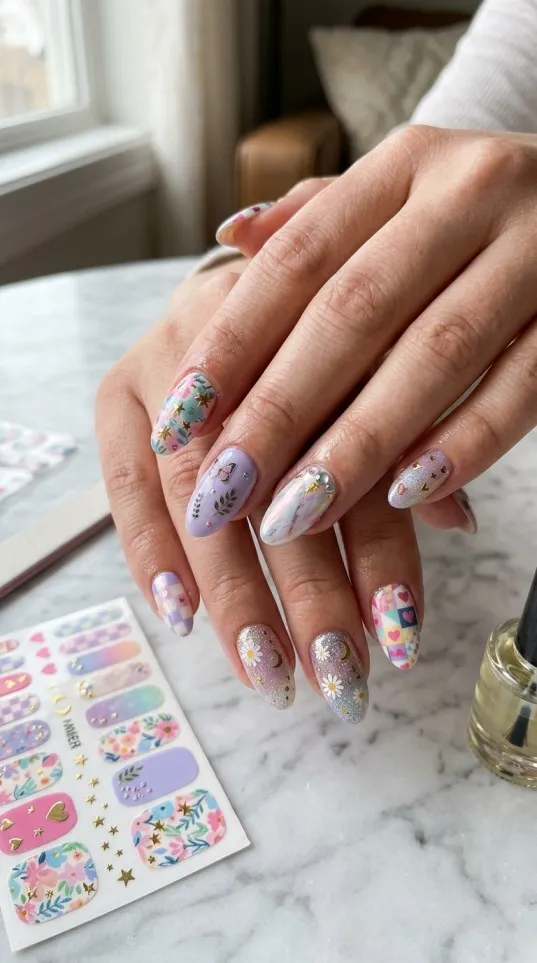
Nail wraps and nail stickers are decorative products that improve the appearance of natural or enhanced nails.
Nail wraps usually cover most of the nail surface, while stickers are smaller decorative pieces that can be placed over a manicure.
They are particularly useful for people who want creative designs without spending a lot of time painting their nails.
Benefits:
- Easy to apply.
- Available in many patterns.
- Suitable for home manicures.
- Useful for seasonal nail art.
- Can save time compared with detailed hand-painted designs.
Best for: Beginners and people who enjoy experimenting with nail art.
3. Nail Enhancements Comparison: Which One Should You Choose?
Now that you understand the different options, let’s compare their main features.
| Enhancement | Main benefit | Extra length possible? |
|---|---|---|
| Acrylic | Firm artificial structure | Yes |
| Hard gel | Sculpted gel extensions | Yes |
| Soft gel | Flexible finish | With suitable systems |
| BIAB | Natural nail structure | Limited, product-dependent |
| Polygel | Mouldable extensions | Yes |
| Dip powder | Durable colour coating | With suitable systems |
| Press-on | Quick artificial nails | Yes |
| Gel-X style | Pre-shaped extensions | Yes |
| Silk/fibreglass | Lightweight reinforcement | Limited |
| French acrylic | Classic artificial design | Yes |
| Nail tips | Added artificial length | Yes |
| Nail wraps | Decorative finish | No |
Wear time and maintenance vary with the product, application, natural nail growth and aftercare.
4. How to Choose the Best Nail Enhancement for Your Needs
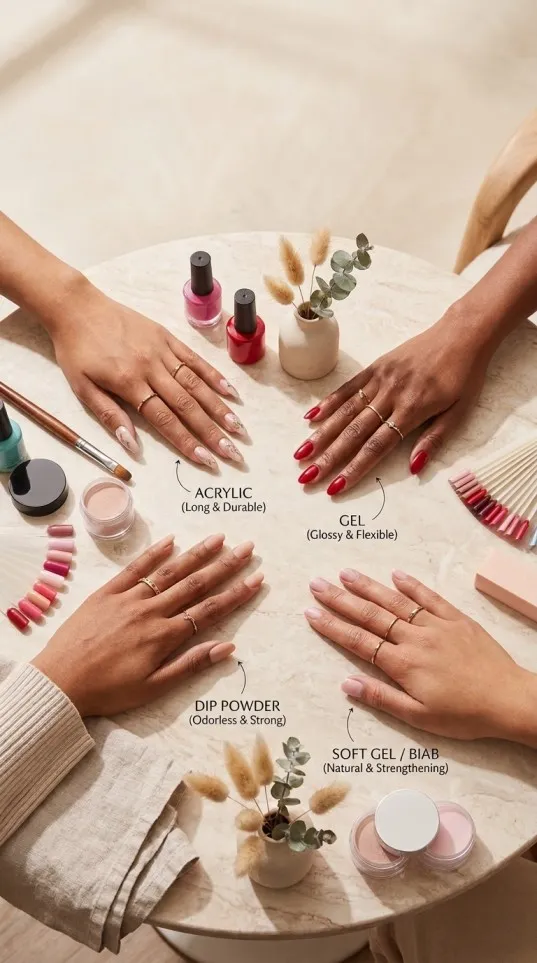
Choosing the right nail enhancement is not just about following the latest beauty trend. You should also consider your natural nails, daily activities and budget.
Here are some useful recommendations:
- For natural-looking nails: Consider BIAB or a sheer soft gel manicure.
- For long nail extensions: Acrylic, hard gel or polygel may be suitable.
- For quick manicures: Try press-on nails.
- For a glossy finish: Consider soft gel polish.
- For customised extensions: Look at sculpted hard gel or acrylic.
- For a home manicure: Choose a suitable press-on kit or regular nail-care products.
For instance, someone working in an office may prefer short BIAB nails, while someone preparing for a wedding may choose long acrylic or gel extensions with detailed nail art.
The best option is the one that looks attractive and feels comfortable in your everyday routine.
5. Step-by-Step Guide: How to Apply Nail Enhancements at Home
If you enjoy doing your nails yourself, some nail enhancement products can be used at home. However, beginners should start with simple options rather than immediately trying complicated acrylic or gel systems.
Here is a basic guide to help you get started.
Step 1: Prepare Your Natural Nails
Start by washing your hands and removing any old nail polish. Make sure your nails are clean and dry.
Gently file the edges to create your preferred shape. Avoid aggressive buffing because excessive filing can thin the natural nail.
Step 2: Choose the Right Nail Enhancement
Decide what type of enhancement you want.
For example:
- Choose press-on nails for a quick manicure.
- Choose a suitable gel polish for a glossy finish.
- Choose BIAB if you want a structured natural nail overlay.
- Choose acrylic or polygel if you want extensions and have the necessary training.
Step 3: Select the Correct Size
If you are using press-on nails or full-cover tips, choose a size that fits each natural nail comfortably.
The artificial nail should cover the nail plate without pressing into the surrounding skin.
Step 4: Apply the Suitable Product
Follow the instructions supplied with your chosen product.
For press-on nails, use the recommended adhesive or tabs. For professional gel and acrylic systems, application requires the correct preparation, product compatibility and curing or setting process.
Never allow uncured gel to touch your skin.
Step 5: Shape and Finish Your Nails
Once your enhancement has been correctly applied, check the shape and edges.
You can choose square, oval, almond or coffin shapes depending on your preference. Add suitable nail art or a compatible top coat if the product instructions allow it.
Step 6: Maintain Your Manicure
Apply cuticle oil around your nails and moisturise your hands regularly.
Avoid using your artificial nails to open cans, scratch surfaces or perform other activities that can cause lifting and breakage.
Important: Do not attempt to remove enhancements by pulling or peeling them off. Follow the manufacturer’s removal instructions or visit a trained nail technician.
6. Best Nail Enhancement Products to Buy on Amazon UK
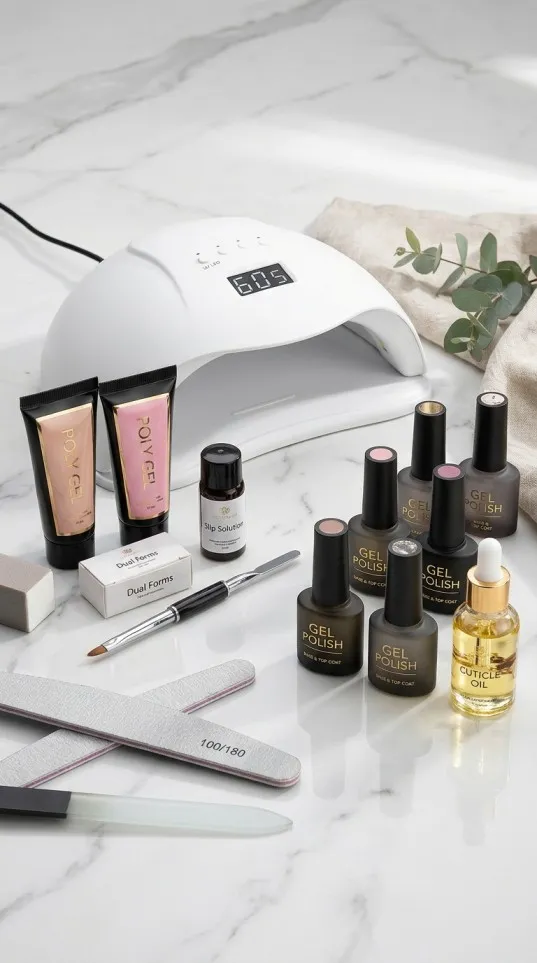
If you want to create beautiful manicures at home, choosing the right products is important. A good-quality nail kit can make application easier and help you achieve a more professional-looking finish.
Here are some popular product categories worth exploring.
1. Beetles Gel Nail Polish Starter Kit
A starter-kit option for people interested in gel manicures and a variety of nail colours.
Suitable for: Gel manicure enthusiasts.Shop Beetles gel kits on Amazon UK
2. Mylee Builder Gel / BIAB Products
A product category to explore if you prefer structured, natural-looking builder gel manicures.
Suitable for: BIAB-style nail overlays.Explore Mylee builder gels on Amazon UK
3. Makartt Polygel Nail Kit
A kit category for people interested in mouldable gel extensions and dual-form application.
Suitable for: Polygel nail extensions.Shop polygel kits on Amazon UK
4. Acrylic Nail Starter Kit
A product category that typically includes acrylic powder, liquid monomer and application accessories.
Suitable for: Acrylic nail application.Explore acrylic nail kits on Amazon UK
5. KISS Press-On Nail Sets
Ready-made artificial nail sets for people who want an easy manicure without sculpting extensions.
Suitable for: Quick and convenient nail enhancements.Find KISS press-on nails on Amazon UK
Buying advice: Before purchasing a nail enhancement kit, check what is included, whether a curing lamp is required, customer reviews and the manufacturer’s instructions. Make sure any lamp is compatible with the gel system you choose. A cheap kit is not necessarily a good investment if it contains incompatible products.
These are Amazon UK search links, not verified live product listings. Check current availability, seller information, prices and product specifications before ordering.
7. How Long Do Different Nail Enhancements Last?
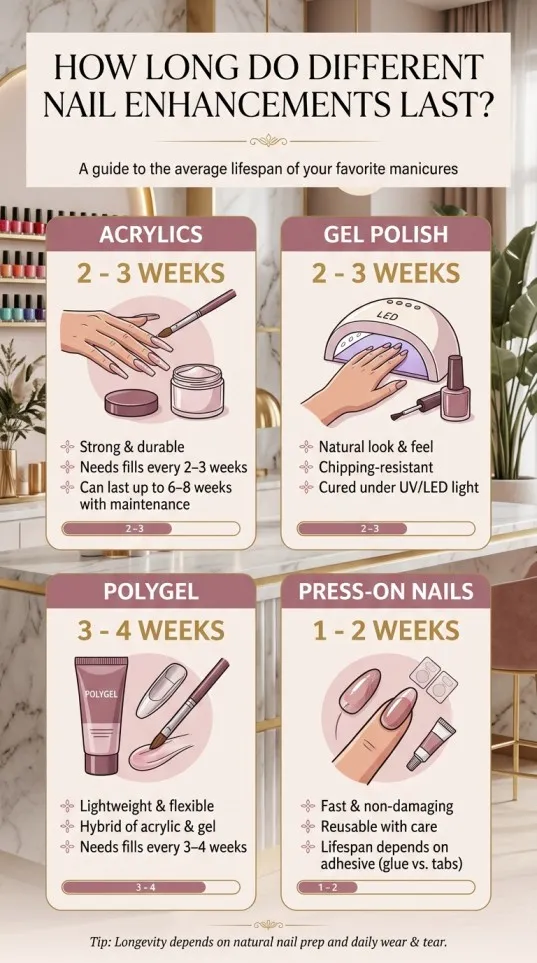
One of the most common questions people ask before getting artificial nails is how long the manicure will last.
The answer depends on the product, natural nail growth, application quality and aftercare.
Here is a general guide:
| Nail enhancement | General wear expectation |
|---|---|
| Acrylic nails | Around 2–3 weeks before maintenance |
| Hard gel | Around 2–3 weeks before maintenance |
| Soft gel polish | Around 2–3 weeks |
| BIAB | Around 2–3 weeks before maintenance |
| Polygel | Around 2–3 weeks before maintenance |
| Dip powder | Around 2–3 weeks |
| Press-on nails | A few days to around 1–2 weeks, depending on adhesive |
| Gel-X style extensions | Around 2–3 weeks before maintenance |
| Silk or fibreglass wraps | Product and maintenance dependent |
These are approximate expectations, not guarantees. Some manicures may need attention sooner, particularly if you work with your hands frequently.
8. Are Nail Enhancements Safe for Natural Nails?
Nail enhancements can be a convenient way to improve the appearance of your nails. However, they need to be applied and removed correctly.
Repeated filing, rough removal, poor hygiene and contact with uncured gel products can create problems.
The American Academy of Dermatology explains that artificial nails can leave natural nails thin, brittle and dry, particularly with frequent applications and maintenance. American Academy of Dermatology
Here are some ways to reduce avoidable damage:
- Choose a trained and experienced nail technician.
- Do not allow gel products to touch your skin.
- Follow the correct curing instructions.
- Avoid pulling off artificial nails.
- Do not repeatedly file the natural nail aggressively.
- Keep your cuticles moisturised.
- Take breaks from artificial enhancements when needed.
- Avoid enhancements over nails that are already damaged or infected.
Also, be aware that some nail enhancement ingredients can cause allergic reactions. If you develop itching, redness, swelling or a rash, stop using the product and seek medical advice.
For additional information, see the American Academy of Dermatology’s manicure safety advice. American Academy of Dermatology+1
9. Common Mistakes to Avoid When Choosing Nail Enhancements
Even a beautiful nail enhancement can become uncomfortable if the wrong product or technique is used.
Here are some mistakes worth avoiding.
1. Choosing nails only because they are trending
A particular style might look beautiful online, but it may not suit your daily routine. Choose a manicure that is practical as well as attractive.
2. Applying too much product
Thick layers do not automatically make nails stronger. Excessive product can create an uneven finish and may interfere with proper curing.
3. Ignoring nail preparation
Clean, properly prepared nails help create a better application. However, preparation should never involve aggressive filing or cutting living skin.
4. Using incompatible products
Not every gel, lamp, primer and top coat works together. Follow the manufacturer’s recommended system.
5. Removing enhancements incorrectly
Never force artificial nails off. Incorrect removal can take layers of your natural nail with them.
6. Buying products without checking their ingredients
Always check the label, safety information and application instructions. This is especially important when purchasing home gel and acrylic kits.
10. Final Thoughts
Choosing between the different types of nail enhancements becomes much easier when you understand how each product works and what it can offer.
Acrylic nails are ideal for people who love long extensions, while hard gel and polygel provide other options for sculpted nail designs. BIAB is a popular choice for natural-looking structured manicures, and press-on nails are convenient when you want an attractive finish without a lengthy salon appointment.
Before buying any nail enhancement product, consider your natural nail condition, lifestyle, budget and preferred appearance. Investing in suitable products and learning the correct application and removal methods can make your manicure experience much better.
You do not need to spend a fortune to enjoy beautiful nails. Start with the enhancement that suits your needs, choose good-quality products and look after your natural nails.
Ultimately, the best nail enhancement is one that makes your hands look beautiful while keeping comfort and nail care a priority.
Frequently Asked Questions About Types of Nail Enhancements
The most popular types include acrylic nails, hard gel, soft gel, BIAB, polygel, dip powder, press-on nails, Gel-X-style extensions, silk wraps and fibreglass nails. Each offers different benefits depending on the length, appearance and finish you want.
BIAB and suitable builder gel overlays are popular options for people who want to add structure without creating long extensions. However, no enhancement guarantees healthier nails, and correct application and removal are essential.
Acrylic enhancements are made by mixing liquid monomer with polymer powder, which hardens in the air. Gel enhancements use specially formulated gel products that generally require UV or LED curing. Both can create attractive nail extensions, but their application and removal methods differ.
BIAB stands for Builder in a Bottle. It is a type of builder gel supplied in a bottle, designed to add structure to natural nails. However, not every builder gel is a BIAB product, and different formulas have different uses.
Acrylic, hard gel and other professionally applied enhancements can provide long-lasting results. However, their actual wear time depends on application quality, natural nail growth and maintenance. Most require attention after a few weeks.
Press-on nails are generally one of the easiest artificial nail options for beginners. They come in ready-made shapes and sizes and can be attached using nail glue or adhesive tabs according to the manufacturer’s instructions.
Neither is automatically better for everyone. Acrylic is popular for strong-looking extensions and detailed designs, while gel offers different options for flexible overlays and sculpted extensions. Your preferred appearance, nail condition and maintenance routine should guide your choice.
For short nails, a suitable builder gel overlay or BIAB manicure may be worth considering if the natural nail is healthy. However, if your nails are weak, peeling or damaged, it is better to address the problem before applying enhancements. A nail professional or dermatologist can help you choose an appropriate approach.