Is BIAB Good for Your Nails? A Complete Guide to BIAB Nail Health
If you love having neat, strong-looking nails but worry that regular gel or acrylic manicures may damage your natural nails, you may have heard about BIAB nails.
BIAB, which stands for Builder in a Bottle, has become a popular option for people who want a long-lasting manicure while keeping a more natural look. Unlike traditional gel polish, BIAB is a thicker builder gel designed to add structure and strength to the natural nail.
But the big question is: Is BIAB good for your nails?
The short answer is: BIAB can be a good option when it is applied, maintained, and removed correctly, but it is not automatically healthier than every other type of manicure.
Your nail health depends on several things, including how much the natural nail is filed, the products being used, how often you wear BIAB, and most importantly, how the product is removed.
In this guide, we will look at the benefits of BIAB nails, possible disadvantages, how BIAB affects natural nails, how to apply it safely, and how to know whether BIAB is right for you.
What Is BIAB?
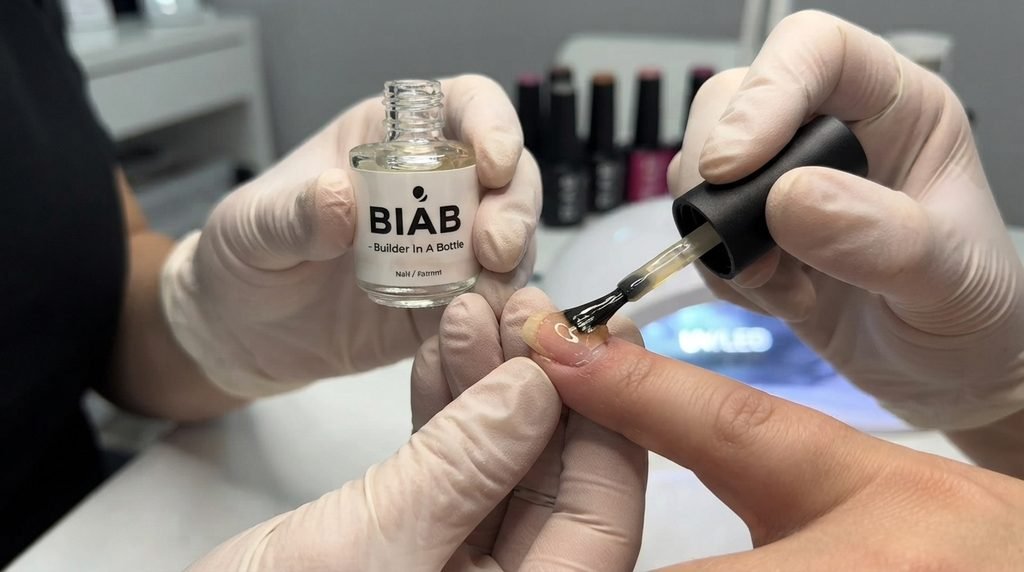
BIAB means Builder in a Bottle. It is a type of builder gel that comes in a bottle and is usually applied directly to the natural nail.
Unlike ordinary gel nail polish, which mainly adds colour and shine, BIAB provides additional structure to the nail.
You can think of it as a flexible protective layer over your natural nail.
BIAB can be used to:
- Add strength to natural nails
- Create a smoother nail surface
- Protect nails from everyday breakage
- Encourage people to grow their natural nails
- Create a clean, polished manicure
- Add a small amount of structure to the nail
- Provide a base for gel colours and nail art
One reason BIAB has become popular is that it can give short or weak-looking nails a more structured appearance without necessarily creating the thick appearance associated with some traditional extensions.
However, BIAB is still a gel product, so it should not be treated as a completely risk-free nail treatment.
So, Is BIAB Good for Your Nails?
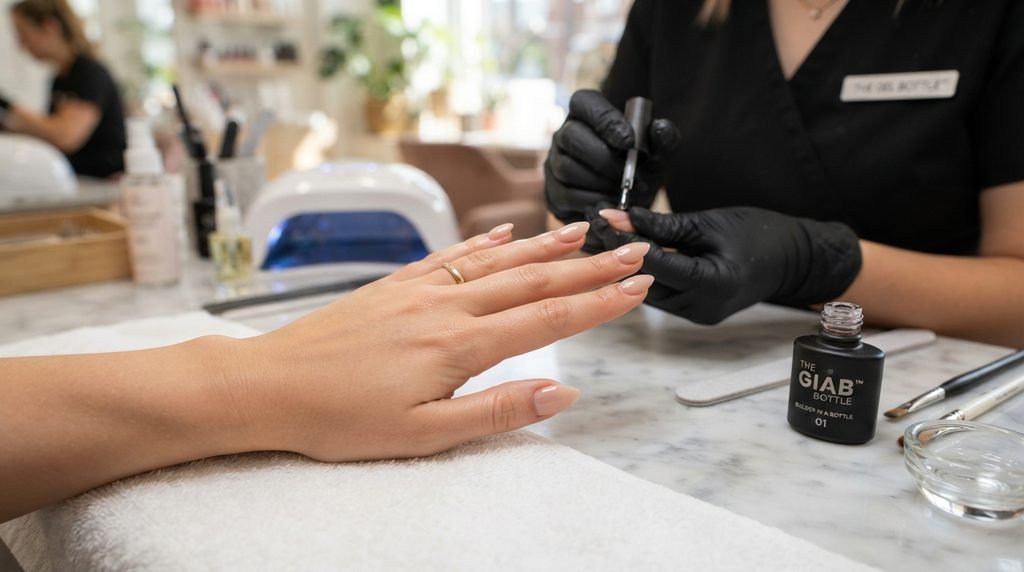
For many people, BIAB can work well as part of a sensible nail-care routine.
The important point is that BIAB itself does not magically make the natural nail healthier.
Instead, it can provide a protective coating that may help reduce everyday breakage while you grow your natural nails.
For example, imagine someone whose nails constantly break whenever they reach a certain length. A properly applied BIAB overlay may provide extra structure and allow the person to maintain longer-looking nails.
However, there is another side to the story.
Dermatologists warn that gel manicures can contribute to nail brittleness, peeling and cracking, especially when used repeatedly or removed incorrectly.
So the better question isn’t simply:
“Is BIAB good or bad?”
Instead, ask:
“Am I using BIAB in a way that protects my natural nails?”
That is where application, maintenance and removal become extremely important.
Benefits of BIAB for Natural Nails
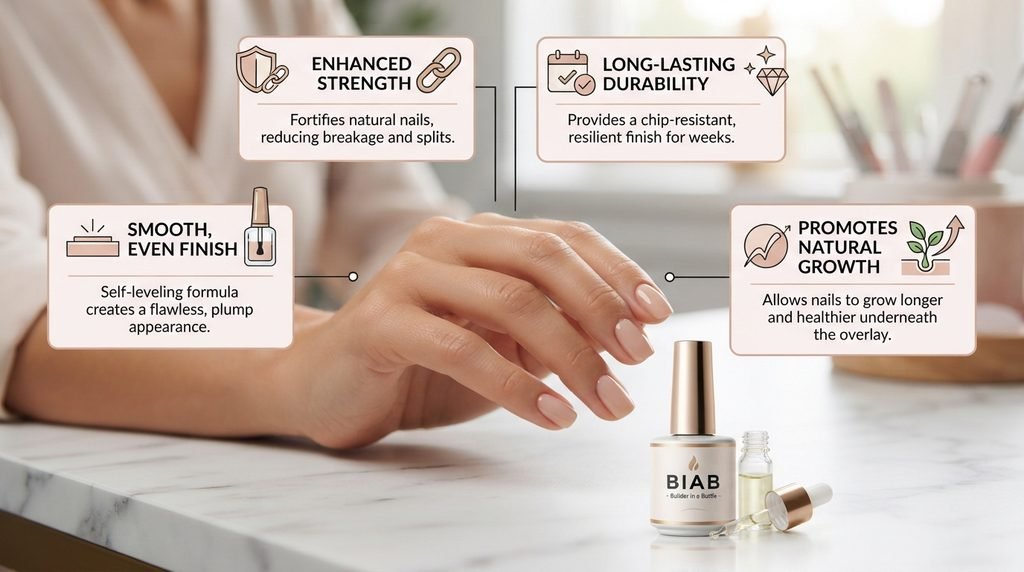
There are several reasons people choose BIAB for natural nails.
1. BIAB Can Add Extra Structure
One of the biggest benefits is the added structure.
If your natural nails are thin or flexible, they may bend easily during everyday activities. A properly applied builder gel can create a stronger protective layer over the nail.
This doesn’t mean your natural nail becomes permanently stronger. The improvement is mainly related to the coating that sits over the nail.
2. It Can Help Reduce Everyday Breakage
Have you ever grown your nails for weeks, only to break one while opening a cupboard or typing?
It is frustrating.
A BIAB overlay can provide additional support and may help reduce the small bends and impacts that cause some nails to break.
This is one reason BIAB for weak nails has become popular.
However, if your nails are already damaged, very thin, painful or changing colour, covering them with BIAB may hide an underlying problem rather than solve it.
The American Academy of Dermatology recommends checking your natural nails for unusual changes and seeking professional advice when persistent nail problems occur.
3. BIAB Gives a Natural-Looking Finish
Another reason people love BIAB nails is their appearance.
BIAB can create a smooth, clean and slightly glossy finish without needing dramatic extensions.
For someone who prefers a simple manicure, a nude or soft pink BIAB overlay can look very natural.
You can also apply gel colour over the builder layer if you want more variety.
4. It Can Support Natural Nail Growth
BIAB does not make your nails grow faster.
However, if your nails normally break before they become long, protecting them from everyday damage may help you retain more length.
For example:
Sarah had always wanted longer nails but could never get past a certain length. Every time her nails started growing, one would crack. After switching to a carefully maintained BIAB overlay, she noticed that her nails were less likely to catch on clothing and break.
The BIAB didn’t magically change the biology of her nails.
Instead, it gave the natural nails a protective layer while they grew.
That distinction is important.
Can BIAB Damage Your Natural Nails?
Yes, BIAB can contribute to nail damage if it is applied or removed incorrectly.
This is something every BIAB user should understand before starting.
The most common problems aren’t necessarily caused by simply having a builder gel coating on the nail. Problems can occur because of aggressive preparation, over-filing, picking, improper removal, or repeated manicures without giving the nails and surrounding skin appropriate care.
The American Academy of Dermatology notes that gel manicures can cause brittleness, peeling and cracking, while artificial nail techniques can also weaken natural nails when preparation and removal are too aggressive.
5 Things That Can Cause BIAB Nail Damage
1. Over-Filing the Natural Nail
Your natural nail should not be aggressively filed just to make the product stick.
Excessive filing can make the nail plate thinner and weaker.
This is particularly important if you regularly visit a salon for BIAB maintenance.
A good technician should understand the difference between preparing the nail surface and unnecessarily removing layers of the natural nail.
2. Picking or Peeling BIAB Off
This is one of the biggest mistakes you can make.
When you notice lifting, you may be tempted to peel the product away.
Don’t.
Picking or scraping gel products can remove layers of the natural nail along with the product.
The American Academy of Dermatology specifically advises against picking gel polish because it can damage the nails.
If your BIAB begins lifting, arrange proper removal or maintenance instead.
3. Poor Removal
Removal is just as important as application.
Even a beautifully applied manicure can become a problem if the product is aggressively filed or pulled away.
Depending on the BIAB system being used, the product may need to be carefully filed, soaked, or removed according to the manufacturer’s instructions.
Never assume that every builder gel can be removed in exactly the same way.
4. Ignoring Nail Problems
If your natural nail is already discoloured, lifting, painful, unusually thick, splitting or changing shape, don’t simply cover it with BIAB.
Nail changes can sometimes be related to infections or other health conditions. Cleveland Clinic notes that changes in nail colour, texture or shape can sometimes signal an underlying problem.
If something looks unusual or doesn’t improve, speak with a dermatologist or other qualified healthcare professional.
5. Never Taking a Break
There is no universal rule saying every person must stop BIAB after a specific number of weeks.
However, regularly checking your natural nails is important.
The AAD recommends taking breaks from gel manicures and keeping nails moisturized between manicures, particularly when nails become dry or brittle.
If your nails begin looking thin, peeling or unusually weak, give them time without the product and focus on basic nail care.
BIAB vs Gel Polish: What’s the Difference?
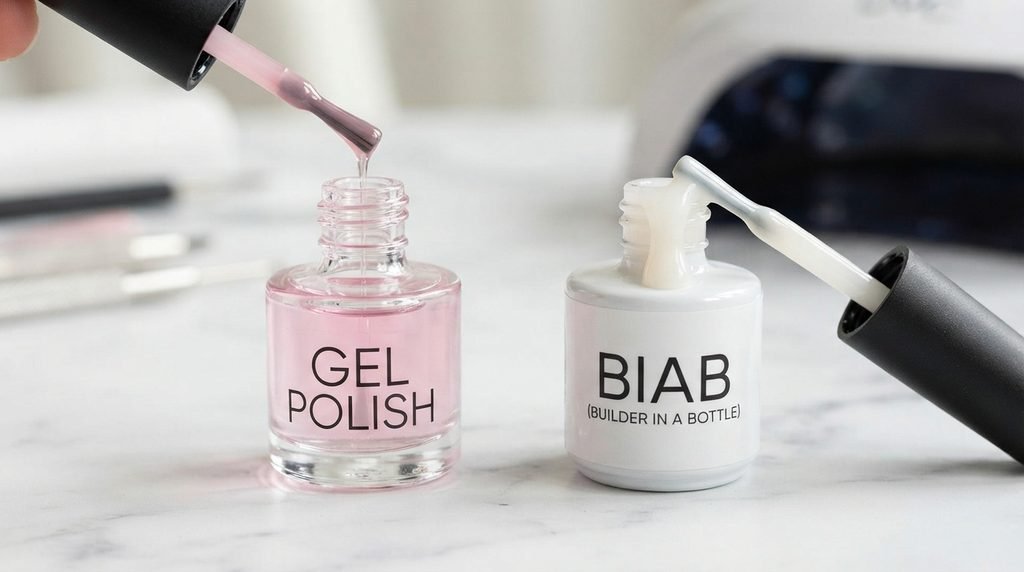
Although both products are cured under a lamp, they serve different purposes.
Gel polish is primarily designed to provide colour and shine.
BIAB is a builder product designed to provide more structure.
Think of gel polish as a coloured coating, while BIAB is more like a structured base layer.
That is why BIAB is often chosen by people who want stronger natural-looking nails rather than simply a long-lasting colour.
However, both involve gel products and curing, so BIAB should not be considered completely free from the concerns associated with gel manicures.
BIAB vs Acrylic Nails
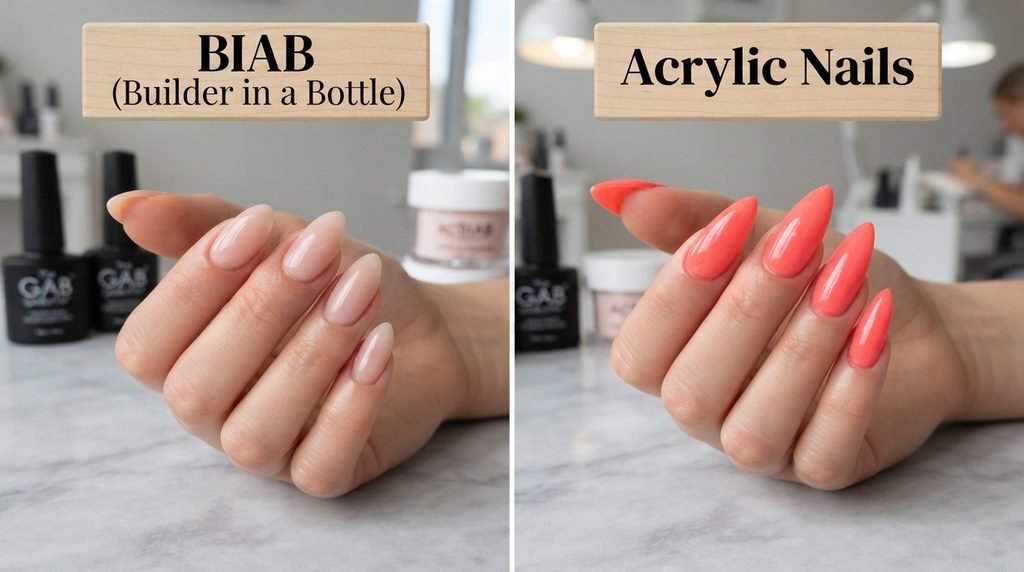
Acrylic nails are another popular way to create stronger and longer nails.
However, the application process is different.
Acrylic systems generally involve applying a mixture that hardens to create an artificial nail structure. BIAB is a builder gel system and is often used directly over the natural nail.
For someone who wants a natural-looking overlay rather than very long extensions, BIAB may be more suitable.
The American Academy of Dermatology explains that artificial nail systems can contribute to thinning and weakening when the natural nail is aggressively filed or when artificial nails are frequently maintained.
Therefore, the technique used by your nail professional matters just as much as the product category.
How to Use BIAB Without Unnecessarily Damaging Your Nails
If you decide that BIAB is right for you, follow these simple steps.
Step 1: Start With Healthy Natural Nails
Before applying BIAB, look at your nails.
Check for:
- Unusual discoloration
- Nail lifting
- Severe peeling
- Pain
- Swelling
- Unusual thickness
- Cracks extending into the nail
- Changes that don’t go away
If you notice something unusual, don’t use BIAB to hide it.
Get the problem checked first.
Step 2: Keep Nail Preparation Gentle
Your nail technician should prepare the nail carefully.
The goal is to remove surface oils and create an appropriate surface for the product without aggressively thinning the nail.
Avoid unnecessary filing of the natural nail.
This is one of the most important steps for maintaining healthy natural nails with BIAB.
Step 3: Apply BIAB Correctly
The builder gel should be applied according to the product manufacturer’s instructions.
The product should not be placed directly onto the surrounding skin.
Getting uncured gel onto the skin repeatedly can increase the risk of developing a skin reaction or allergy to certain acrylate or methacrylate ingredients found in gel systems.
For this reason, neat application and proper curing are important.
Step 4: Cure the Product Properly
BIAB needs to be cured under the correct lamp for the required amount of time.
Don’t guess.
Use the lamp and curing instructions recommended for the specific product system.
Incorrect curing can affect how the product performs and may increase the chance of problems.
Step 5: Look After Your Cuticles
Your cuticles are not just something to remove during a manicure.
They help protect the area around the nail.
The AAD recommends avoiding aggressive cuticle cutting because the cuticle helps protect against infection.
Instead, focus on keeping the surrounding skin moisturized.
A simple cuticle oil or moisturizer can help keep the skin comfortable and prevent excessive dryness.
How to Maintain BIAB Nails
Good maintenance can make a huge difference.
Keep Your Nails at a Practical Length
Long nails can look beautiful, but extremely long nails can experience more leverage and accidental impacts.
If your lifestyle involves lots of typing, cleaning, cooking or manual work, a moderate length may be easier to manage.
Don’t Use Your Nails as Tools
Avoid using your nails to:
- Open cans
- Scratch surfaces
- Remove labels
- Pry things open
- Pick at objects
Your nails are not tools.
Wear Gloves During Cleaning
Cleaning products and frequent exposure to water can be hard on the hands and surrounding skin.
Wearing household gloves can help reduce unnecessary exposure.
Moisturize Regularly
Use hand cream and cuticle oil regularly, especially after washing your hands.
Moisturizing is particularly useful when your nails and surrounding skin feel dry.
How to Remove BIAB Safely
Removal is one of the most important parts of your BIAB nail care routine.
Never pull, bite or peel BIAB from your nails.
If your system is soak-off, the product may be removed using an appropriate acetone-based process. Other builder products may require controlled filing.
The exact method depends on the product.
The American Academy of Dermatology advises against picking or scraping gel products because doing so can damage the nail.
When acetone is required, the AAD recommends limiting acetone exposure to the nails and protecting the surrounding skin.
If you’re unsure about removal, professional removal is usually the safer choice.
What Should You Do After Removing BIAB?
Once your nails are bare, take a few minutes to examine them.
Look at:
- Nail thickness
- Nail colour
- Peeling
- Cracks
- White spots
- Splitting
- Nail lifting
- Skin irritation
If your nails look and feel healthy, continue with basic nail care.
If they appear unusually thin, painful, damaged or discoloured, avoid immediately covering them again and consider getting professional advice.
A simple routine can include:
- Keep nails at a comfortable length.
- Apply cuticle oil.
- Moisturize your hands.
- Avoid picking or scraping the nail surface.
- Give your nails a break if they are becoming brittle.
- Get persistent nail changes checked.
Is BIAB Good for Weak Nails?
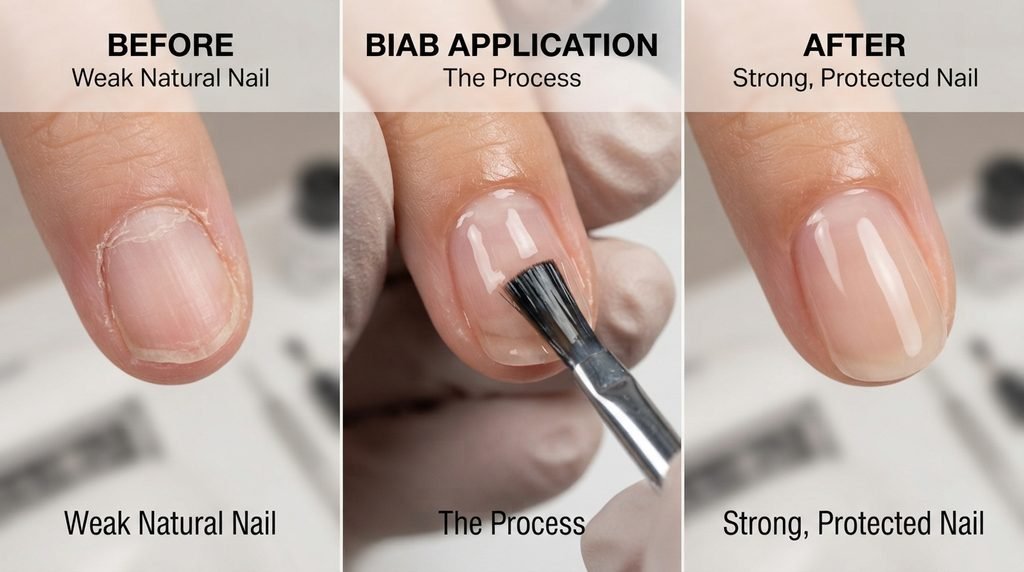
This depends on what you mean by “weak.”
If your nails are simply flexible and break easily, a carefully applied BIAB overlay may help protect them from everyday breakage.
However, BIAB does not cure an underlying nail condition.
If your nails are repeatedly splitting, changing colour, lifting, becoming painful or developing unusual texture, it’s better to find out why before covering them.
In other words:
BIAB can protect a healthy natural nail, but it shouldn’t be used as a treatment for an unexplained nail problem.
Is BIAB Better Than Regular Nail Polish?
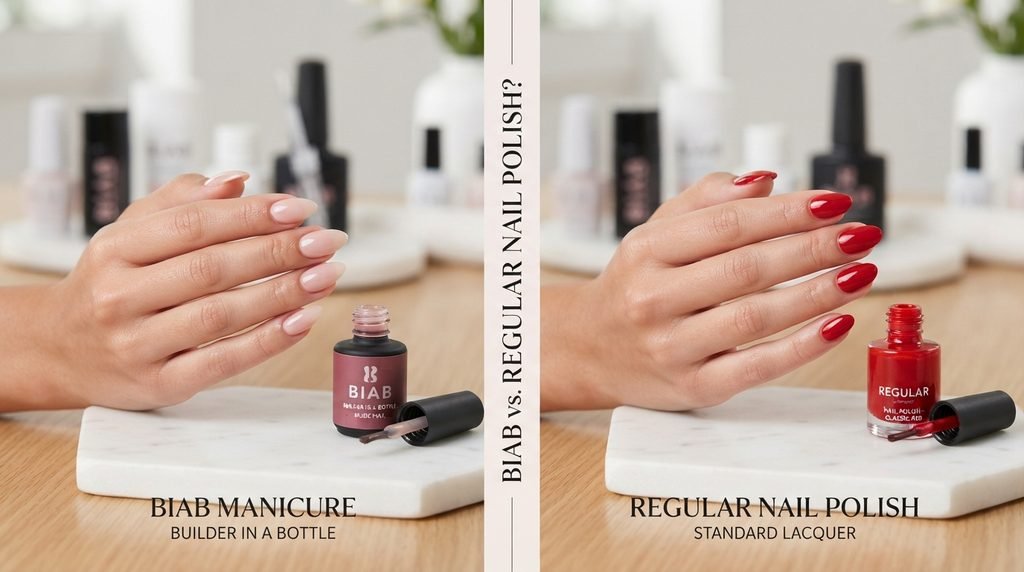
It depends on what you want.
If you want something simple that is easy to remove, regular nail polish may be enough.
If you want longer wear, a glossy finish and additional structure, BIAB may be more appealing.
However, BIAB requires more careful application and removal than ordinary polish.
So your choice should depend on your lifestyle, nail condition and how much maintenance you are comfortable with.
Who Should Consider BIAB?
BIAB may be worth considering if you:
- Prefer a natural-looking manicure
- Want extra structure for your natural nails
- Frequently experience nail breakage
- Want to grow your natural nails
- Like long-lasting manicures
- Prefer a clean, minimal nail style
- Are willing to maintain and remove the product properly
The key is choosing a reputable product and an experienced nail technician who prioritizes the condition of your natural nails.
Who Should Avoid BIAB for Now?
You may want to postpone BIAB if your nails are currently:
- Painful
- Severely damaged
- Very thin
- Peeling badly
- Lifting
- Discoloured
- Showing signs of infection
- Experiencing unexplained changes
Covering a problem does not make the problem disappear.
If you’re unsure about a nail change, professional medical advice is more appropriate than simply applying another manicure.
Is BIAB Worth It?
For someone who wants a natural-looking, structured and long-lasting manicure, BIAB can be a worthwhile option.
Its biggest advantage is that it can provide a protective layer over the natural nail while still giving a relatively natural appearance.
However, the quality of the result depends heavily on technique.
A good BIAB manicure should not require aggressive filing, picking or rough removal.
And while BIAB can make nails look stronger, it is important to remember that the product itself isn’t permanently strengthening the natural nail underneath.
The goal should be healthy nails first and beautiful nails second.
Final Verdict: Is BIAB Good for Your Nails?
So, is BIAB good for your nails?
It can be, when used correctly.
BIAB can give natural nails extra structure, reduce everyday breakage and create a smooth, polished appearance. For people who struggle to grow their nails because they constantly break, it can be a useful part of a nail-care routine.
But it isn’t completely risk-free.
Gel products can contribute to brittleness, peeling and cracking, particularly when they are repeatedly applied or improperly removed. Dermatologists also recommend paying attention to nail health, avoiding aggressive cuticle cutting, protecting the surrounding skin and taking breaks when nails become damaged.
The most important BIAB rules are simple:
Don’t over-file your natural nails.
Don’t pick or peel the product.
Use the correct curing system.
Remove BIAB properly.
Keep your nails and cuticles moisturized.
And don’t cover unexplained nail problems.
If you follow those basics, BIAB can be a practical option for achieving the neat, strong-looking nails you’ve been trying to grow.
Ultimately, the best BIAB manicure isn’t simply the one that looks beautiful when you leave the salon.
It’s the one that still leaves your natural nails looking and feeling healthy underneath.