
What Are BIAB Nails? A Complete Beginner’s Guide to Builder in a Bottle
If you love the neat, glossy look of a manicure but find that your natural nails chip, bend, or break easily, you may have heard the term BIAB nails. It has become increasingly popular in salons because it offers a way to add structure and strength to natural nails while still keeping a relatively natural appearance.
But what are BIAB nails, exactly? Are they the same as gel nails? Are they better than acrylics? How long do they last? And, most importantly, are they worth trying?
In this guide, we’ll answer all of these questions in simple language. We’ll also walk through how a BIAB manicure works, explain its benefits and drawbacks, discuss aftercare, and show you what to look for when choosing a BIAB nail product or salon.
Quick answer: BIAB stands for Builder in a Bottle. It is a type of builder gel supplied in a bottle, usually with a brush, and is designed to add strength and structure to the natural nail. BIAB can be used as a natural-nail overlay and, depending on the specific formula, for repairs or certain types of extensions. (The GelBottle INC)
What Does BIAB Stand For?
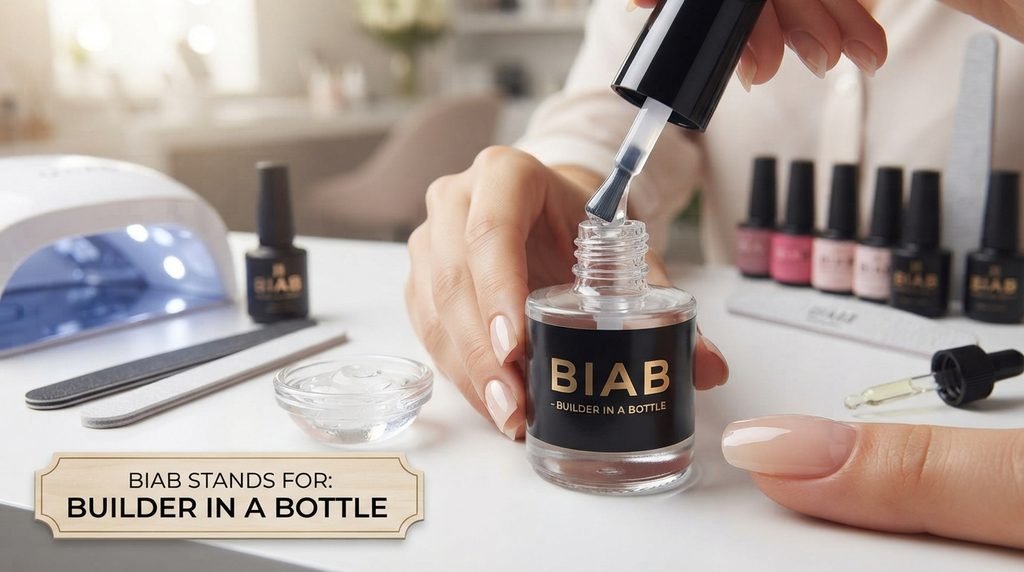
BIAB stands for Builder in a Bottle.
The name is actually quite straightforward. A builder gel is placed inside a polish-style bottle, making it easier for a nail technician to apply than some traditional builder gels that come in pots.
The important thing to understand is that BIAB isn’t simply another name for gel polish. Gel polish is mainly designed to provide colour and shine, whereas builder gel is designed to create additional structure and strength.
According to NailKnowledge, BIAB is a type of soak-off builder gel that can be used to strengthen natural nails, create structured overlays, support natural nail growth, and make small repairs or extensions. (NailKnowledge)
The original Builder In A Bottle™ product is a trademarked product name associated with The GelBottle, although the term “BIAB” is now commonly used when people talk about builder gel in general. (The GelBottle INC)
What Are BIAB Nails?
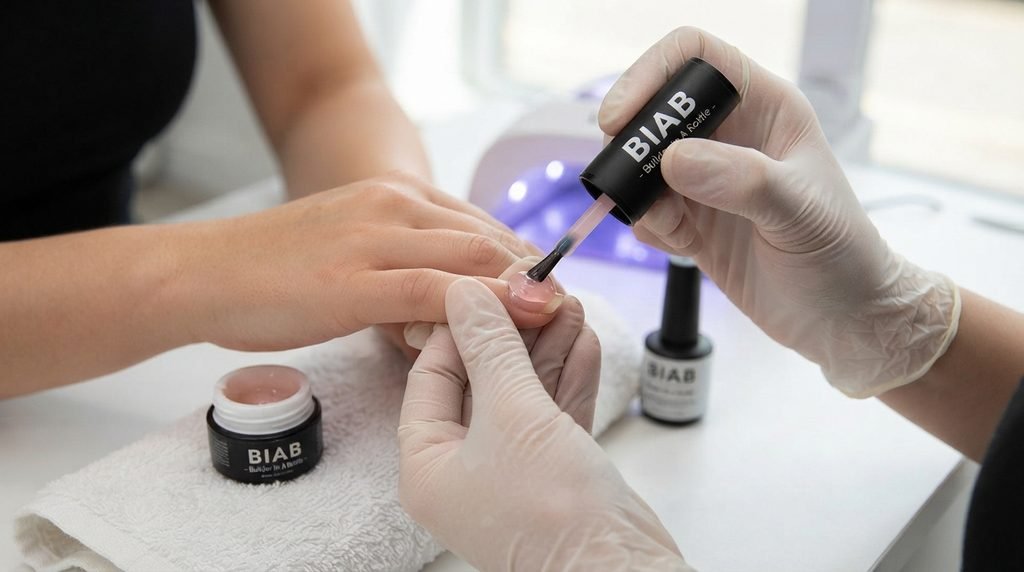
BIAB nails are natural nails that have been coated with builder gel to give them additional structure and support.
Think of it this way:
Your natural nail is like a thin piece of wood. Gel polish can decorate that piece of wood, but it doesn’t fundamentally turn it into a stronger structure. BIAB, on the other hand, is designed to create a thicker, structured layer over the nail.
A nail technician can shape the product so that it supports the natural nail’s stress area, often creating a gentle apex—the slightly raised part of a properly structured nail.
This is one reason BIAB can be useful for people whose nails are prone to bending or breaking.
The result is usually:
- A natural-looking nail shape
- A smooth, glossy surface
- Additional structure
- Greater resistance to everyday bending and breakage
- The option to wear the builder gel alone or underneath gel polish
- The ability to keep your natural nails rather than automatically using extensions
Some BIAB formulas are flexible and soak-off, while others have different removal requirements. Therefore, it is important to check the exact product system rather than assuming every product labelled “BIAB” behaves in exactly the same way. (The GelBottle INC)
How Do BIAB Nails Work?
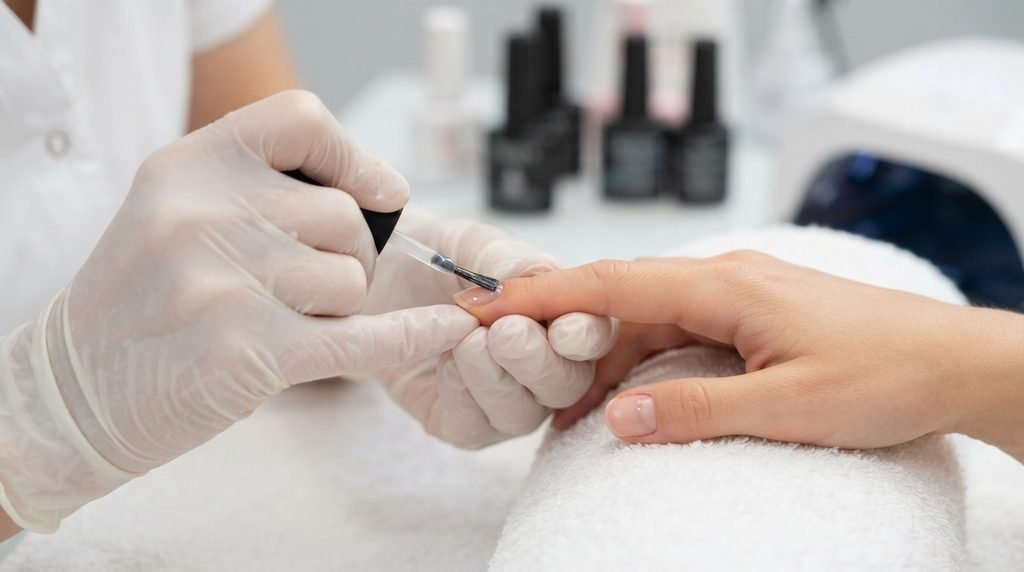
The magic isn’t really magic—it comes down to the way builder gel is formulated and cured.
BIAB is generally thicker than ordinary gel polish. This allows a nail technician to build structure instead of simply painting colour onto the nail.
During a typical service, the technician:
- Prepares the natural nail.
- Applies the appropriate base or bonding layer if required by the product.
- Applies BIAB.
- Shapes the builder gel to create the desired structure.
- Cures it under a compatible UV/LED nail lamp.
- Adds colour or top coat if desired.
- Finishes and checks the shape.
The exact process depends on the brand and formula. For example, some BIAB formulas contain primer and base components and can be applied directly to the natural nail, while other formulations require an additional base product. (The GelBottle INC)
That distinction matters.
Don’t assume that every builder gel can be applied in exactly the same way. Following the manufacturer’s instructions and using a compatible curing lamp are important parts of getting a properly cured and durable result.
BIAB Nails vs Gel Polish
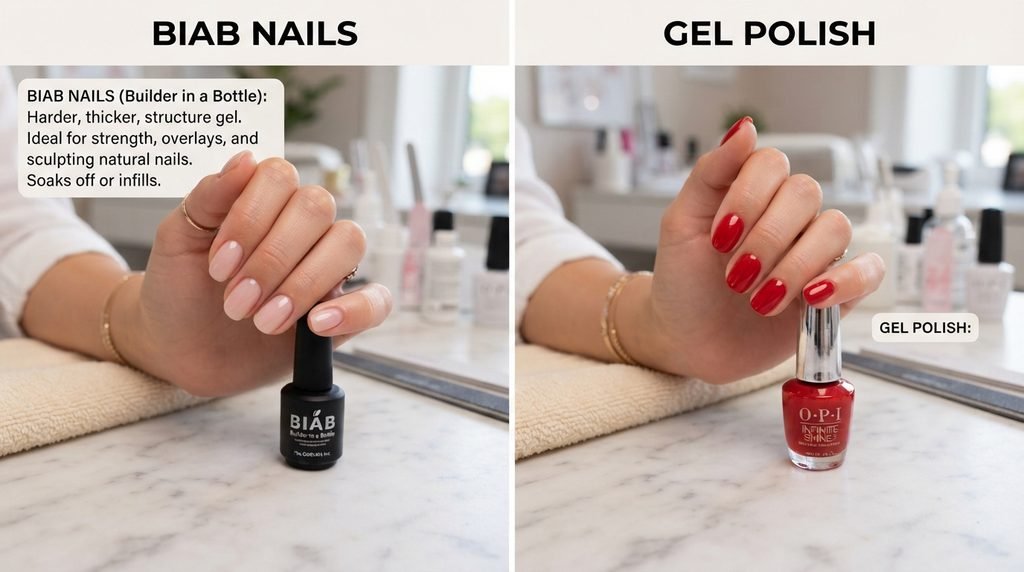
One of the most common questions beginners ask is:
“Is BIAB just gel polish?”
No.
Although both products are cured under a nail lamp, they serve different purposes.
| Feature | BIAB | Gel Polish |
|---|---|---|
| Main purpose | Strength and structure | Colour and shine |
| Texture | Generally thicker | Generally thinner |
| Builds structure | Yes | Usually no |
| Can support natural nails | Yes | Limited |
| Creates an apex | Yes | No |
| Available in colours | Many formulas are | Yes |
| Can be worn alone | Yes, depending on product | Yes |
| Can be combined | Yes | Often applied over builder gel |
A simple way to remember the difference is:
Gel polish decorates. BIAB builds.
That doesn’t mean gel polish is inferior. It simply means the two products are designed for different jobs.
BIAB Nails vs Acrylic Nails
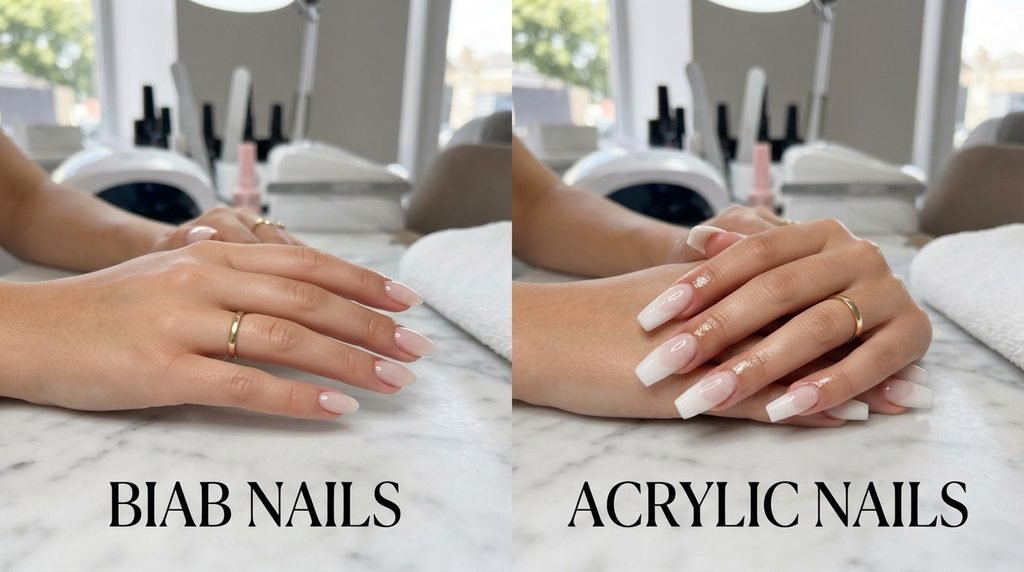
Another common comparison is BIAB vs acrylic.
Acrylic systems use a liquid monomer and powder polymer that combine to create a hard enhancement. BIAB is a gel-based system that is cured using a nail lamp.
In general, BIAB is associated with a more flexible feel, particularly in soak-off builder-gel systems. NailKnowledge describes BIAB as sitting between softer rubber-base products and harder gels in terms of structure and flexibility. (NailKnowledge)
Here’s a simplified comparison:
| Feature | BIAB | Acrylic |
|---|---|---|
| Base technology | Builder gel | Liquid + powder |
| Curing | UV/LED lamp | Air curing |
| Feel | Generally flexible | Generally rigid |
| Natural nail overlay | Common | Possible |
| Extensions | Possible with suitable systems | Very common |
| Removal | Depends on formula | Usually filed |
| Appearance | Often natural | Can be natural or dramatic |
| Best known for | Strengthening natural nails | Strong extensions and sculpted shapes |
Neither option is automatically right for everyone.
If your goal is simply to make your natural nails stronger while keeping them relatively short and natural-looking, BIAB may be something worth discussing with a qualified nail technician.
If your goal is very long, highly sculpted nails, your technician may recommend another enhancement system.
What Are the Benefits of BIAB Nails?
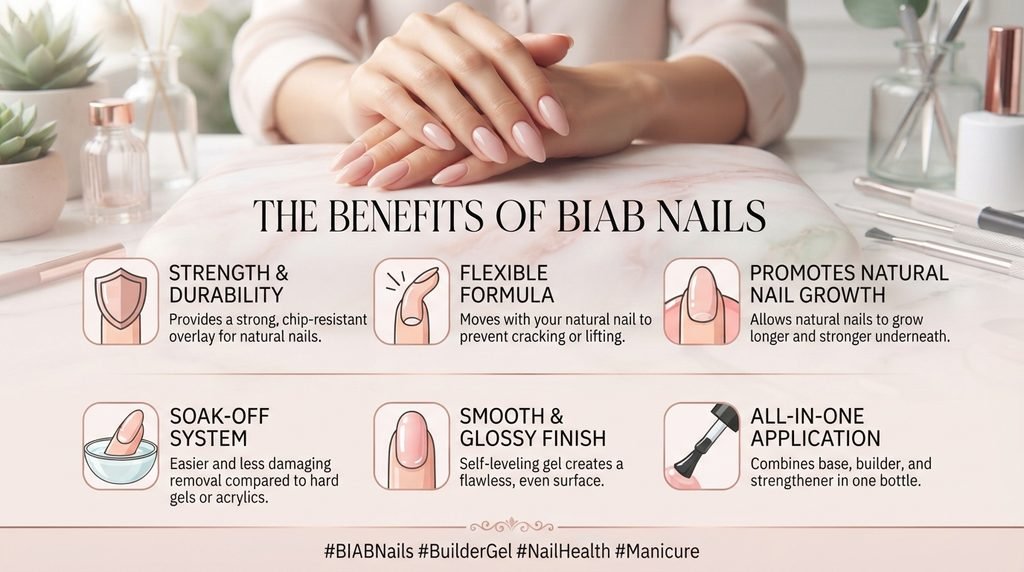
There is a reason BIAB manicures have become so popular.
1. They Can Add Strength to Natural Nails
One of the biggest attractions of BIAB is its ability to add structure to natural nails.
If your nails bend easily or regularly break when they reach a certain length, a properly applied builder-gel overlay can provide additional support.
The GelBottle describes BIAB as being used on natural nails to enhance strength and support growth, particularly for brittle nails. (The GelBottle INC)
However, it’s worth keeping expectations realistic.
BIAB doesn’t magically repair a damaged nail from the inside. Instead, the product creates a protective enhancement over the nail while the natural nail continues to grow underneath.
2. It Can Give You a Natural Look
Not everyone wants extremely long or dramatic nails.
Many people simply want their nails to look:
- Clean
- Smooth
- Healthy-looking
- Shiny
- Neat
- Slightly longer
- More uniform
That’s where natural BIAB nails can be especially appealing.
Many BIAB products are available in nude, pink, milky, beige, and other subtle shades, so you can sometimes skip additional colour altogether.
For someone who prefers an understated manicure, a sheer pink BIAB with a glossy top coat can look beautifully simple.
3. You Can Grow Your Natural Nails
Here’s a situation many people know all too well.
You finally grow your nails to the length you want. Then one nail catches on your clothes, another splits, and suddenly you’re reaching for the nail clippers.
A structured BIAB overlay can help protect the natural nail from everyday stress.
The goal isn’t to make your nails indestructible. Instead, the additional structure can help reduce bending and accidental breakage.
This is why BIAB for nail growth is often discussed. The product doesn’t make the nail grow faster; rather, protecting the nail from repeated breakage can make it easier to retain length as it grows.
4. BIAB Can Be Used for Minimal Nail Art
BIAB doesn’t have to mean a plain manicure.
You can put gel polish over it and create:
- French tips
- Chrome nails
- Ombre nails
- Nude nail designs
- Glitter nails
- Floral designs
- Minimal nail art
- Seasonal designs
For example, you could have a nude BIAB base with a thin white French tip.
This gives you the strength and structure of the builder layer while allowing almost unlimited creative options on top.
What Are the Disadvantages of BIAB Nails?
A good article shouldn’t only tell you why something is great.
There are also some things to consider before booking a BIAB manicure.
BIAB Isn’t Completely Damage-Proof
Incorrect preparation, over-filing, picking, poor removal, or inappropriate application can contribute to nail damage.
The American Academy of Dermatology notes that artificial and gel nail systems can contribute to brittleness, peeling, and cracking, and recommends sensible precautions around gel manicures. (American Academy of Dermatology)
So, the technician matters.
A beautiful BIAB set isn’t just about the bottle of product. Preparation, application, curing, maintenance, and removal all matter.
It Requires Regular Maintenance
BIAB isn’t a one-and-done treatment.
Your natural nail continues growing, so eventually you’ll see new nail at the cuticle area.
At that point, the product needs to be maintained or removed appropriately.
Depending on the product and salon system, maintenance may involve an infill/rebalance or removal and a fresh application.
Your nail technician should tell you how frequently you should return based on your individual nails and the product being used.
Not Every BIAB Formula Is the Same
This is particularly important.
“BIAB” is often used as a broad term, but products can differ significantly.
Some are designed to soak off. Others may be file-off systems. Some are softer and more flexible, while others are harder and more rigid.
For example, The GelBottle’s product information distinguishes between different BIAB formulations and explains that some products require a rubber base while others incorporate primer and base components. (The GelBottle INC)
So instead of asking only:
“Do you use BIAB?”
ask:
“Which BIAB system do you use, and how is it removed?”
That simple question can tell you much more.
How Is a BIAB Manicure Done?
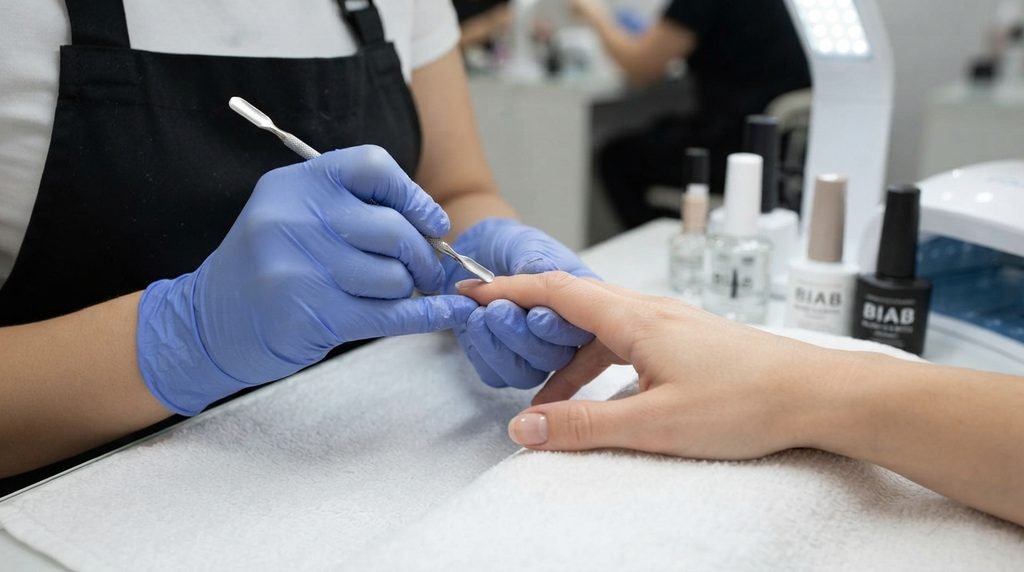
If you’re considering your first appointment, here’s a simplified look at the process.
Step 1: Nail Assessment
Your technician should first look at your natural nails.
They’ll consider:
- Nail length
- Nail shape
- Strength
- Existing product
- Breakage
- Lifting
- Damage
- Your desired result
This helps determine whether a BIAB overlay is appropriate and which formula may be suitable.
Step 2: Natural Nail Preparation
The nail is cleaned and prepared.
This can include removing old product, shaping the free edge, gently preparing the nail surface, and dealing appropriately with the surrounding skin.
Proper preparation is extremely important because product lifting can occur when application and preparation aren’t done correctly.
Step 3: Base or Bonding Product
Depending on the BIAB formula, the technician may apply a base or bonding product.
Some products incorporate base components, while others require a separate base. Always follow the instructions for the specific system. (The GelBottle INC)
Step 4: Applying the BIAB
The technician applies the builder gel over the natural nail.
This is where skill becomes particularly important.
The product needs to be distributed appropriately so that the nail has enough support without becoming unnecessarily thick.
A structured nail typically has more product around its stress area and apex than at the free edge.
Step 5: Curing
The nail is placed under the appropriate UV/LED nail lamp.
The lamp cures the gel, turning it from a workable product into a solid enhancement.
The correct lamp and curing time are important. Don’t substitute a random lamp simply because it looks similar.
Step 6: Shaping
Once cured, the technician checks the structure and shape.
Depending on the system, filing may be used to refine the surface.
The goal is a smooth, balanced nail that doesn’t look bulky.
Step 7: Colour and Top Coat
You can leave the BIAB in its natural shade or add:
- Gel polish
- French tips
- Nail art
- Chrome
- Glitter
- A glossy top coat
And that’s it—you have your finished BIAB nails.
How Long Do BIAB Nails Last?
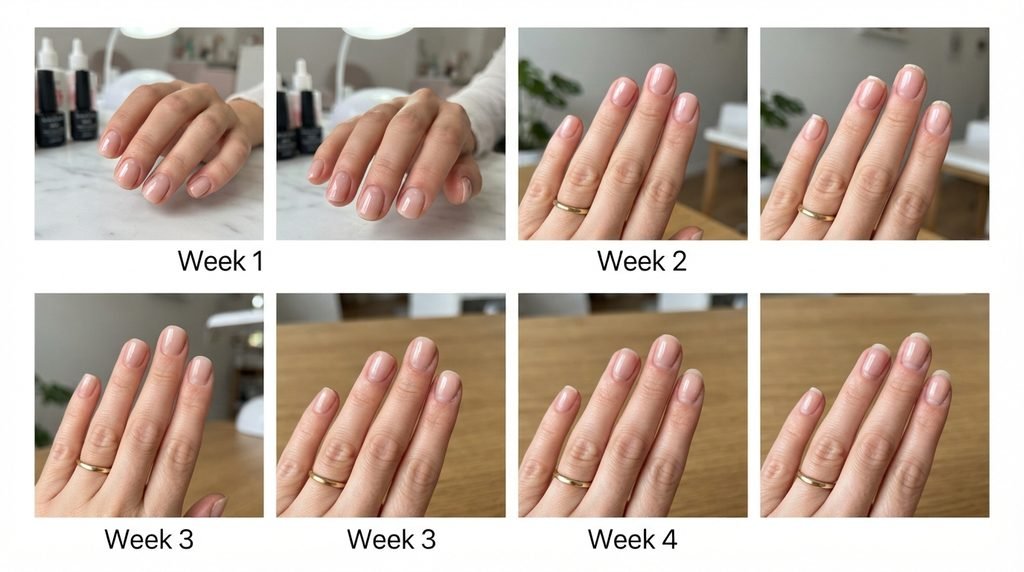
The exact wear time depends on:
- The product used
- Your natural nails
- Application quality
- Nail preparation
- Your lifestyle
- How you care for your nails
- How quickly your nails grow
Some BIAB systems are marketed as lasting for several weeks when properly applied and maintained. For example, The GelBottle consumer material states that its BIAB system can last up to four weeks. (The Gel Bottle)
However, don’t treat “up to four weeks” as a guarantee for every person.
A person who works with their hands all day, frequently washes dishes, or uses their nails as tools may experience different wear from someone with a gentler routine.
How to Look After BIAB Nails
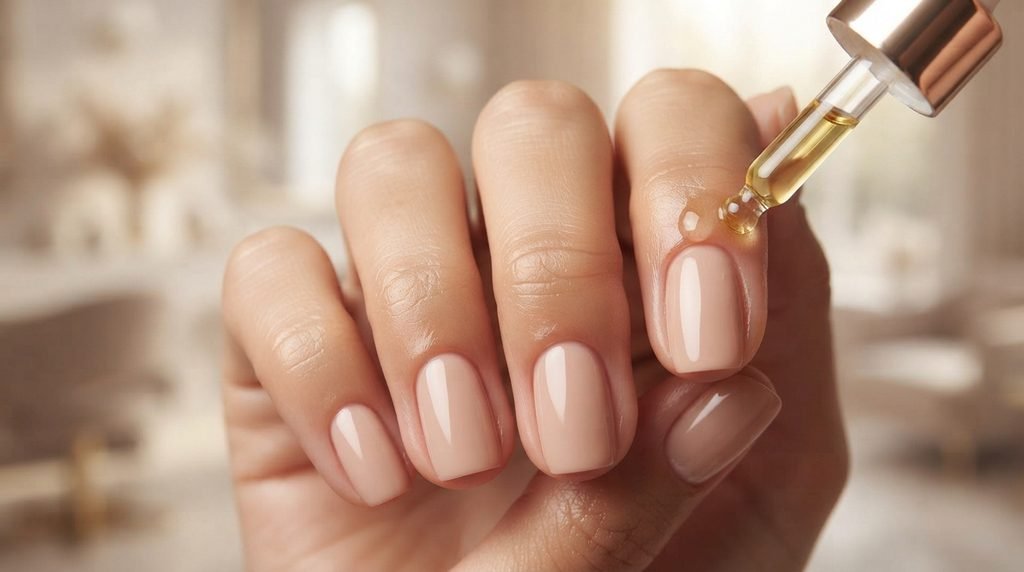
Getting BIAB applied is only half the story.
Your aftercare routine matters too.
Do:
- Keep your nails reasonably dry when possible.
- Wear gloves when doing household cleaning.
- Use cuticle oil regularly.
- Treat your nails gently.
- Return to your technician for appropriate maintenance.
- Have professional removal when necessary.
Don’t:
- Use your nails to open cans.
- Pick or peel the BIAB.
- Bite the product.
- Rip off lifted gel.
- File aggressively at home.
- Ignore significant lifting or irritation.
The American Academy of Dermatology specifically advises against picking gel polish off and recommends professional removal rather than peeling or scraping it away. (American Academy of Dermatology)
Is BIAB Good for Weak Nails?
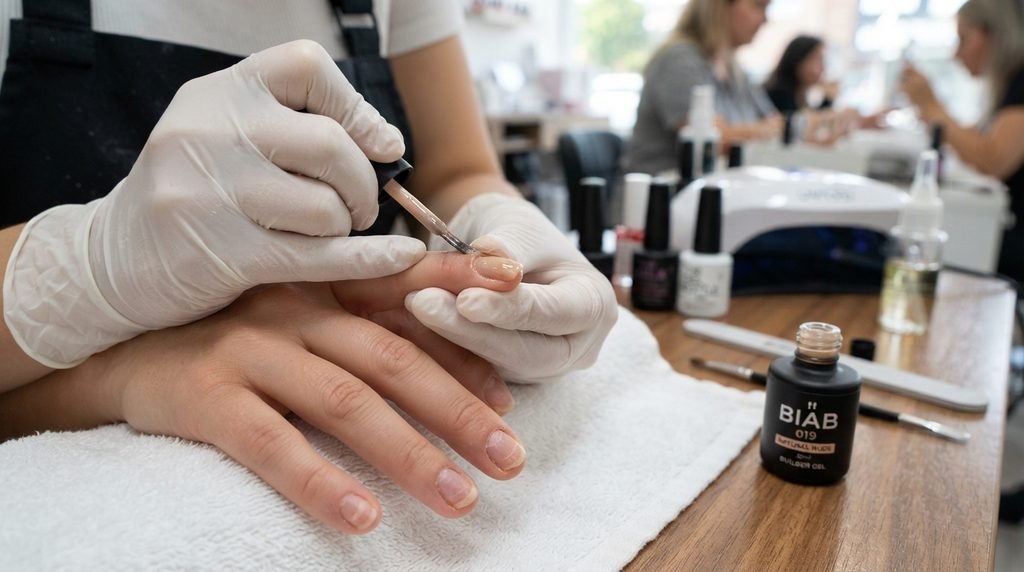
This is probably one of the biggest reasons people search for BIAB nails.
If your nails are naturally thin, flexible, or prone to breaking, a builder-gel overlay may provide additional structure.
However, there is an important distinction:
BIAB can protect and reinforce the nail; it doesn’t necessarily treat the reason your nails are weak.
If your nails have suddenly become unusually brittle, painful, discoloured, separated from the nail bed, or otherwise changed significantly, speak with a healthcare professional rather than simply covering the problem with an enhancement.
And remember: even flexible gel systems can cause nail problems if they are applied or removed incorrectly. (American Academy of Dermatology)
Is BIAB Safe?
When applied correctly and used according to the manufacturer’s instructions, BIAB is widely used as a professional nail enhancement system.
Nevertheless, gel products require proper curing and careful handling.
One important concern is skin contact with uncured gel. Nail professionals should avoid allowing uncured product to sit on surrounding skin, and the product should be cured according to its manufacturer’s instructions.
There is also UV exposure during curing. The American Academy of Dermatology recommends protecting the hands from UV radiation associated with gel manicures, including using broad-spectrum SPF 30+ sunscreen or opaque fingerless gloves. (American Academy of Dermatology)
So, if you regularly get gel manicures, this is a small but worthwhile part of your routine.
What Should You Look for When Buying BIAB?
If you’re buying a BIAB nail kit or choosing a professional product, don’t simply choose the prettiest bottle.
Look for:
1. Clear Product Instructions
A reputable manufacturer should explain:
- How to prepare the nail
- Which base is required
- Which lamp should be used
- How long to cure
- How to remove the product
- Whether the product is soak-off or file-off
2. A Compatible Lamp
The curing lamp is part of the system—not merely an accessory.
Using an inappropriate lamp can compromise curing.
3. Suitable Formula
Different nails may require different levels of flexibility and strength.
Professional education from The GelBottle, for example, discusses differences between soft, hard, fibre and other BIAB formulations and how nail type and lifestyle can influence product selection. (TGB Academy)
4. Professional Guidance
If you’re new to builder gel, learning proper application is worth the effort.
A professional nail technician can assess your nails and select a suitable system instead of simply applying the same product to everyone.
Should You Buy a BIAB Nail Kit?
If you already have professional nail-training experience, a BIAB nail kit can be a convenient way to have the necessary products together.
For beginners, however, buying a bottle and immediately experimenting on yourself isn’t necessarily the best approach.
There is a learning curve.
You need to understand:
- Natural nail preparation
- Product thickness
- Nail structure
- Apex placement
- Curing
- Product compatibility
- Safe removal
- Hygiene
- Troubleshooting lifting and breakage
Some manufacturers offer dedicated professional training. The GelBottle, for example, provides BIAB education covering application, formula selection, extensions, repairs, infills and removal. (The Gel Bottle)
If you want salon-quality results, investing in proper education can be more valuable than buying lots of colours.
A Simple BIAB Buying Checklist
Before you spend your money, ask yourself these questions:
Do I want stronger natural nails?
If yes, BIAB may be worth considering.
Do I want very long extensions?
If yes, ask a nail technician whether BIAB or another enhancement system is more appropriate for your desired length.
Do I prefer a natural manicure?
BIAB is particularly appealing if you like nude, milky, pink or sheer finishes.
Do I want lots of nail art?
BIAB works well as a structured base for many nail-art styles.
Am I willing to maintain the manicure?
Any enhancement system requires maintenance.
Do I know how the product should be removed?
Always know the removal method before buying.
My First BIAB Experience: Why Structure Matters
Imagine someone who has spent months trying to grow their nails.
Every time they reach the desired length, one breaks.
So they try a traditional manicure. Beautiful—but a few days later, the same problem happens.
Then they try BIAB.
The first difference they notice isn’t necessarily the colour. It’s the feel of the nail.
Instead of a thin, flexible nail that bends whenever it hits something, there’s now a structured layer providing support.
A few weeks later, the natural nail underneath has continued growing.
That’s the appeal of BIAB in a nutshell.
It isn’t about creating an artificial-looking nail. For many people, it’s about giving their own nails enough support to make the natural look easier to maintain.
Of course, results vary. But when the right formula is paired with good preparation, application and aftercare, the concept is remarkably practical.
BIAB Nails: Frequently Asked Questions
Are BIAB nails the same as builder gel?
BIAB is a type of builder gel, specifically referring to builder gel supplied in a bottle. NailKnowledge defines BIAB as Builder In A Bottle and describes it as a soak-off builder gel used to add strength and structure. (NailKnowledge)
However, formulations vary between brands.
Can BIAB make your nails grow?
BIAB doesn’t biologically make your nails grow faster.
Instead, it can provide structure that may help reduce breakage, allowing you to retain more natural nail length as the nail grows.
Can you put gel polish over BIAB?
Yes, many BIAB systems are designed to be used underneath gel polish.
The exact compatibility should always be checked with the product manufacturer.
Can BIAB be used on short nails?
Yes. Short BIAB nails are one of the most common uses.
A structured overlay can provide additional support without requiring long extensions.
Can BIAB extend nails?
Some BIAB systems can be used to create short or medium extensions, while others are primarily designed for natural nail overlays.
The manufacturer’s instructions matter here. For example, The GelBottle describes certain BIAB formulations as suitable for extensions using sculpting forms or tips. (The GelBottle INC)
Can you remove BIAB at home?
That depends on the formula.
Some BIAB products are soak-off systems, while others are file-off.
Because incorrect removal can damage the natural nail, it’s safest to follow the manufacturer’s removal instructions and use a trained professional when you’re unsure.
Does BIAB damage your natural nails?
BIAB itself shouldn’t be viewed as a guarantee of either “healthy” or “damaging” nails.
The result depends heavily on preparation, application, curing, maintenance and removal.
Gel and artificial nail systems can contribute to nail brittleness, peeling or cracking, particularly when misused or removed improperly. (American Academy of Dermatology)
Final Verdict: Are BIAB Nails Worth Trying?
If you’ve been asking “what are BIAB nails?”, the simplest answer is this:
BIAB nails are natural nails reinforced with builder gel designed to provide additional structure, strength and durability.
They’re particularly attractive for people who want to grow their natural nails, prefer a polished but relatively natural appearance, or find that ordinary manicures don’t provide enough support.
The biggest advantage is versatility. You can keep your BIAB manicure simple with a sheer nude shade, or use it as a strong foundation for gel polish and nail art.
At the same time, BIAB isn’t a miracle product. Your results depend on the formula, nail preparation, technician’s skill, curing system, maintenance and removal.
So, if you’re ready to try it, don’t just search for the cheapest BIAB nail kit or the first salon advertising BIAB. Look for a reputable product, clear application instructions, appropriate training and a professional who understands nail structure.
When those pieces come together, BIAB can be a practical way to enjoy stronger-looking, beautifully structured natural nails without automatically committing to long artificial extensions.
And that’s ultimately what makes BIAB so appealing: you don’t necessarily have to choose between natural-looking nails and durable nails—you can work toward both.
Helpful Resources
- The GelBottle — What Is BIAB? — Product-specific information about Builder In A Bottle.
- NailKnowledge — BIAB Glossary — Independent nail-industry explanation of BIAB.
- The GelBottle Academy — BIAB Blueprint — Professional education covering BIAB formulas and application.
- American Academy of Dermatology — Gel Manicure Safety — Dermatologist guidance on protecting nails and skin during gel manicures.
- American Academy of Dermatology — Artificial Nail Damage Prevention — Practical advice for reducing nail damage.