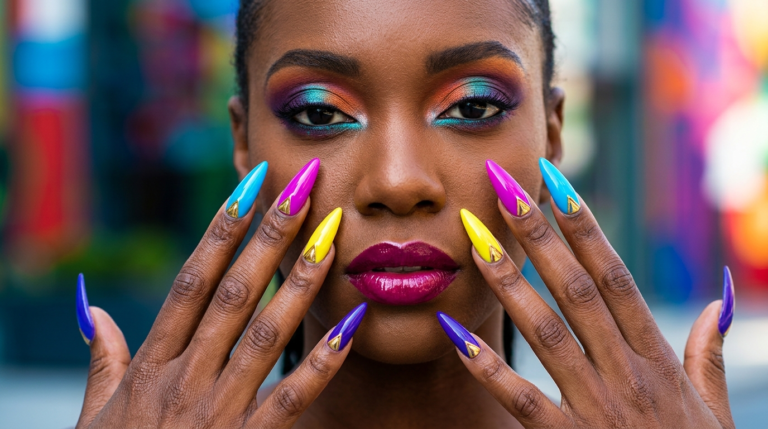
BIAB Gel Extensions: A Complete Guide to Strong, Natural-Looking Nails
If you love the look of longer nails but want something that feels more natural than traditional acrylics, BIAB gel extensions are worth knowing about. They combine the structure of a builder gel with the clean, polished look that many people want from their manicure.
BIAB stands for Builder In A Bottle. It is a type of builder gel designed to add strength and structure to natural nails. Depending on the formula and application system, BIAB can also be used to create short to medium nail extensions, overlays, repairs, and other structured nail enhancements.
The result can be a neat, smooth manicure with extra length without making the nails look overly thick.
But are BIAB extensions right for you? What is the difference between BIAB and regular gel extensions? How are they applied? And what should you look for when buying a BIAB product?
Let’s go through everything step by step.
What Are BIAB Gel Extensions?
BIAB gel extensions are nail extensions created using a builder gel system known as Builder In A Bottle.
Unlike regular gel polish, builder gel has a thicker structure that can be built up to create strength and shape. Some BIAB formulas are designed mainly for natural-nail overlays, while others can be used for extensions with forms, tips, or compatible extension systems.
Think of it this way:
- Gel polish mainly adds colour and shine.
- BIAB adds structure and strength.
- BIAB extensions can add structure, strength, and extra length.
- Hard gel is another type of enhancement product that can be used for longer or more structured extensions.
One important point is that “BIAB” can refer to a range of different builder-gel formulas rather than one identical product. Different brands may have different systems, curing requirements, removal methods, and recommended uses.
For example, The GelBottle’s current BIAB range includes formulas intended for natural overlays, short extensions, longer extensions, and specialised systems.
So, before buying a product, always check its specific instructions.
Why Are BIAB Gel Extensions So Popular?
The popularity of BIAB nails comes from the balance between a natural appearance and added structure.
Many people don’t want extremely long or bulky nails. They simply want their nails to look slightly longer, smoother, and more polished.
That is where BIAB gel extensions can be useful.
A properly structured set can give you:
- A clean nail shape
- Added length
- A smooth surface
- More structure than ordinary gel polish
- A natural-looking finish
- Plenty of options for nude, milky, sheer, or coloured designs
Some BIAB formulas are also self-levelling, which can make it easier for a trained nail technician to create a smooth surface and build an appropriate apex.
However, the final result depends heavily on nail preparation, product choice, application technique, curing, and removal.
BIAB Extensions vs Regular Gel Extensions
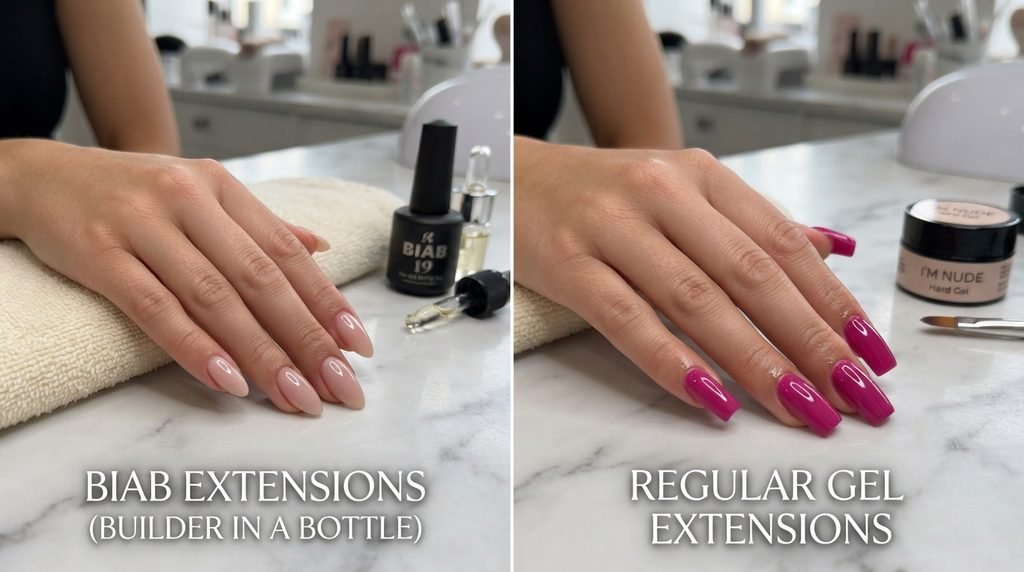
At first glance, BIAB gel extensions and regular gel nail extensions can look very similar.
The main difference is the type of product and system being used.
Traditional gel extensions may use a separate base product, builder gel, forms, tips, or other extension systems.
BIAB is a builder-gel category that is often supplied in a bottle with a brush, although the exact formula varies by brand.
Some BIAB products have a built-in base, while others require a separate base product. Some are soak-off systems, while others are file-off formulas.
This means you should never assume that every BIAB product can be applied or removed in exactly the same way.
A Simple Comparison
| Feature | BIAB Gel Extensions | Traditional Gel Extensions |
|---|---|---|
| Main product | Builder gel | Builder/extension gel |
| Natural look | Often very natural | Can be natural or sculpted |
| Structure | Yes | Yes |
| Added length | Depends on formula | Yes |
| Application | Bottle-and-brush or compatible system | Usually more system-dependent |
| Colours | Clear, nude, milky, coloured options | Usually separate gel colours |
| Removal | Depends on formula | Depends on product |
| Best for | Structured, natural-looking enhancements | Various lengths and shapes |
The most important thing is not simply choosing “BIAB” because it is popular. Instead, choose a formula that matches the length, structure, nail type, and service you want.
Can BIAB Be Used for Nail Extensions?
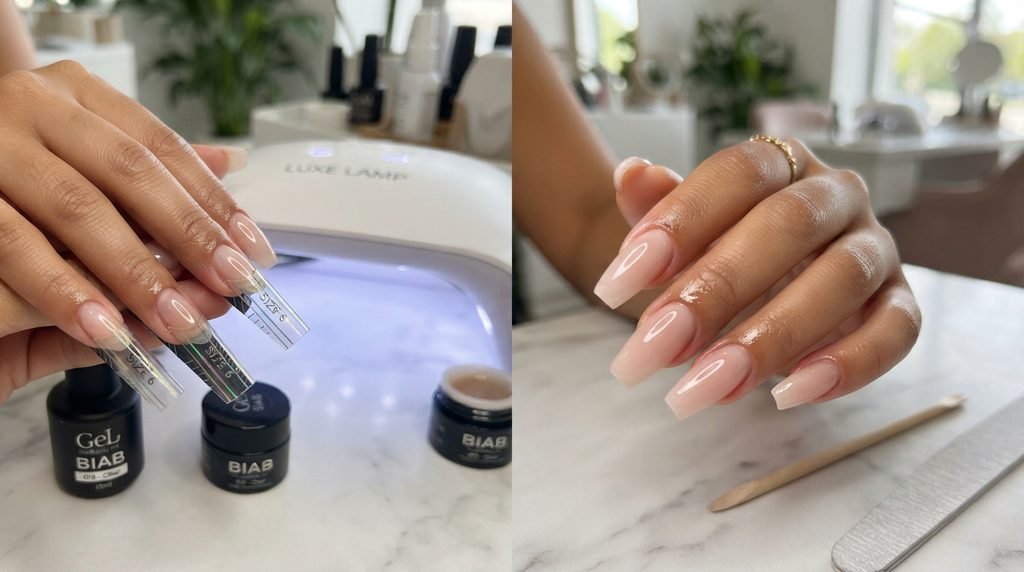
Yes, but not every BIAB formula is designed for extensions.
This is one of the most important things to understand before buying.
Some BIAB formulas are specifically intended for natural-nail overlays. Others can create short extensions using forms. Some systems can work with tips or specialised extension products.
For example, The GelBottle’s application information states that certain File-Off BIAB formulas can be used for short extensions, while other formulas are intended for different applications.
Therefore, always check the manufacturer’s application guide.
If you want long BIAB extensions, look for a product specifically designed for longer extensions or sculpting rather than assuming a standard overlay product will do the job.
How Long Can BIAB Extensions Be?
The length depends on the particular BIAB formula and extension system.
Some builder gels are designed for short to medium extensions, while stronger or specialised formulas can be used for longer enhancements.
For example, current professional BIAB systems include products designed for short-to-medium extensions as well as harder builder formulas intended for longer, more durable extensions.
If you are new to BIAB, starting with a short or medium length is usually easier to manage.
Longer nails require more attention to:
- Apex placement
- Nail architecture
- Sidewalls
- Free-edge thickness
- Stress points
- Product balance
The longer the extension becomes, the more important correct structure becomes.
What Do BIAB Gel Extensions Look Like?
One of the biggest reasons people choose BIAB gel extensions is their appearance.
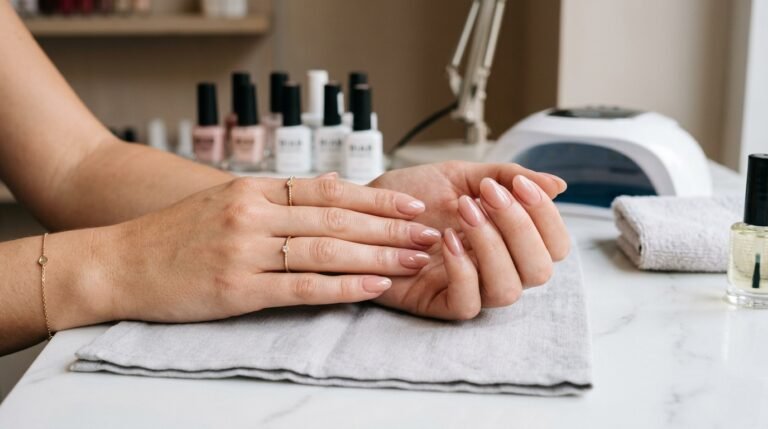
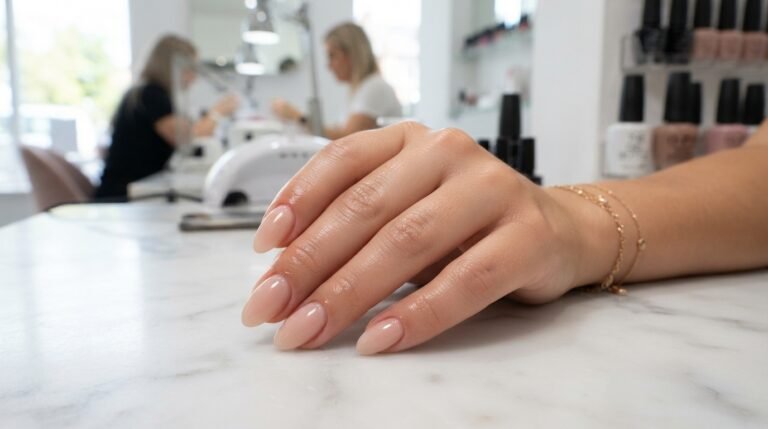
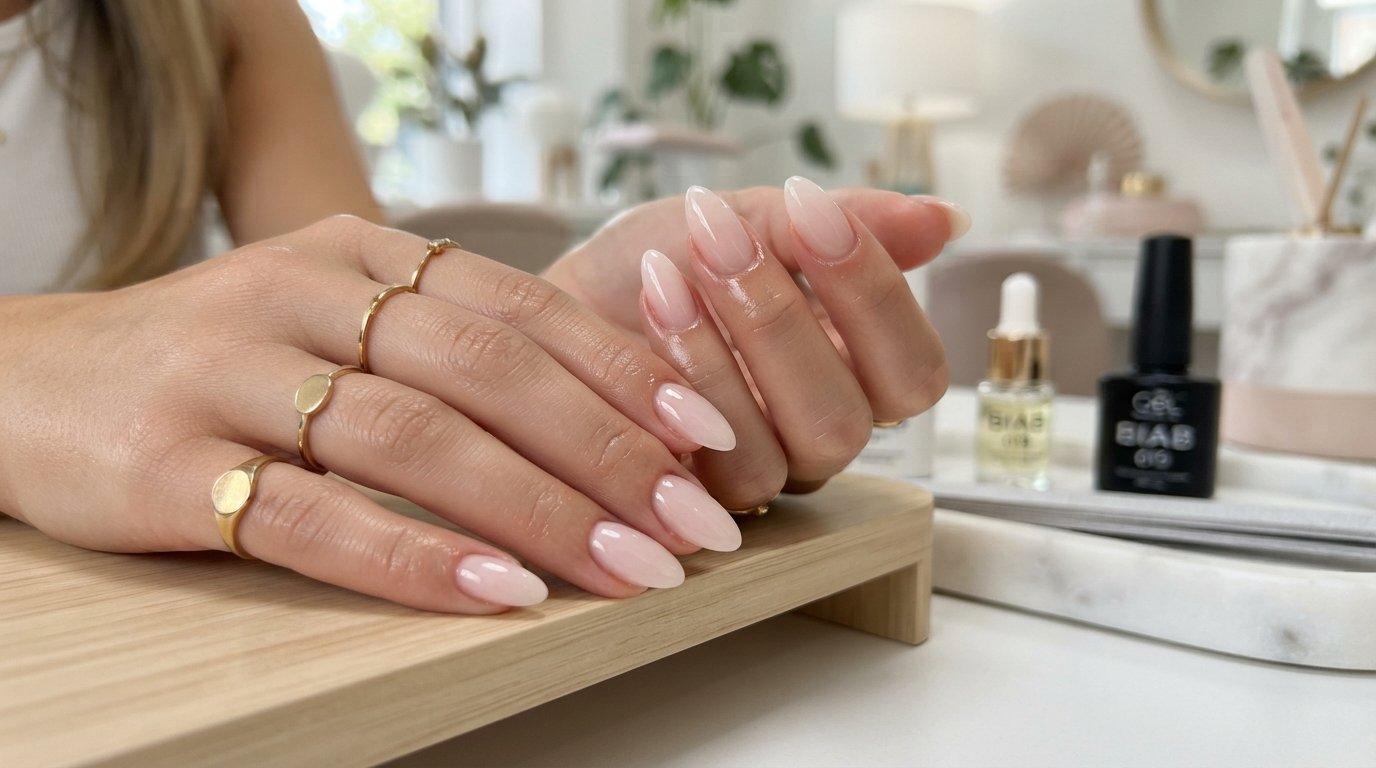
A good BIAB set can have a clean, smooth and natural-looking finish rather than looking overly thick.
Popular finishes include:
- Clear BIAB
- Milky white BIAB
- Soft pink BIAB
- Nude BIAB
- Peachy nude
- Sheer beige
- French manicure
- Glazed finishes
- Minimal nail art
- Gel polish over BIAB
The nude and milky shades are especially useful when you want a simple manicure that works with almost any outfit.
You can also apply colour or nail art over a suitable BIAB base. Some BIAB products can act as a foundation underneath gel colour, depending on the manufacturer’s instructions.
A Quick Real-Life Example
Imagine someone who has naturally thin nails that keep breaking just when they start getting a little length.
They don’t necessarily want extremely long acrylic nails.
They simply want their nails to grow a little longer and look neat.
A structured BIAB overlay may help provide additional support, while a suitable extension system can provide extra length when needed.
Now imagine that person wants a short almond shape for a wedding.
Instead of going immediately for very long extensions, a nail technician could create a modest extension and build the structure around the natural nail.
The final look can be simple, elegant, and easy to style.
That is one reason BIAB gel extensions appeal to people who prefer a more natural-looking manicure.
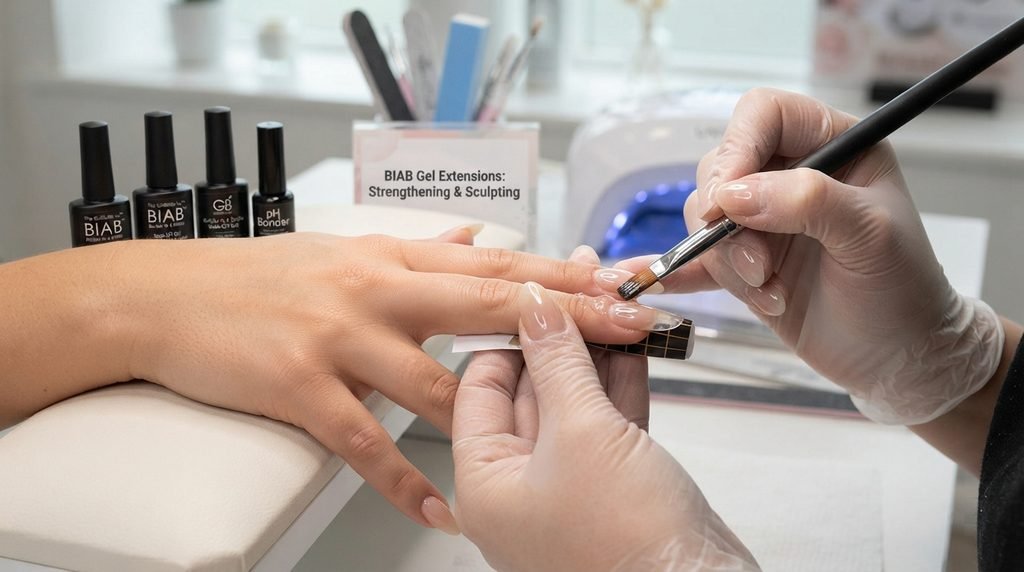
How to Apply BIAB Gel Extensions Step by Step
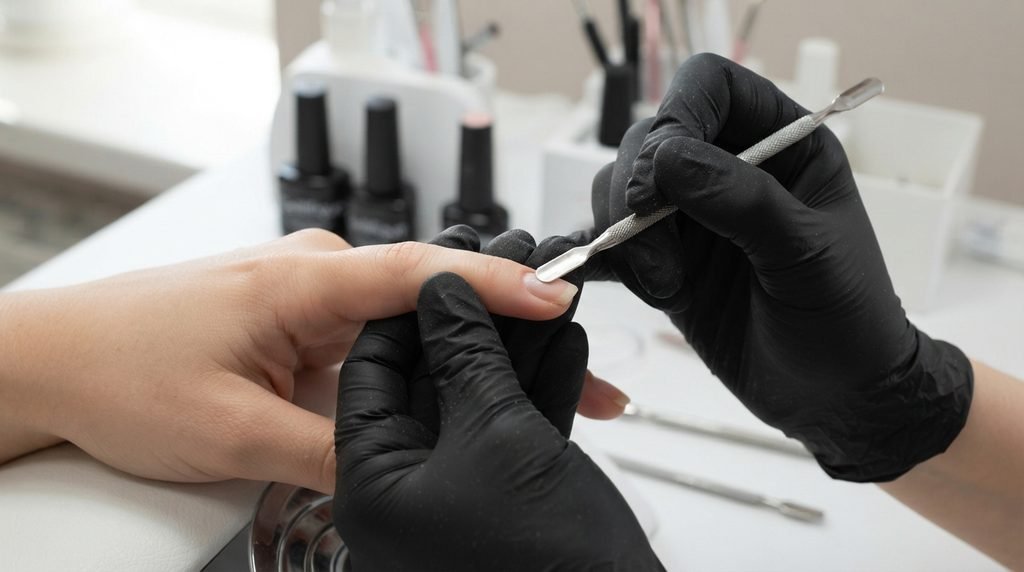
The exact process depends on the product, so the manufacturer’s instructions should always come first.
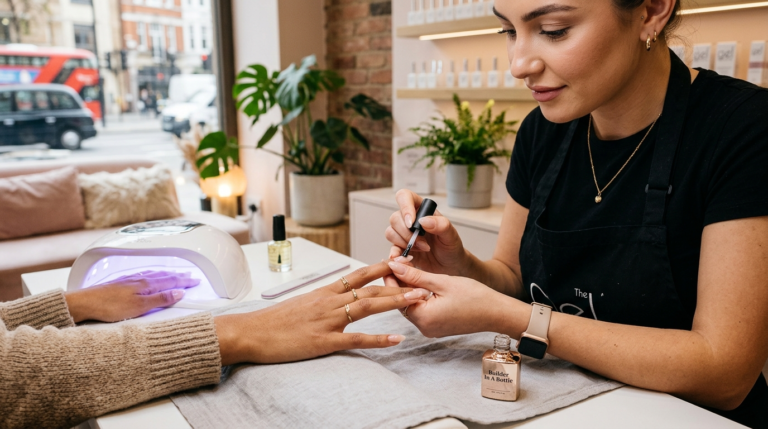
Professional application guides commonly include nail preparation, extension placement, builder-gel application, curing, refinement, and finishing.
Here is a general overview.
Step 1: Prepare the Nails
Start with clean hands and nails.
The nail technician should:
- Sanitise the hands.
- Gently push back the cuticles.
- Remove loose non-living cuticle from the nail plate.
- Shape the natural nail.
- Gently remove surface shine if the system requires it.
- Clean and dehydrate the nail plate according to the product instructions.
Proper preparation matters because product applied over contamination, oil, or unsuitable cuticle residue can lead to lifting.
Professional application instructions emphasise sanitising, cuticle preparation, shaping, gentle buffing, and cleansing before enhancement application.
Step 2: Choose the Extension Method
Depending on the product, extensions may be created using:
- Nail forms
- Tips
- Full-cover extension systems
- Compatible extension products
Don’t mix systems randomly.
For example, some BIAB products are specifically designed to work with particular extension systems.
Step 3: Apply the Base or Bonding Layer
Some BIAB products have a built-in base, while others require a separate base or bonding product.
This is why reading the product instructions is essential.
Using an unnecessary base can be just as problematic as skipping a required one.
Step 4: Build the Extension
The builder gel is then applied carefully to create the desired length and structure.
The product should not be allowed to flood onto the surrounding skin or cuticle.
A trained nail technician will control the amount of product and shape it around the nail’s architecture.
Step 5: Cure the Product
The gel must be cured using the correct lamp and curing instructions for that particular product.
Do not simply use any random lamp and assume the gel has cured correctly.
Professional application guides specify the curing method and timing for their particular systems.
If you experience a strong heat sensation during curing, follow the manufacturer’s instructions. Some professional systems specifically provide low-heat curing guidance.
Step 6: Refine the Shape
After curing, the nail can be refined with a suitable file or buffer.
This is where the technician perfects:
- Sidewalls
- Free edge
- Apex
- Overall shape
- Surface smoothness
The goal is not simply to make the nail thick.
The goal is to create a balanced structure.
Step 7: Add Colour or Top Coat
Once the structure is finished, you can choose your final look.
You might select:
- A nude BIAB finish
- Gel polish
- French tips
- Minimal nail art
- Chrome effects
- A glossy top coat
- A matte finish
Some BIAB systems can also be used underneath gel colour, depending on the formula.
What Shape Works Best With BIAB Extensions?
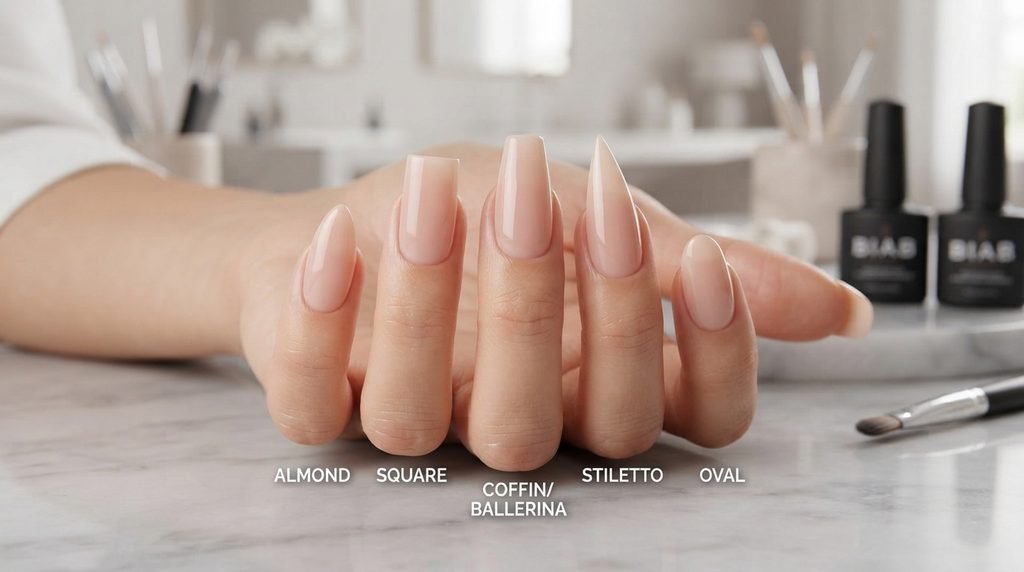
There is no single shape that works for everyone.
Popular options include:
Almond
BIAB almond extensions create a soft, elegant appearance. The tapered sides can make the nails appear longer.
Square
Square extensions offer a clean, modern appearance and work particularly well at shorter lengths.
Squoval
A combination of square and oval, squoval nails are practical and softer around the corners.
Coffin
BIAB coffin nails offer a more dramatic shape. They generally work better when there is enough length to create the tapered silhouette.
Oval
Oval nails have a soft, classic appearance and are a good option if you prefer something understated.
When choosing a shape, consider your natural nail, finger shape, lifestyle, and the amount of length you actually need.
BIAB Gel Extensions for Short Nails
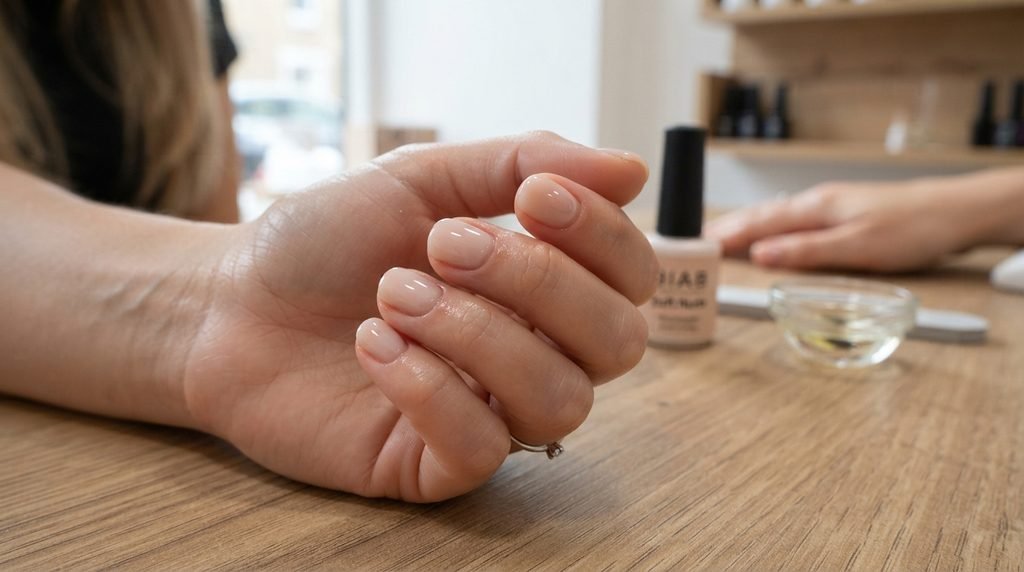
You don’t need extremely long nails to enjoy BIAB extensions.
In fact, short extensions can be a great starting point.
If your natural nails are very short, adding just a few millimetres can make a noticeable difference without creating an extreme look.
A professional BIAB application guide specifically identifies certain BIAB formulations for short extensions of around 2–3 mm.
This makes short BIAB extensions particularly interesting for people who want:
- A little extra length
- Better shape
- A clean manicure
- A natural appearance
- Easier everyday wear
BIAB Gel Extensions for Long Nails
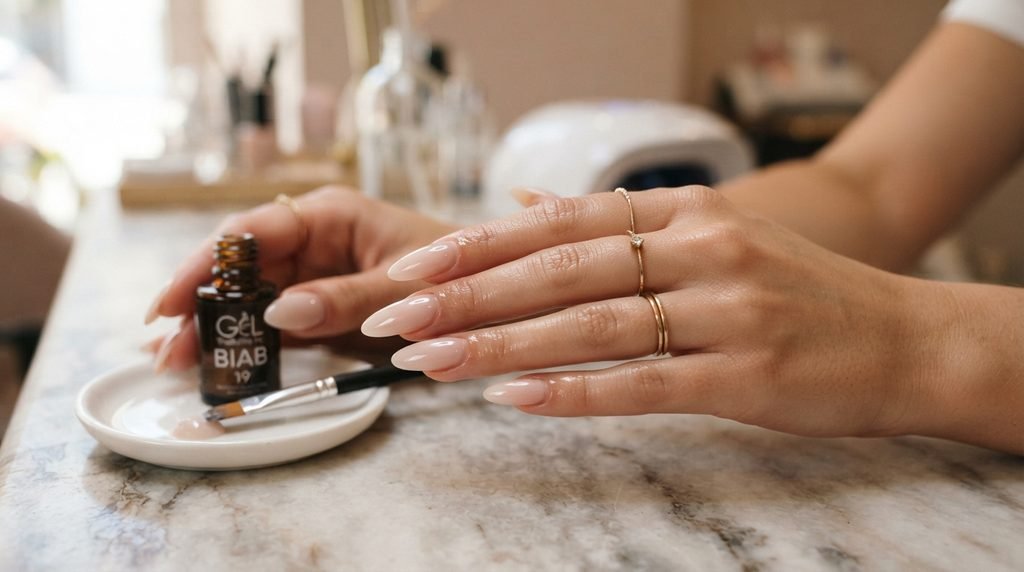
If you want long nails, product selection becomes even more important.
A standard soft builder product may not be suitable for every long-extension service.
For longer lengths, specialised builder systems such as Hard BIAB may be designed for additional structure and durability. Current professional guidance describes Hard BIAB as a file-off builder system intended for longer, structured extensions.
Long nails also require careful maintenance.
If you regularly use your nails as tools—for example, opening cans, lifting heavy objects, or scratching surfaces—the extra leverage can place stress on the enhancement.
Are BIAB Extensions Strong?
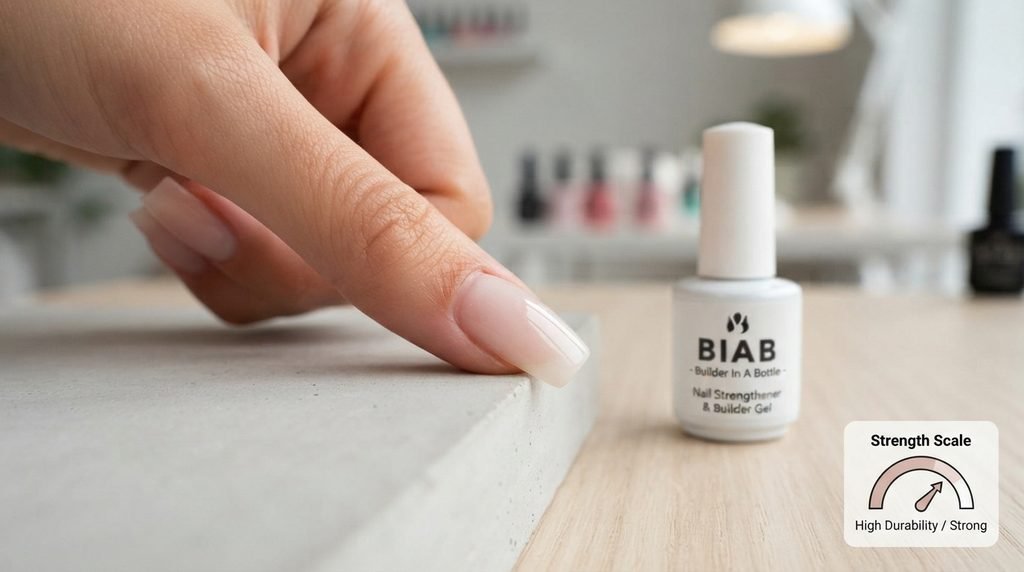
BIAB gel extensions are designed to provide structure, but “strong” does not mean unbreakable.
The strength of a finished nail depends on several factors:
- The specific formula
- Nail preparation
- Correct application
- Correct curing
- Nail architecture
- Extension length
- Lifestyle
- Aftercare
Some newer builder formulas are reinforced with fibres to improve structural performance. For example, Fibre BIAB uses microscopic fibres within the gel and is designed for overlays and extensions.
However, no nail enhancement should be treated as indestructible.
How Long Do BIAB Extensions Last?
There is no single number that applies to every person.
Retention depends on the product, application, natural nail, lifestyle, aftercare, and growth.
As the natural nail grows, the structure changes. Eventually, the nails need maintenance, an infill/rebalance, or removal and a fresh application depending on the system.
Professional BIAB education resources include guidance on infills, rebalancing, and removal because these are important parts of maintaining structured enhancements.
Rather than waiting until a nail becomes loose or damaged, follow the maintenance schedule recommended by your nail technician.
BIAB Extensions Aftercare Tips
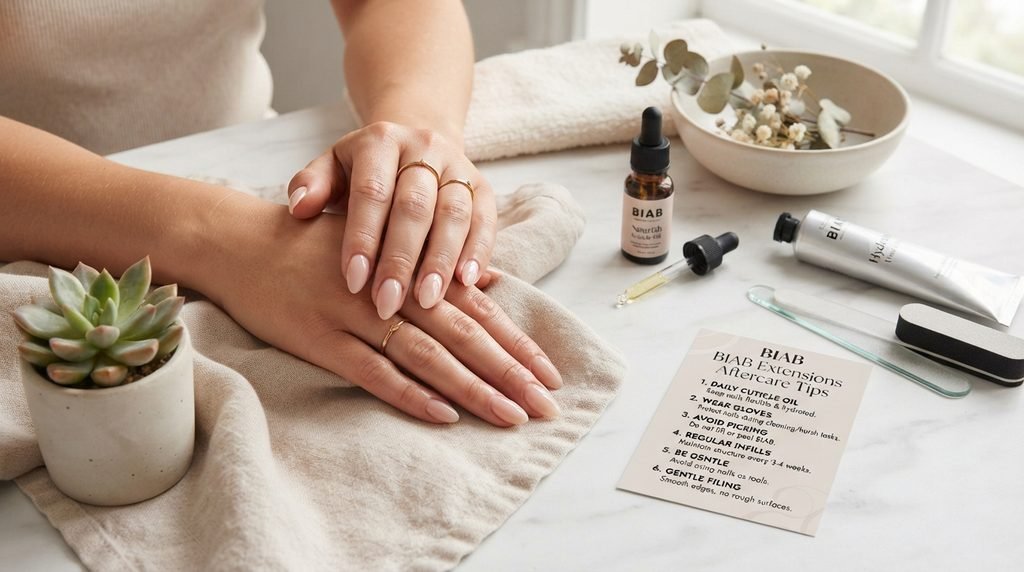
Good aftercare can make your manicure look better for longer.
1. Don’t Use Your Nails as Tools
Avoid using your extensions to open packages, scrape labels, or pry things open.
2. Use Cuticle Oil
Regular cuticle oil can help keep the surrounding skin comfortable and conditioned.
3. Wear Gloves
If your hands are regularly exposed to cleaning products or prolonged water contact, wearing protective gloves can help reduce exposure.
4. Don’t Pick or Peel
If an extension starts lifting, don’t pull it off.
Picking at product can damage the natural nail.
5. Get Professional Removal
The correct removal process depends on the BIAB formula. Some systems can be soaked off, while others are designed to be filed off.
Never assume that every builder gel can be removed in the same way.
Can You Remove BIAB Extensions at Home?
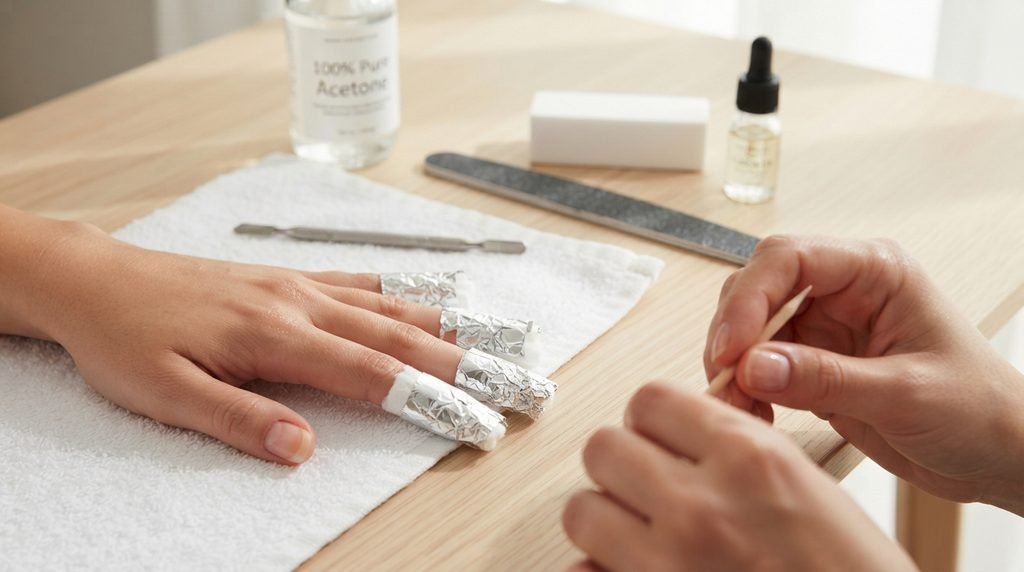
It depends on the formula.
Some BIAB products are soak-off gels, while others are file-off systems.
For example, certain BIAB formulas are designed to soak off, while specific file-off products require filing rather than soaking.
This is why you should identify the exact product before attempting removal.
If you’re unsure, professional removal is the safer option.
Avoid aggressively scraping, peeling, or forcing the product away from the natural nail.
How to Choose the Right BIAB Gel
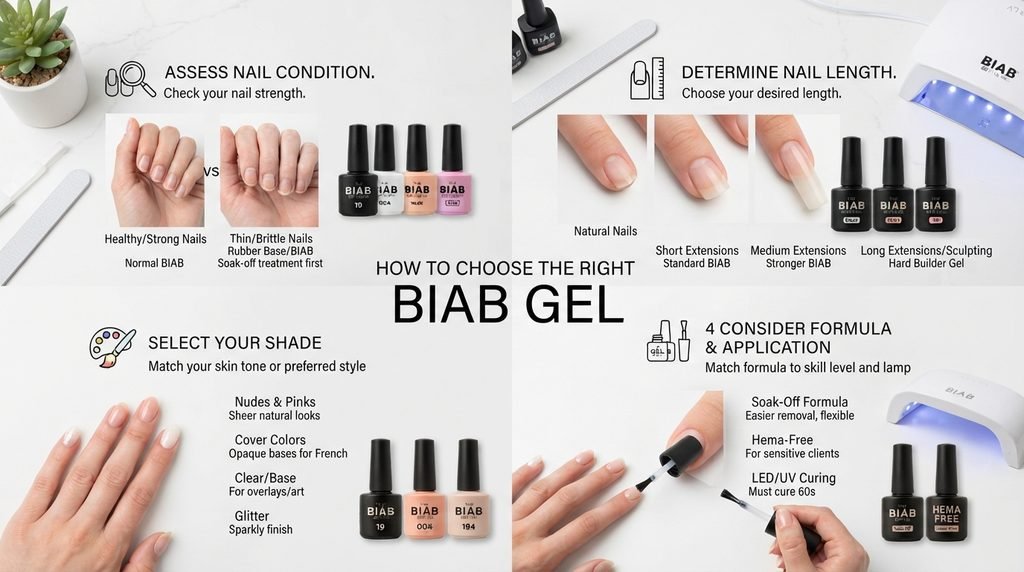
If you’re planning to buy BIAB gel for extensions, don’t choose based only on the colour or popularity.
Look at these factors first.
1. Check the Intended Use
Make sure the product specifically supports the type of extension you want.
2. Check the Viscosity
A thicker product may provide more control for certain structured applications, while a self-levelling formula may spread more easily.
3. Check the Base Requirements
Some formulas have a built-in base, while others require a separate bonding or base layer.
4. Check the Curing Instructions
Use the manufacturer’s recommended lamp and curing procedure.
5. Check the Removal Method
Find out whether the product is soak-off or file-off before buying it.
6. Consider HEMA-Free Options
If you have known sensitivities or allergies, discuss appropriate products with a qualified professional.
Some modern BIAB systems are available in HEMA-free and TPO-free formulations.
However, “HEMA-free” should not be treated as a guarantee that a product cannot cause a reaction. Always check the complete ingredient information and follow professional guidance.
Are BIAB Gel Extensions Worth Buying?
For someone who wants a structured manicure with a natural-looking appearance, BIAB gel extensions can be a practical option.
They offer flexibility in the types of looks you can create, from a simple nude manicure to a longer French set.
The biggest advantage is versatility.
A suitable BIAB formula can potentially be used for:
- Natural nail overlays
- Short extensions
- Structured manicures
- Nail repairs
- Longer extensions with appropriate formulas
- Nude manicures
- French designs
- Gel colour underneath or over the builder system
Professional BIAB ranges now include multiple formulas designed for different nail types, lengths, and service requirements.
However, buying the right product matters more than simply buying a product labelled “BIAB.”
If you want the best possible result, choose a reputable professional product, follow its application instructions, use the correct lamp, and have extensions applied by a trained nail technician.
Final Thoughts on BIAB Gel Extensions
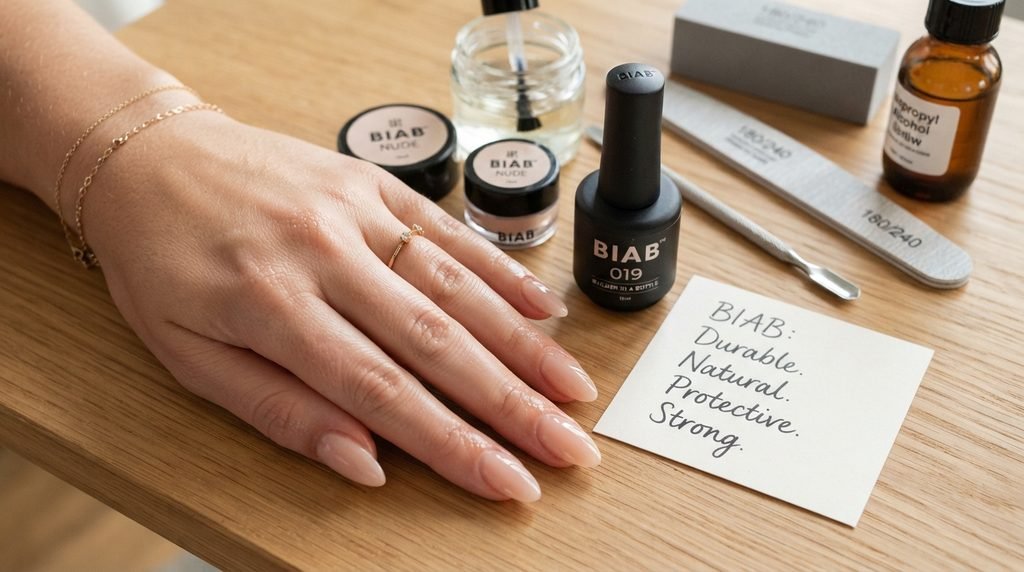
BIAB gel extensions have become popular because they sit between a natural-looking manicure and a more structured nail enhancement.
They can give you additional length, shape, and structure while still allowing you to create soft and elegant designs.
The key is choosing the correct formula.
If you want short, natural-looking extensions, look for a BIAB product specifically approved for short extensions. If you want longer nails, look for a builder system designed for greater length and structure.
And remember: the product is only one part of the result.
Preparation, application, curing, nail structure, maintenance, and removal all matter.
If you’re buying BIAB for home use, read the manufacturer’s complete instructions before starting. If you’re getting extensions professionally, ask your nail technician which BIAB formula they use and why it suits your desired length and nail type.
With the right product and proper technique, BIAB gel extensions can give you the polished, structured look you’re after without sacrificing the clean and natural appearance that makes BIAB so popular.
Frequently Asked Questions
What are BIAB gel extensions?
BIAB gel extensions are nail extensions created with a builder-gel system known as Builder In A Bottle. Depending on the formula, BIAB can be used for natural overlays, short extensions, or longer structured extensions.
Are BIAB extensions the same as acrylics?
No. BIAB is a builder-gel system, while acrylic enhancements use a different chemistry and application process. The finished appearance can also be different.
Can BIAB make nails longer?
Yes, but the amount of length depends on the particular BIAB formula and extension system. Not every BIAB product is designed for extensions.
Can you put gel polish over BIAB?
Many BIAB systems can be used underneath gel colour, but you should always follow the manufacturer’s instructions for the specific formula.
Are BIAB extensions good for short nails?
They can be. Short BIAB extensions can add a small amount of length while maintaining a natural appearance. Certain professional BIAB formulations are specifically recommended for short extensions.
Can BIAB extensions be long?
Yes, with a suitable formula and extension system. Some specialised builder products are designed for longer, more structured extensions.
Can BIAB be soaked off?
Some BIAB formulas are soak-off, while others are file-off. Always check the exact product instructions before removal.
Is HEMA-free BIAB better?
HEMA-free formulas can be useful for people who need to avoid HEMA, but “better” depends on the individual product, application, and needs. If you have a known allergy or sensitivity, check the complete ingredient information and seek professional advice.
How do I get the best BIAB extension results?
Use a product designed for your desired length, prepare the nail correctly, follow the manufacturer’s curing instructions, maintain the correct structure, and have removal performed correctly.
Helpful Resources
For more detailed information, you can explore professional resources such as:
- The GelBottle — What Is BIAB?
- The GelBottle — BIAB Application Guide
- The GelBottle — How to Apply BIAB
- The GelBottle — BIAB Formula Guide
- The GelBottle — Professional BIAB Education Hub
These resources are especially useful when you want to verify the application, curing, extension, and removal requirements of a particular BIAB formula.