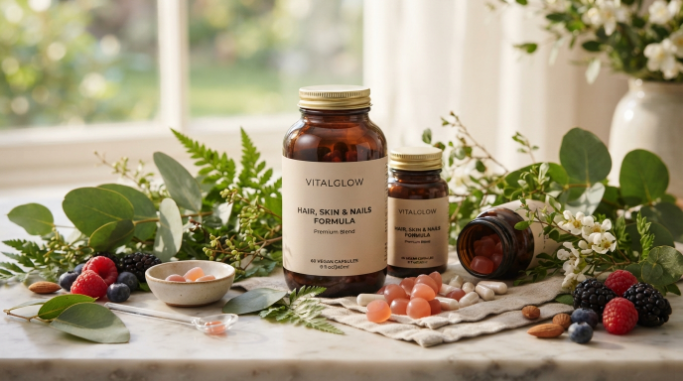
Hair and Nail Vitamins: A Complete Guide to Choosing the Right Supplements
Healthy-looking hair and strong nails often start with what is happening inside your body. That is why hair and nail vitamins have become so popular among people who want fuller-looking hair, stronger nails, and a simple addition to their daily beauty routine.
You may have seen bottles promising thicker hair, faster growth, stronger nails, and healthier skin. But with so many products available, it can be difficult to know what actually matters.
The truth is a little more balanced.
Certain nutrients are important for normal hair and nail health, particularly when your diet does not provide enough of them. However, taking more vitamins does not automatically mean your hair will grow faster or your nails will become stronger. The American Academy of Dermatology (AAD) recommends finding out whether you actually have a nutritional deficiency before taking supplements specifically for hair loss. (AAD)
So, if you are considering hair and nail vitamins, the smartest approach is to understand the nutrients, know what supplements can and cannot do, and choose a product carefully.


What Are Hair and Nail Vitamins?
Hair and nail vitamins are dietary supplements containing vitamins, minerals, and sometimes other nutrients that are marketed to support healthy hair, nails, and skin.
Depending on the product, a formula may contain ingredients such as:
- Biotin
- Vitamin C
- Vitamin D
- Vitamin E
- Zinc
- Iron
- Folate
- Vitamin B12
- Omega-3 fatty acids
- Collagen
- Other vitamins and minerals
However, not every person needs every one of these nutrients in supplement form.
Your body requires nutrients for many normal functions, and hair and nails are only one part of the picture. For example, biotin helps the body convert carbohydrates, fats, and proteins into energy. (ODS)
The important distinction is that having enough of a nutrient is different from taking a large amount of that nutrient.
Why Do People Take Hair and Nail Vitamins?
Imagine someone notices that their nails have started breaking every time they try to grow them.
At the same time, they notice more hair in their brush.
Naturally, they start searching online for a solution.
They see hair growth vitamins, biotin supplements, hair skin and nails vitamins, and dozens of other products.
It is easy to think, “Maybe I just need more vitamins.”
Sometimes nutrition can be part of the problem. The AAD notes that insufficient biotin, iron, protein, or zinc can contribute to noticeable hair loss. (AAD)
However, hair shedding can have many other causes, including illness, hormonal changes, hereditary hair loss, and physical or chemical damage.
That is why supplements should not be treated as a universal answer to every hair problem.
Key Nutrients in Hair and Nail Vitamins
Let’s look at some of the ingredients commonly found in hair and nail supplements.
1. Biotin
If there is one ingredient that appears everywhere in the world of beauty supplements, it is biotin.
Biotin is also called vitamin B7. It is a water-soluble B vitamin found naturally in foods such as eggs, fish, meat, nuts, seeds, and some vegetables. (ODS)
Biotin deficiency can cause symptoms including thinning hair and brittle nails. However, true biotin deficiency is rare, and the NIH says there is limited scientific evidence that taking biotin supplements improves hair or nail health in people who are not deficient. (ODS)
So, while biotin for hair growth is a popular search term, more biotin is not necessarily better.
There is another important reason to be careful with high-dose biotin.
Large amounts of biotin can interfere with certain laboratory tests and potentially produce inaccurate results. (ODS)
If you take a biotin supplement, tell your healthcare professional before having blood tests.
2. Iron
Iron is another nutrient that sometimes appears in discussions about hair health.
If someone does not get enough iron, it can contribute to hair loss. The AAD lists iron deficiency among nutritional factors that can be associated with noticeable hair loss. (AAD)
However, this does not mean everyone with thinning hair should start taking iron tablets.
Too much iron can be harmful. The AAD specifically advises that iron supplementation should be considered when testing shows a deficiency, rather than simply taking it because of hair loss. (AAD)
That is why testing can be more useful than guessing.
3. Zinc
Zinc plays important roles in the body, and inadequate zinc intake can be associated with hair loss.
Again, though, supplementation makes the most sense when a deficiency or inadequate intake is actually present.
A good hair and nail vitamin formula may contain zinc, but check the amount rather than assuming that a higher dose provides greater benefits.
4. Vitamin D
Vitamin D is another nutrient commonly included in beauty supplements.
Vitamin D has many important functions in the body, and low levels can occur for a variety of reasons.
If you are concerned about your vitamin D status, testing and professional advice are more useful than automatically taking a high-dose supplement.
5. Vitamin C
Vitamin C is widely known for its role in normal immune function and its antioxidant properties.
It also helps the body absorb iron from plant-based foods.
A balanced diet containing fruits and vegetables can provide vitamin C without necessarily requiring a beauty supplement.
6. Vitamin E
Vitamin E is another antioxidant nutrient frequently found in hair skin and nails supplements.
However, more is not automatically better.
The AAD warns that excessive amounts of certain nutrients, including vitamin E, have been associated with hair loss. (AAD)
This is an important reminder that supplements should be used thoughtfully.
Do Hair and Nail Vitamins Really Work?
This is probably the biggest question people have.
The answer depends on why your hair or nails are struggling in the first place.
If someone has a genuine nutrient deficiency, correcting that deficiency may help address problems caused by inadequate nutrition.
But if someone already gets enough of a nutrient, taking extra amounts may not produce the dramatic transformation promised by some advertisements.
The AAD notes that research into supplements for hair growth has produced mixed results, with many studies finding little or no effect on hair growth and thickness. (AAD)
Similarly, the NIH says that evidence supporting biotin supplements for hair health is limited. (ODS)
Therefore, a good hair and nail vitamins product should be viewed as nutritional support—not a guaranteed hair-growth treatment.
Hair Growth Vitamins vs. Hair Loss Treatments
It is important not to confuse supplements with medical treatments.
Supplements provide nutrients.
Hair-loss treatments may target specific medical causes of hair loss.
For example, hereditary hair loss, thyroid conditions, scalp disorders, hormonal changes, and other medical issues may require different approaches.
The AAD explains that dermatologists may use blood tests or other assessments when they suspect that hair loss is related to a vitamin deficiency, hormone imbalance, disease, or infection. (AAD)
So, if you have sudden or significant hair loss, identifying the cause should come before buying a large collection of supplements.
Hair and Nail Vitamins for Stronger Nails
Hair gets most of the attention, but nails can also provide clues about nutrition and overall health.
If your nails are:
- Breaking easily
- Splitting
- Peeling
- Very thin
- Struggling to grow
you may start searching for vitamins for stronger nails.
Biotin is often promoted for brittle nails. The NIH reports that several small studies have examined high-dose biotin for brittle nails, but the evidence is limited and larger controlled studies are needed. (ODS)
Therefore, don’t expect an instant transformation from a supplement.
Nails grow slowly, so changes naturally take time.


What Should a Good Hair and Nail Vitamin Contain?
There isn’t one perfect ingredient list for everyone.
Instead, look for a product that:
Has clearly listed ingredients
You should be able to see exactly what is in the supplement.
Provides sensible amounts
A huge number printed on the front of the bottle does not automatically mean better results.
Comes from a reputable manufacturer
Look for transparent labeling and quality-control information.
Fits your nutritional needs
A supplement should complement your diet rather than replace it.
Matches your dietary preferences
You may prefer:
- Vegan supplements
- Vegetarian supplements
- Gluten-free products
- Sugar-free gummies
- Capsules
- Tablets
- Powdered supplements
Step-by-Step Guide to Choosing Hair and Nail Vitamins
Buying a supplement does not have to be confusing.
Use this simple process.
Step 1: Identify Your Main Goal
Ask yourself what you actually want to address.
Is it:
- Hair shedding?
- Brittle nails?
- Poor dietary intake?
- General nutritional support?
- Hair breakage?
Different problems can have different causes.
Step 2: Look at Your Diet
Before reaching for supplements, look at what you eat.
Are you getting enough:
- Protein?
- Fruits?
- Vegetables?
- Whole grains?
- Nuts and seeds?
- Fish or other protein sources?
The AAD recommends that healthy adults generally try to meet their nutrient needs through a balanced diet. (AAD)
Step 3: Consider Testing
If you’re experiencing noticeable hair loss or other changes, talk to a healthcare professional about whether blood testing is appropriate.
Testing can help identify whether you are actually low in particular nutrients.
That is much more useful than guessing.
Step 4: Compare Supplement Labels
Look beyond the beautiful bottle.
Compare:
- Ingredient amounts
- Serving size
- Number of servings
- Added sugars
- Allergens
- Other ingredients
- Manufacturer information
Step 5: Check for Third-Party Testing
Independent quality testing can provide additional information about whether a supplement contains what its label says it contains.
The AAD recommends considering supplements from reputable distributors and notes that third-party verification can help consumers assess product quality. (AAD)
Step 6: Follow the Recommended Dose
Don’t assume that doubling the serving will double the results.
It may instead increase the risk of side effects or excessive nutrient intake.
When Should You Take Hair and Nail Vitamins?
There isn’t one universal time that is best for every supplement.
Some products are designed to be taken with food, while others may have specific manufacturer instructions.
The simplest approach is to:
- Read the label.
- Follow the recommended serving.
- Take it consistently.
- Avoid taking additional supplements containing the same nutrients unless advised to do so.
Consistency matters more than finding a “magic” time of day.
How Long Does It Take to See Results?
This is where patience becomes important.
Hair does not transform overnight.
Nails don’t suddenly become strong after taking a few capsules.
Your results can depend on:
- Your starting nutritional status
- Your diet
- Genetics
- Hair-growth cycle
- Nail-growth rate
- Underlying health conditions
- The specific supplement
- Whether you actually have a deficiency
If your hair loss is significant, don’t wait indefinitely for a supplement to work. The AAD recommends seeing a dermatologist because hair loss has many possible causes and finding the cause can help determine the appropriate treatment. (AAD)
A Simple Daily Routine for Hair and Nail Health
You don’t need a complicated 12-step routine.
Try building your day around a few basic habits.
Morning
Have a balanced breakfast containing protein.
Take your supplement according to its label if you and your healthcare professional have decided it is appropriate.
During the Day
Drink enough fluids and include fruits, vegetables, whole grains, and protein-rich foods.
Evening
Handle your hair gently.
Avoid excessive pulling and aggressive brushing.
For nails, keep them clean and avoid using them as tools.
Weekly
Check your nails and scalp.
If you notice significant changes, persistent shedding, or other unusual symptoms, consider speaking with a healthcare professional.
Common Mistakes People Make With Hair and Nail Vitamins
Mistake 1: Taking Multiple Supplements Together
Someone might take a multivitamin, biotin capsule, hair gummy, collagen powder, and another beauty supplement at the same time.
The problem?
You may unknowingly consume overlapping nutrients.
Read every label.
Mistake 2: Assuming More Is Better
This is one of the biggest mistakes.
The AAD warns that excessive amounts of certain nutrients can actually contribute to problems, including hair loss. (AAD)
Mistake 3: Treating Every Hair Problem With Vitamins
Hair loss can have many causes.
A vitamin cannot fix every cause.
Mistake 4: Ignoring Protein
Hair is largely made of a protein called keratin.
Therefore, an overall balanced diet matters.
The AAD specifically notes that inadequate protein intake can contribute to hair loss. (AAD)
Mistake 5: Expecting Overnight Results
Hair and nails take time.
Give your routine time to work, but don’t ignore persistent or worsening problems.
Are Hair and Nail Gummies Better Than Capsules?
Not necessarily.
Hair and nail gummies can be convenient and enjoyable, especially for people who dislike swallowing capsules.
However, some gummies contain added sugar and may provide different nutrient amounts than capsules.
Capsules can make it easier for manufacturers to provide certain nutrient combinations without adding as much flavoring or sweetener.
The better format is simply the one that:
- Fits your dietary preferences
- Provides the nutrients you need
- Has transparent labeling
- You can take consistently
What About Collagen for Hair and Nails?
Collagen is frequently included in hair skin and nails vitamins.
It is an important structural protein in the body and is naturally present in connective tissues.
The AAD notes that collagen supplementation may potentially improve skin appearance and possibly hair and nail strength, but more research is needed. (AAD)
So, collagen can be an ingredient to consider, but it should not be presented as a guaranteed hair-growth solution.
Who Should Be Careful With Hair and Nail Supplements?
Some people should speak with a healthcare professional before starting supplements.
This may include people who:
- Take prescription medicines
- Are pregnant or breastfeeding
- Have an existing medical condition
- Have known nutrient abnormalities
- Are preparing for medical testing
- Are taking several supplements already
Biotin deserves special attention because high amounts can interfere with some laboratory tests. (ODS)
How to Buy Hair and Nail Vitamins With Confidence
If you’re ready to purchase a supplement, don’t buy it simply because the bottle has beautiful hair imagery.
Instead, ask:
What nutrients does it contain?
How much of each nutrient does it provide?
Does the product clearly disclose its ingredients?
Is the manufacturer reputable?
Has the product undergone appropriate quality testing?
Does it fit my personal dietary and nutritional needs?
Am I taking other supplements with overlapping ingredients?
If the answers make sense, you’ll be in a much better position to make an informed purchase.
Frequently Asked Questions About Hair and Nail Vitamins
What are the best vitamins for hair and nails?
There is no single vitamin that is best for everyone. Nutrients such as biotin, iron, zinc, vitamin D, and others can be important depending on a person’s nutritional status. The AAD recommends addressing documented deficiencies rather than automatically taking high-dose supplements. (AAD)
Does biotin make hair grow faster?
Biotin deficiency can cause thinning hair, but biotin deficiency is rare. The NIH says there is limited evidence that biotin supplements improve hair health in people without a deficiency. (ODS)
Can hair and nail vitamins stop hair loss?
Not necessarily. Hair loss has many causes, and supplements are most relevant when inadequate nutrition is contributing to the problem.
Are hair vitamins safe?
Supplements can have risks, especially at high doses or when combined with medicines or other supplements. Always follow the product directions and consider professional advice when appropriate.
Can biotin affect blood tests?
Yes. High amounts of biotin can interfere with some laboratory tests and produce inaccurate results. (ODS)
How long should I take hair and nail vitamins?
That depends on the product and your individual nutritional needs. Follow the label and any advice from your healthcare professional rather than taking a supplement indefinitely.
Can I take hair vitamins and a multivitamin together?
You can potentially duplicate nutrients by combining products. Check both labels carefully and ask a healthcare professional or pharmacist if you’re unsure.
Final Thoughts on Hair and Nail Vitamins
Beautiful hair and strong nails are influenced by many things, including nutrition, genetics, everyday care, and overall health.
That is why hair and nail vitamins should be viewed as part of a bigger picture.
A quality supplement can be a convenient way to fill nutritional gaps when you actually need additional nutrients. However, it should not replace a balanced diet or medical evaluation when you’re experiencing significant hair loss or other unexplained changes.
Before buying hair growth vitamins, look at the ingredients rather than relying only on impressive marketing claims. Check the dosage, choose a reputable manufacturer, and consider third-party quality testing.
Most importantly, remember that more vitamins do not automatically mean better hair or stronger nails.
If you have a confirmed deficiency, correcting it can be important. If you don’t have a deficiency, however, taking large doses may provide little benefit and can sometimes create unnecessary risks. (AAD)
So, choose your hair and nail vitamins with the same care you would use when choosing any other health supplement: understand what you’re buying, check the ingredients, follow the recommended dose, and choose a product that genuinely fits your needs.
That way, you’re not simply buying a bottle because it promises beautiful hair.
You’re making a more informed choice about your daily nutrition and beauty routine.