August BIAB Nails: The Complete Guide to Colours, Care, and Getting Them Right This Month
Summer isn’t over yet, but your nails don’t have to know that. If you’ve spent June and July chasing every neon shade in the salon fridge, August is the month things settle down a bit — and that’s exactly where August BIAB nails step in.
I remember sitting in a salon chair a few Augusts ago, watching my nail tech mix a soft coral shade while she talked me out of the neon orange I’d walked in wanting. “Wrong month for that,” she said. “August wants something warmer, something that’ll still look good in September.” She was right, and that one conversation changed how I think about seasonal nail choices ever since.
This guide walks you through everything worth knowing about BIAB nails this August — what the treatment actually is, which colours are trending, how to look after them, and how to avoid the mistakes that leave people disappointed with an otherwise brilliant product.
What Is BIAB, Exactly?
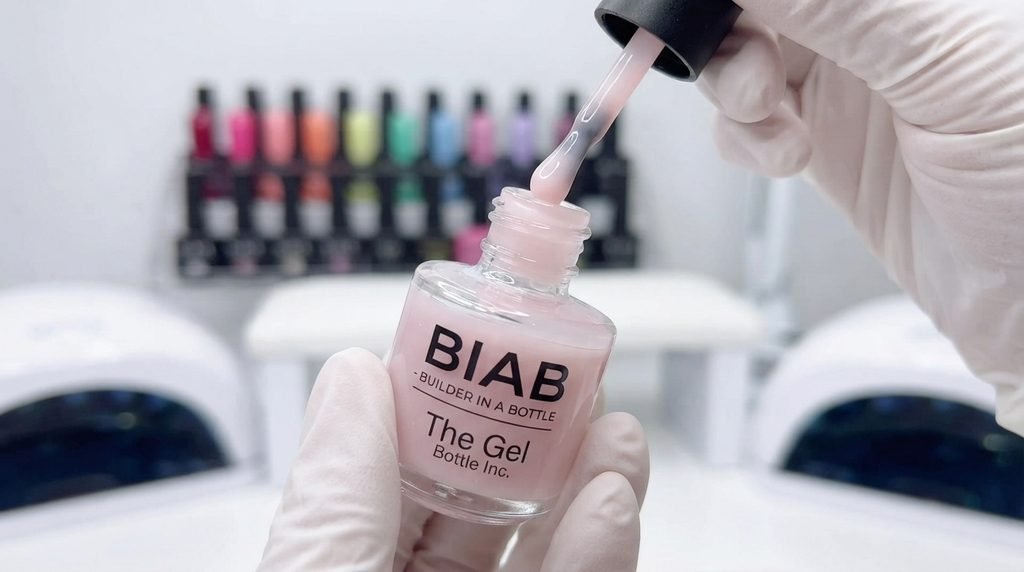
BIAB stands for Builder in a Bottle, a strengthening gel that’s brushed straight onto your natural nail rather than glued on as an extension. Think of it less like fake nails and more like a flexible, glossy armour for the nails you already have.
Unlike acrylics, which sit on top of the nail bed and can feel heavy, BIAB bonds directly to the nail plate. It flexes when your nail flexes and hardens under UV or LED light, giving you a manicure that moves with your hands instead of fighting them. That’s a big part of why so many people with weak, peeling, or brittle nails end up switching to it and never looking back.
The other reason it’s stuck around is durability. A well-applied BIAB set typically lasts three to four weeks without chipping, which puts it ahead of standard gel polish and miles ahead of regular varnish.
Why August Calls for a Different Approach
Every season nudges nail trends in a slightly different direction, and August sits in an odd, lovely spot between peak summer and early autumn. The neon brights of June and July start to feel a little loud, while the deep chocolate browns of October haven’t quite arrived yet.
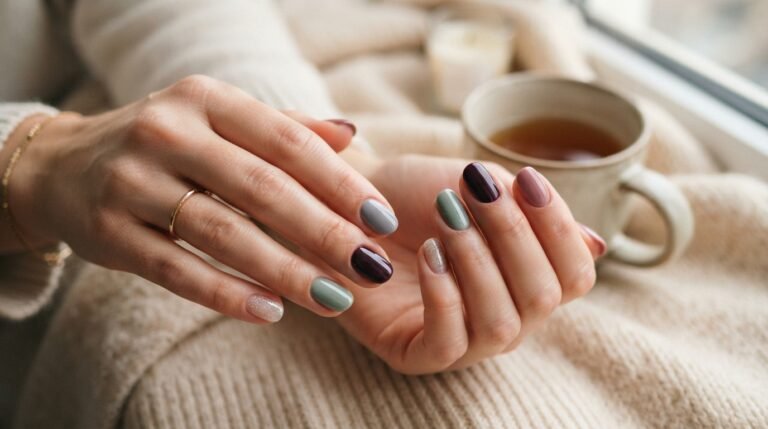
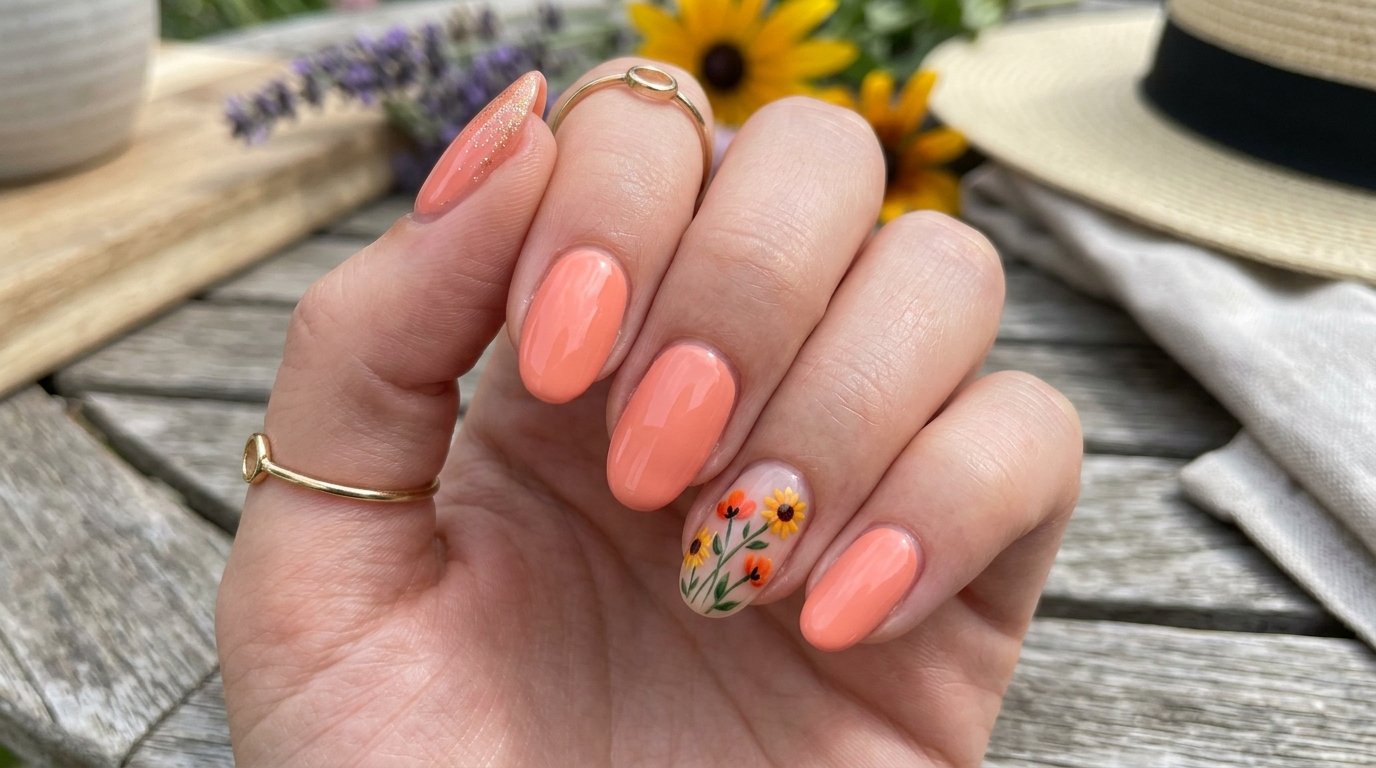
According to recent seasonal colour forecasting, the shades actually being booked this month lean toward peridot green, deep coral-red, milky nude, and a soft denim blue — colours chosen because they carry a set through the rest of the month without looking like leftover summer polish. Peridot ties neatly to August’s birthstone, coral-red keeps warmth without tipping into neon, milky nude works as a reset after a decorated summer, and denim blue quietly previews the shift toward cooler months.
Finish matters just as much as colour this year. Flat, mirror-bright chrome has softened into a pearlescent chrome, which uses fine opalescent pigment instead of high-shine metallic powder — closer to the inside of a seashell than a mirror. Glazed jelly finishes have also taken over from solid, opaque polish, giving nails a glassy, lit-from-within look that photographs beautifully in late-summer sun.
The Top August Nail Shades Worth Booking
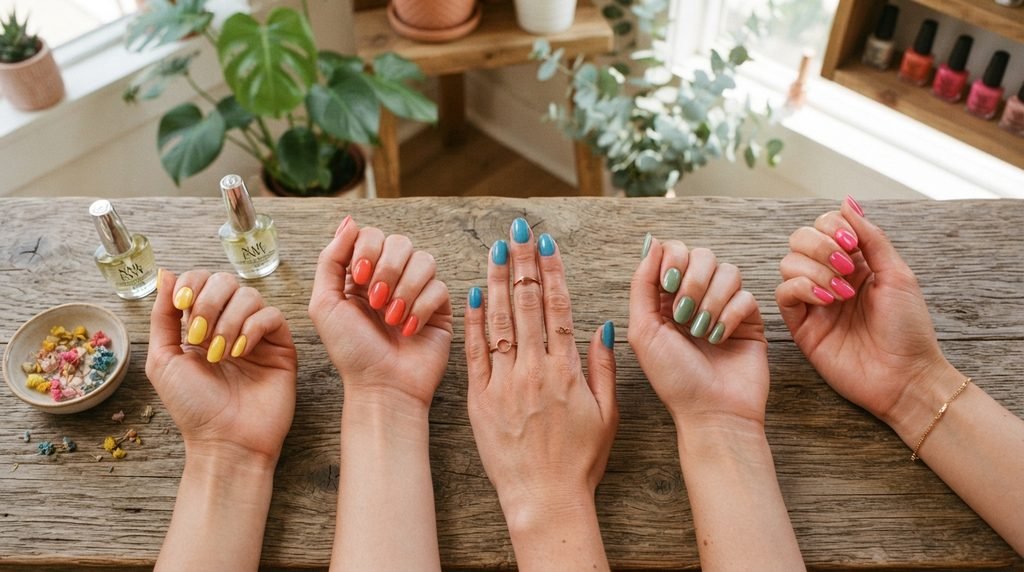
- Sheer coral – works across nail lengths and most skin tones, and it’s currently one of the most requested shades in UK salons.
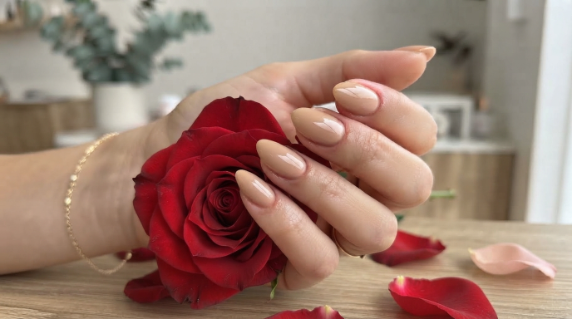
- Milky white or milky nude – two thin coats over a strong base give a soft, veiled look that flatters a tan rather than fighting it.
- Deep coral-red – warm without drifting into neon, ideal for a “one last holiday” mani.
- Peridot or olive green – ties to the month’s birthstone and reads beautifully on deeper skin tones.
- Denim blue – quieter than the rest of the list, but consistently showing up in bookings as autumn approaches.
Step-by-Step: What Happens During a BIAB Appointment
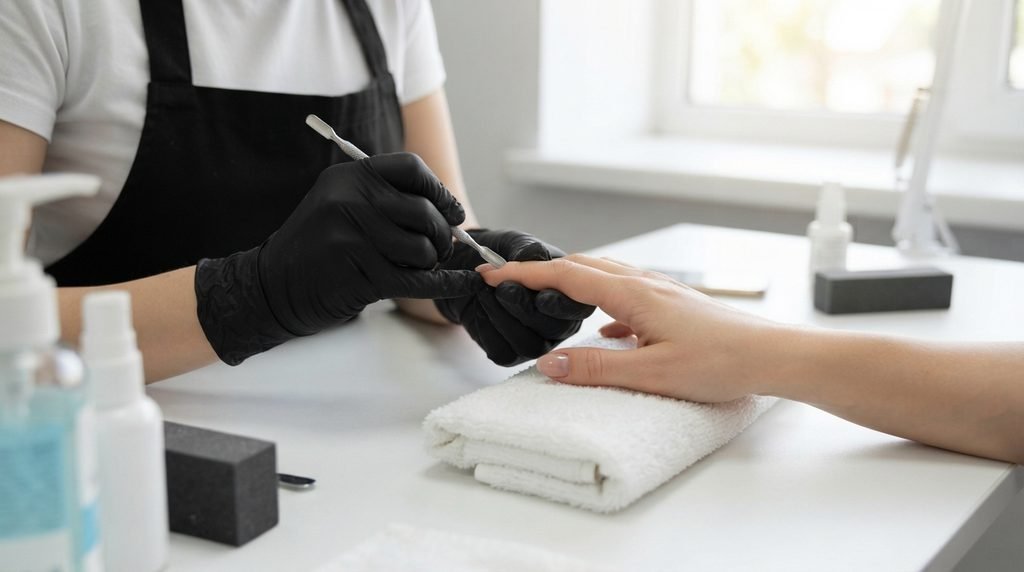
If you’ve never had BIAB nails done before, knowing what to expect makes the whole thing far less intimidating.
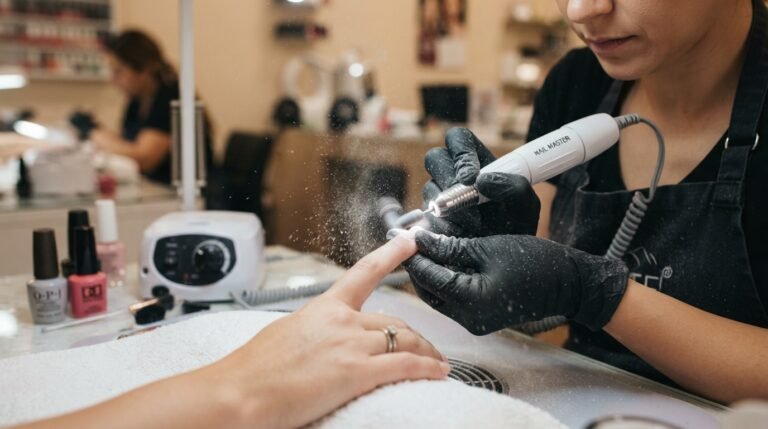
- Prep and shaping. Your nail tech pushes back the cuticles, shapes the free edge, and lightly buffs the nail surface so the gel has something to grip onto.
- Dehydrating and priming. A dehydrator removes any natural oils, and a primer is applied to help the BIAB bond properly. Skipping this step is one of the most common reasons a set lifts early.
- First thin layer. A very thin layer of clear or coloured BIAB gel is brushed on and cured under a UV or LED lamp for around 30 to 60 seconds.
- Building the apex. A second, slightly thicker layer is applied to the centre of the nail to create structure and strength, then cured again.
- Shaping and filing. Once cured, the tech files the nail into its final shape — square, almond, coffin, or whatever you’ve asked for.
- Colour and top coat. If you’re going for a colour rather than a natural finish, this is added now, followed by a glossy or matte top coat and a final cure.
- Cuticle oil finish. A drop of cuticle oil massaged into the skin around the nail locks in moisture and finishes the look.
The whole process usually takes 45 minutes to just over an hour, depending on whether you’re having a full colour set or a natural overlay.
How to Make BIAB Nails Last the Full Month
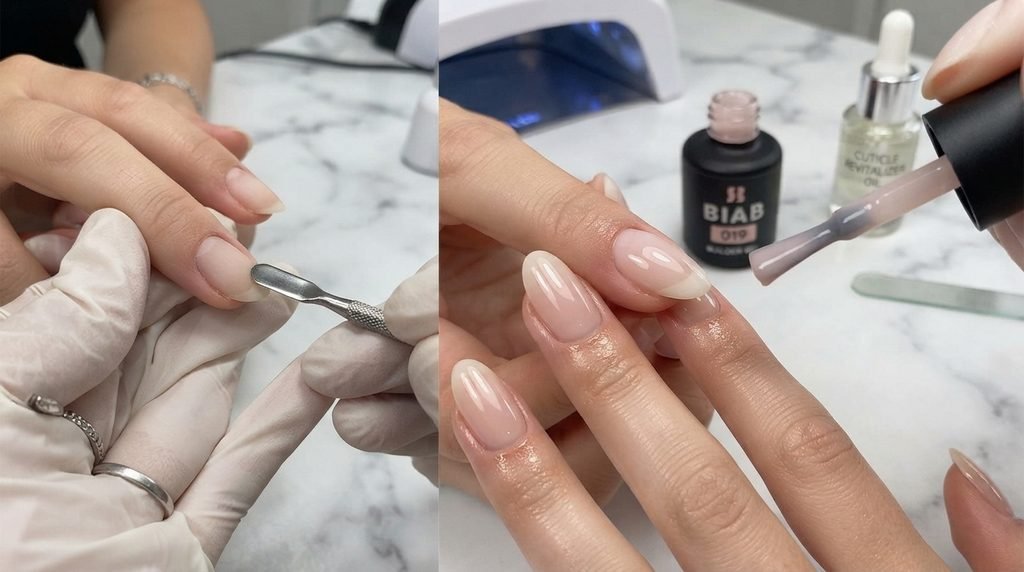
A good BIAB set should comfortably see you through three to four weeks, but how you treat your hands afterwards makes a real difference.
- Wear gloves for cleaning and washing up. Prolonged contact with hot water and detergent softens the gel and speeds up lifting.
- Moisturise your hands daily, but keep the product off the nail itself in the first 48 hours after application.
- Use your nails as tools sparingly. Opening cans, scratching off stickers, and prying things apart puts pressure exactly where BIAB is weakest — the free edge.
- Book a soak-off, not a pick-off. Peeling BIAB off yourself takes layers of your natural nail with it. A proper soak-off removal at the salon protects the nail underneath.
- Top up cuticle oil every couple of days. Dry cuticles are one of the fastest routes to lifting at the sides of the nail.
I once tried to stretch a set an extra two weeks past when I should have gone back for infills, and by the end I had a visible gap of regrowth and two nails that had started lifting at the corners. Lesson learned — infills every three to four weeks keep the set looking fresh and stop small lifting from turning into a bigger problem.
BIAB vs Acrylic vs Shellac: Where It Fits

It helps to see BIAB next to the treatments people usually compare it to.
| Treatment | Best For | Typical Wear Time | Feel on the Nail |
|---|---|---|---|
| BIAB | Strengthening natural nails, subtle length | 3–4 weeks | Flexible, lightweight |
| Acrylic | Significant length and dramatic shapes | 2–3 weeks before infill | Rigid, can feel heavy |
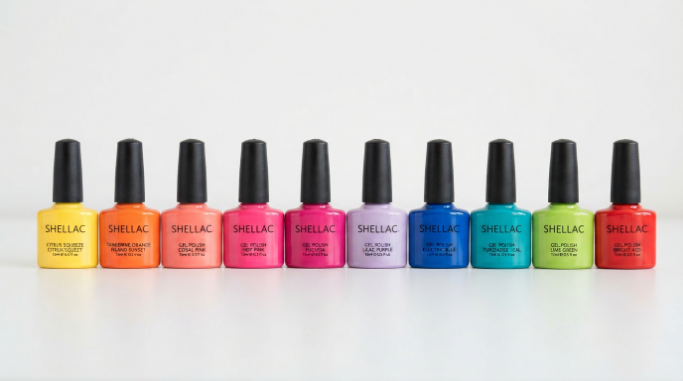
| Shellac | Colour only, no added strength | 10–14 days | Thin, close to natural nail |
If your main goal is stronger nails that still look like your own, BIAB usually wins that comparison. If you want dramatic length that your natural nail simply can’t grow to on its own, acrylic still has its place. Shellac remains the quickest, lowest-commitment option when you just want colour without the strengthening benefits.
Choosing the Right Products for an At-Home BIAB Set
Salon application is still the gold standard, but plenty of people are having good results doing BIAB at home with the right kit. A solid starter set needs four things: a BIAB builder gel, a UV or LED curing lamp, a gentle nail file and buffer, and a good cuticle oil to finish the job.
If you’re buying your first kit, a builder gel kit that includes a lamp is usually the better value, since curing lamps vary a lot in strength and a mismatched one can leave your gel undercured and prone to lifting. For anyone who already owns a lamp and just wants to top up on colour, a clear BIAB builder gel gives you a neutral base you can layer any polish over.
Whichever kit you choose, read the cure times on the bottle carefully — under-curing is the single biggest reason home BIAB sets don’t last as long as salon ones.
Common Mistakes That Ruin a BIAB Set Early
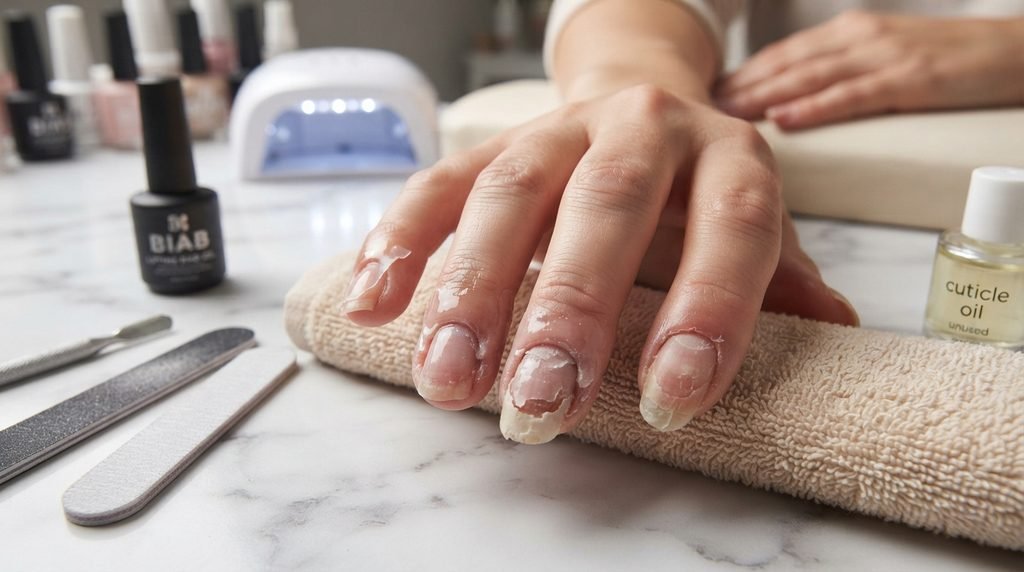
- Applying it too thick. A thick, cloudy layer takes longer to cure properly and is far more likely to lift.
- Skipping the dehydrator and primer. These two steps do most of the work in helping the gel bond to the nail.
- Using an underpowered lamp. Not all UV or LED lamps cure at the same speed — check your gel’s instructions against your lamp’s wattage.
- Filing too aggressively into the natural nail. Over-filing at removal or infill stage thins the nail plate and leaves it weaker over time.
- Ignoring early lifting. A small lift at the edge left untreated becomes a bigger gap that traps moisture and encourages fungal issues underneath.
Final Thoughts
August is a genuinely good month for BIAB nails — warm enough for coral and jelly finishes, but with just enough of an autumn nudge to bring in deeper greens and denim blues. Whether you’re booking a salon appointment or building your own kit at home, the fundamentals stay the same: thin layers, proper curing, and consistent aftercare. Get those right, and a single set will comfortably carry you from the last days of summer straight into September.
Frequently Asked Questions
1. How long do BIAB nails actually last? Most well-applied sets last three to four weeks before an infill is needed, assuming normal daily wear and proper aftercare.
2. Is BIAB better for your nails than acrylic? Generally, yes. Because BIAB bonds directly to the natural nail rather than sitting on top of a tip, it tends to cause less damage over repeated applications and flexes more naturally with the nail.
3. Can I do BIAB nails at home without professional training? Yes, with the right kit and a bit of patience. The main risks for beginners are applying the gel too thickly and under-curing it, so start with thin, even layers.
4. What’s the difference between BIAB and regular builder gel? “BIAB” is largely a brand-driven term (originally popularised by The Gel Bottle) for a specific type of builder gel, though the phrase is now used generically for similar self-levelling formulas from other brands.
5. Why is my BIAB lifting at the edges after only a week? The most common causes are skipping the dehydrator or primer step, applying the gel too close to the cuticle, or prolonged contact with water shortly after application.
6. What August nail colours are trending in the UK right now? Sheer coral, milky white, deep coral-red, peridot green, and denim blue are among the most requested shades this month, alongside pearlescent chrome and glazed jelly finishes.
7. Can BIAB be removed at home safely? It’s possible with acetone soak-off pads, but a proper salon soak-off protects the natural nail far better than filing or peeling it off yourself.
8. Does BIAB damage your natural nails? When applied and removed correctly, BIAB is considered one of the gentler options for the natural nail. Damage usually comes from improper removal (peeling or over-filing), not from the product itself.
9. How much does a BIAB manicure typically cost in the UK? Prices vary by salon and location, but a full BIAB set generally falls somewhere between £25 and £45, with infills usually costing less than a full new set.
10. Can I still get BIAB nails done if my nails are very weak or bitten? Yes — in fact, BIAB is one of the most commonly recommended treatments for weak or bitten nails, since the flexible gel adds strength without the rigidity of acrylic.