Electric Nail File: The Complete Guide to Choosing and Using a Nail File Electric
If you love doing your nails at home, you have probably seen a nail file electric—also called an electric nail file, electric nail drill, or e-file—and wondered whether it is actually worth buying.
At first, an electric nail file can look a little intimidating. There is a small handpiece, different bits, speed controls, and sometimes a whole collection of sanding bands. Compared with an ordinary nail file, it definitely looks more complicated.
But once you understand what each part does, an electric nail file can become one of the most useful tools in a home manicure kit.
It can help with shaping, smoothing, removing product, refining extensions, and preparing certain manicure surfaces. However, it also needs to be used carefully. An electric file removes material much faster than a manual file, so learning the correct technique is important.


Important: An electric nail file is a precision tool, not something that should be used aggressively on natural nails. Dermatologists warn that aggressive manicure techniques can damage nails and surrounding skin. The American Academy of Dermatology also recommends leaving cuticles alone because they help protect against infection. (AAD)
What Is a Nail File Electric?
A nail file electric is a powered manicure tool that uses a rotating bit to file, smooth, shape, or remove nail products.
Instead of moving a traditional nail file backward and forward by hand, the electric device rotates a small abrasive bit at a controlled speed.
You may hear several names for the same general type of tool:
- Electric nail file
- Nail drill
- Electric nail drill
- E-file
- Nail file machine
- Electronic nail file
- Electric manicure file
Although people often call it a “nail drill,” you are not actually drilling into the nail. The rotating attachment is designed to file or buff material.
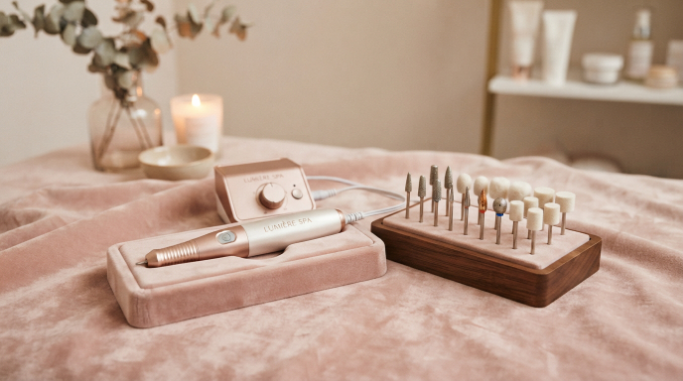
A typical system contains:
- A control unit
- A handpiece
- A speed control
- A forward/reverse control on some models
- Interchangeable nail bits
- Sometimes sanding bands
- A power cable or rechargeable battery
The exact features vary between models, so it is worth checking the manufacturer’s instructions before buying or using one.
Why Use an Electric Nail File?
The biggest advantage of an electric nail file is efficiency.
A manual nail file can work perfectly well for basic shaping, but removing thick artificial nail material by hand can take considerably more effort.
An e-file can be useful for people who regularly work with:
- Gel manicures
- Acrylic nails
- Builder gel
- BIAB-style manicures
- Nail extensions
- Press-on nail refinement
- Nail art
- Professional manicures
However, that doesn’t mean an electric file is necessary for everyone.
If you only occasionally shape short natural nails, a traditional nail file may be all you need.
If, on the other hand, you frequently create elaborate manicures or work with artificial nail products, an electric nail file machine can save time and give you greater control once you learn how to use it properly.
Electric Nail File vs. Manual Nail File
Both tools have a place in a nail-care routine.
| Feature | Electric Nail File | Manual Nail File |
|---|---|---|
| Speed | Faster | Slower |
| Learning curve | Higher | Very easy |
| Best for | Product removal and detailed work | Basic shaping |
| Power required | Yes | No |
| Portability | Depends on model | Excellent |
| Precision | Very good with practice | Good |
| Cost | Usually higher | Usually inexpensive |
| Beginner friendly | Requires practice | Very beginner friendly |
For many people, the best approach isn’t choosing one or the other.
You can use an electric nail file for appropriate tasks and keep a traditional nail file for everyday shaping.
What Can an Electric Nail File Be Used For?
The purpose of an e-file depends on the bit you attach.
A suitable bit may be used for:
Shaping Artificial Nails
An e-file can help shape acrylic, gel, and other artificial nail enhancements.
Smoothing Product
It can help smooth uneven areas of artificial nail material.
Removing Nail Product
Certain bits are designed for removing artificial product, although this requires practice and careful control.
Refining Extensions
When used appropriately, an electric file can help refine the shape of extensions.
Cleaning Around Certain Areas
Some professional techniques use specialized bits to refine areas around the nail. However, this is where beginners should be particularly careful.
The American Academy of Dermatology warns against aggressive electric-file techniques that remove the cuticle because the cuticle is a protective barrier. (AAD)
Can You Use an Electric Nail File on Natural Nails?
Yes, some electric files can be used around or on natural nails, but this is where caution matters most.
Natural nails are much thinner and more delicate than layers of acrylic or gel.
It is very easy for an inexperienced user to remove too much natural nail.
Dermatologists recommend gentle nail care and note that aggressive filing and manicures can contribute to nail damage. The AAD also recommends using a nail file to smooth rough edges and filing in the same direction rather than aggressively filing back and forth. (AAD)
For a beginner, it is generally sensible to learn on artificial product first rather than immediately experimenting aggressively on the natural nail plate.
Understanding Electric Nail File Bits
One of the most confusing things about buying an electric nail file is seeing a box containing ten, fifteen, or even more bits.
Don’t worry—you don’t need to memorize everything immediately.
Bits vary by:
- Shape
- Material
- Grit
- Diameter
- Intended purpose


Mandrel and Sanding Bands
A mandrel is a bit designed to hold a sanding band.
Sanding bands are small abrasive sleeves that fit over the mandrel.
They are commonly available in different grits, allowing you to choose a rougher or finer abrasive depending on the task.
Because sanding bands are disposable, they can be convenient when hygiene is particularly important.
Carbide Bits
Carbide nail drill bits are commonly used by nail professionals for working with artificial nail products.
They come in different shapes and coarseness levels.
A coarse carbide bit can remove product quickly, while a finer bit can be used for more controlled refining.
Because carbide bits can remove material rapidly, beginners should avoid pressing hard.
Ceramic Bits
Ceramic nail drill bits are another popular option.
They are often used for product removal and refinement and can be available in different shapes and grits.
The correct choice depends on what you’re trying to accomplish.
Diamond Bits
Diamond nail drill bits have an abrasive surface and are available in many shapes.
Fine diamond bits can be useful for detailed work, but again, the specific purpose depends on the bit.
When shopping for your first electric nail file, don’t choose a machine simply because it comes with the largest number of bits.
A smaller selection of useful, good-quality bits can be much easier for a beginner to understand.
What Does Nail File Grit Mean?
You’ve probably seen terms such as:
- Fine grit
- Medium grit
- Coarse grit
Grit describes the abrasiveness of the filing surface.
Generally, a coarser grit removes material more quickly, while a finer grit is better suited to smoothing and finishing.
This is why using a coarse bit on delicate natural nails can be risky.
The general rule is simple:
The more aggressive the abrasive, the more carefully you need to control it.
When you’re learning, don’t assume that “more powerful” means “better.”
Control is much more important than speed.
How to Choose the Best Electric Nail File
Buying an electric nail file can feel overwhelming because there are so many options.
Instead of focusing only on RPM numbers or the number of bits included, consider the following.
1. Adjustable Speed
A good electric nail drill should allow you to control the speed.
This is important because different tasks require different levels of control.
A beginner should be able to start slowly rather than immediately using the highest setting.
2. Comfortable Handpiece
You’ll be holding the handpiece for extended periods, especially during detailed work.
Look for something that:
- Feels comfortable
- Isn’t excessively heavy
- Has a secure grip
- Doesn’t vibrate excessively
- Is easy to control
A comfortable handpiece can make a surprisingly big difference.
3. Low Vibration
Excessive vibration can make detailed filing uncomfortable and can make it harder to control the tool.
A smoother handpiece is often worth paying attention to when comparing models.
4. Forward and Reverse Rotation
Some electric nail file machines offer both forward and reverse rotation.
This can be useful for professional-style work because it allows the user to change the rotation direction depending on the working position.
If you’re a complete beginner, however, this feature doesn’t need to be the deciding factor.
5. Rechargeable Battery
A cordless electric nail file can be convenient if you don’t want to sit beside a power outlet.
Rechargeable models are particularly useful for mobile nail technicians and people who move around while doing their nails.
On the other hand, corded machines don’t require you to remember to charge them.
6. Speed Display
A digital speed display can make it easier to see your selected setting.
This is a useful feature when you’re learning because you can gradually become familiar with different speeds.
7. Bit Compatibility
Check what type of bits the machine accepts.
You don’t want to purchase an e-file and later discover that your preferred attachments aren’t compatible.
Step-by-Step: How to Use an Electric Nail File
If you’re new to an electric nail file, don’t rush.
The goal isn’t to finish as quickly as possible.
The goal is to learn how the machine feels and how much material it removes.


Step 1: Prepare Your Workspace
Choose a clean, well-lit area.
Keep your:
- Electric file
- Correct bit
- Nail brush
- Hand cream
- Clean towels
- Appropriate protective equipment
within easy reach.
Good lighting is particularly important because you need to see exactly where the bit is touching.
Step 2: Select the Correct Bit
Don’t simply grab the largest or roughest bit.
Choose the bit according to the job.
If you’re removing artificial product, use an appropriate product-removal bit.
If you’re smoothing a surface, select a suitable finer attachment.
If you’re working near delicate skin, be extremely cautious.
Step 3: Insert the Bit Correctly
Turn the machine off before changing bits.
Insert the bit according to the manufacturer’s instructions and make sure it is securely held.
Never try to change a bit while the machine is running.
Step 4: Start at a Low Speed
This is one of the most important beginner habits.
Turn the machine on at a low setting.
Get used to the vibration and movement.
Once you’re comfortable, you can gradually adjust the speed according to the task and manufacturer’s guidance.
Step 5: Hold the Handpiece Lightly
Don’t grip the handpiece as though you’re trying to stop it from moving.
A relaxed grip gives you better control.
Think about using a pencil.
You’re guiding the tool—not forcing it.
Step 6: Keep the Bit Moving
Don’t hold a rotating bit in one place.
Keeping it moving helps reduce the chance of creating excessive heat or filing one area too deeply.
If the area becomes uncomfortable or hot, stop.
Step 7: Use Light Pressure
Let the abrasive bit do the work.
You don’t need to press heavily.
Heavy pressure can remove material too quickly and may increase heat and discomfort.
Step 8: Check Your Progress Frequently
Stop every so often and look at the nail from different angles.
Ask yourself:
- Is the shape even?
- Am I removing enough material?
- Am I removing too much?
- Is the surface still healthy?
- Is the nail becoming hot?
- Am I getting too close to the skin?
Taking small pauses can prevent big mistakes.
A Personal Tip for Beginners
One of the easiest mistakes to make with an electric nail file is becoming excited when you see how quickly it removes product.
You start slowly.
Then you realize, “Wow, this is much faster than a manual file!”
So you increase the speed.
Then you press harder.
And suddenly you’ve removed far more product than you intended.
That’s why beginners should focus on control before speed.
The machine should make your work easier—not encourage you to rush.
How to Use an Electric Nail File on Gel or Acrylic
Artificial nail products are generally thicker than natural nails, which is one reason e-files are popular in professional nail services.
However, you still need to be careful.
When removing artificial product, avoid filing all the way down into the natural nail simply because you can no longer see the product clearly.
The goal is controlled removal.
If you are inexperienced with gel nail removal or acrylic removal, professional instruction can be worthwhile.
The AAD notes that artificial nails can contribute to nail damage, particularly when nails are repeatedly filed or products are removed aggressively. (AAD)
For gel polish specifically, the AAD warns that picking or filing off gel polish can significantly damage the natural nails and recommends appropriate removal methods instead. (AAD)
Electric Nail File and Cuticles: Be Careful
This deserves its own section.
You may have seen videos showing an e-file manicure where a drill is used around the cuticle area.
It can look incredibly neat.
However, removing or aggressively filing the cuticle is not something beginners should attempt casually.
The American Academy of Dermatology explains that the cuticle acts as a protective barrier. Breaching it can increase the risk of bacterial or fungal infection. (AAD)
Therefore, don’t buy an electric nail file thinking that you need to remove every bit of cuticle to achieve a professional-looking manicure.
Healthy nail care should come first.
Electric Nail File Safety Tips
An electric nail file is more powerful than a traditional file, so safety matters.
Keep the Tool Moving
Don’t leave a rotating bit in one place.
Don’t Apply Excessive Pressure
Let the bit work naturally.
Don’t Use a Damaged Bit
Replace worn, damaged, or unsuitable attachments.
Don’t Share Disposable Items
Disposable sanding bands should not be reused between clients.
Clean Reusable Tools Properly
Follow the manufacturer’s cleaning and disinfection instructions.
The AAD recommends paying attention to tool cleanliness and disinfection when receiving manicure services. (AAD)
Protect Your Workspace From Dust
Electric filing can create nail-product dust.
A suitable dust-collection or ventilation setup can make the working environment more comfortable, especially if you use an e-file regularly.
Never Ignore Pain or Heat
If the nail becomes painful or excessively hot, stop.
Common Electric Nail File Mistakes
Mistake #1: Using the Highest Speed
More RPM doesn’t automatically mean better results.
Mistake #2: Pressing Too Hard
Heavy pressure can make the tool remove material much faster than expected.
Mistake #3: Staying in One Spot
This can create unnecessary heat and uneven filing.
Mistake #4: Using the Wrong Bit
A bit designed for one task isn’t automatically suitable for another.
Mistake #5: Filing Natural Nails Aggressively
Natural nails require much more care than thick artificial product.
Mistake #6: Cutting or Filing the Cuticle
The cuticle helps protect the nail area and shouldn’t be aggressively removed. (AAD)
Mistake #7: Ignoring Nail Problems
An electric file should never be used to hide a nail problem.
If you notice persistent pain, swelling, redness, nail lifting, significant discoloration, or other unusual changes, stop the manicure and consider seeing a dermatologist. The AAD recommends professional evaluation for concerning nail changes. (AAD)
Is an Electric Nail File Worth Buying?
For the right person, an electric nail file can be a very useful investment.
It makes the most sense if you:
- Do your nails regularly
- Wear gel or acrylic enhancements
- Enjoy DIY manicures
- Want faster product removal
- Create nail extensions
- Want more control over shaping
- Are willing to learn proper technique
However, if you only paint your natural nails occasionally, a good manual nail file may be perfectly adequate.
So the real question isn’t:
“Is an electric nail file better?”
It’s:
“Will I actually use the features an electric file provides?”
If the answer is yes, buying a quality model can be worthwhile.
What Should You Look for in a Nail File Electric?
Before purchasing, use this quick checklist.
✔ Adjustable Speed
Important for controlling different tasks.
✔ Comfortable Handpiece
You want something that feels balanced in your hand.
✔ Low Vibration
Helpful for precise work.
✔ Good Bit Selection
Quality matters more than simply having dozens of bits.
✔ Rechargeable Option
Useful if you want cordless convenience.
✔ Clear Instructions
Especially important for beginners.
✔ Replaceable Bits
Make sure you can easily purchase compatible attachments later.
✔ Reliable Construction
A cheap machine that vibrates heavily or feels difficult to control may not be a bargain in the long run.
Electric Nail File for Beginners: What Should You Buy?
If you’re completely new to e-files, don’t feel pressured to buy the most powerful professional machine available.
A beginner-friendly electric nail file should ideally have:
- Adjustable speed
- Comfortable handpiece
- Simple controls
- Secure bit holder
- Several basic bits
- Rechargeable battery or convenient power supply
- Clear instructions
You don’t need twenty different functions.
In fact, too many options can make learning harder.
Start with the basics.
Once you become comfortable, you can add specialized bits and accessories.
How to Maintain Your Electric Nail File
Taking care of the machine can help keep it working properly.
After each use:
- Turn the machine off.
- Remove the bit.
- Clean the bit according to its material and manufacturer’s instructions.
- Remove visible dust from the handpiece.
- Store the bits safely.
- Keep the machine somewhere dry.
- Charge a rechargeable model according to its instructions.
Never submerge an electrical handpiece in water unless the manufacturer specifically states that it is designed for that.
Electric Nail File vs. Professional Salon E-File
A professional salon e-file may offer:
- Higher durability
- More precise speed control
- Better handpieces
- Lower vibration
- More powerful motors
- Greater bit compatibility
A home-use electric nail file, however, can be perfectly suitable for someone who only does their own nails.
The important thing is matching the machine to your actual needs.
If you are a beginner, paying for professional-level power without learning the technique may not give you better results.
Frequently Asked Questions About Electric Nail Files
What is a nail file electric?
A nail file electric is a powered nail-care tool that uses a rotating bit to file, smooth, shape, or remove nail material.
Is an electric nail file the same as a nail drill?
In everyday nail terminology, electric nail drill and electric nail file often refer to the same type of manicure device.
Can beginners use an electric nail file?
Yes, but beginners should start slowly, learn the purpose of each bit, and practice controlled movements rather than immediately using high speeds.
Can I use an electric nail file on natural nails?
Some e-files can be used carefully around natural nails, but aggressive filing can thin or damage them. Natural nails require a much gentler approach than artificial nail product. (AAD)
Can an electric nail file remove gel?
Certain e-file bits can remove artificial nail products, but gel removal should be performed carefully. The AAD specifically cautions that filing or picking gel polish off the natural nail can cause significant damage. (AAD)
What speed should beginners use?
There isn’t one universal speed that is appropriate for every machine, bit, nail type, and task. Start at a low setting and follow the manufacturer’s instructions.
Can I use the same bit for everything?
It’s better to choose bits according to the task. Different shapes, materials, and grits are designed for different purposes.
Is an electric nail file better than a manual file?
Not necessarily. An electric nail file can be faster and more versatile, particularly for artificial nail products, while a manual file is inexpensive and perfectly suitable for basic nail shaping.
Is an electric nail file worth it for home use?
If you regularly do gel, acrylic, extensions, or detailed manicures, it can be a worthwhile investment. If you only occasionally shape natural nails, you may not need one.
Final Thoughts
An electric nail file can completely change the way you approach DIY manicures.
Instead of spending ages manually filing thick product, you can use an appropriate e-file and bit to make certain jobs faster and more controlled.
But remember: power isn’t the goal—precision is.
A quality nail file electric should give you control over speed, feel comfortable in your hand, and work with reliable bits. More importantly, you should learn how to use it before attempting complicated techniques.
If you’re shopping for one, look beyond impressive RPM numbers and huge bit collections. Pay attention to adjustable speed, vibration, handpiece comfort, bit quality, battery life, compatibility, and ease of use.
And if you’re a beginner, start slowly.
Your natural nails don’t need to be aggressively filed to look beautiful. Dermatologists recommend gentle nail care and caution against aggressive cuticle removal and damaging manicure techniques. (AAD)
Once you understand the machine and develop a steady hand, an electric nail file can become a practical addition to your nail-care collection—especially if you regularly work with gel, acrylic, BIAB, or nail extensions.
The best purchase isn’t necessarily the most powerful model. It’s the one that gives you control, comfort, reliability, and the right tools for the manicures you actually want to create.