What’s BIAB Nails? A Complete Beginner’s Guide to Builder in a Bottle
What’s BIAB Nails? If you love having neat, polished nails but your natural nails break, peel, or never seem to grow past a certain length, you may have heard the term BIAB nails.
BIAB has become a popular option for people who want stronger-looking natural nails without always relying on traditional extensions. But what exactly are BIAB nails? How do they work? Are they the same as gel polish? How long do they last? And are they worth trying?
In this guide, we’ll explain what BIAB nails are, how Builder in a Bottle works, how BIAB is applied, how to care for it, and what you should know before buying a BIAB product or booking a BIAB manicure.
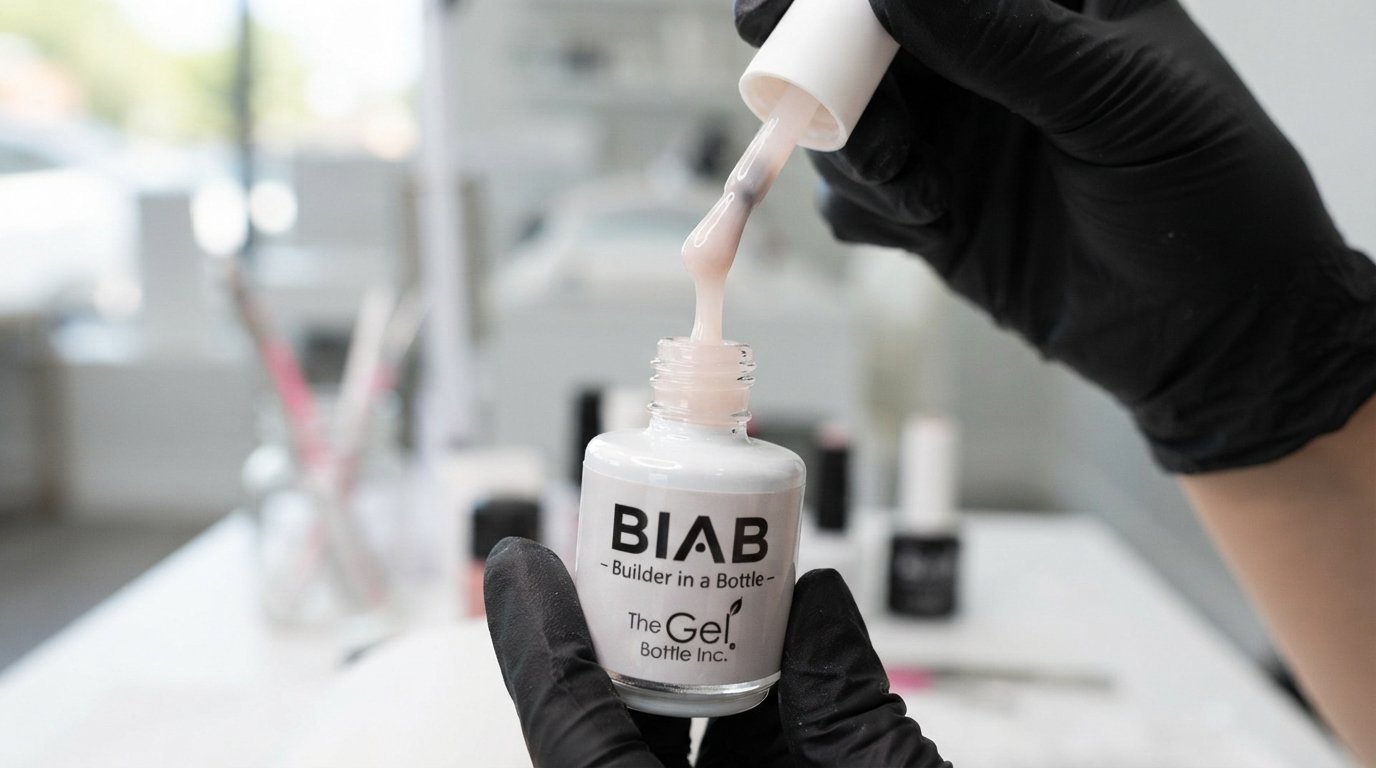
Quick answer: BIAB stands for Builder in a Bottle. It is a type of builder gel designed to add structure and strength to the natural nail. Depending on the formula, it can also be used for natural nail overlays and some types of extensions. The original BIAB system was developed by The GelBottle.
What Does BIAB Stand For?
BIAB stands for Builder in a Bottle.
Unlike ordinary gel nail polish, which mainly adds colour and shine, builder gel is designed to create more structure on the nail.
The idea behind BIAB is fairly simple: instead of applying a thin layer of colour alone, a builder product is used to create a stronger overlay over the natural nail.
According to The GelBottle, BIAB is a range of soak-off gel builders that can be used on natural nails to enhance their strength and support natural nail growth.
That makes BIAB particularly interesting if your nails are naturally thin, weak, brittle, or prone to breaking.
What’s BIAB Nails?
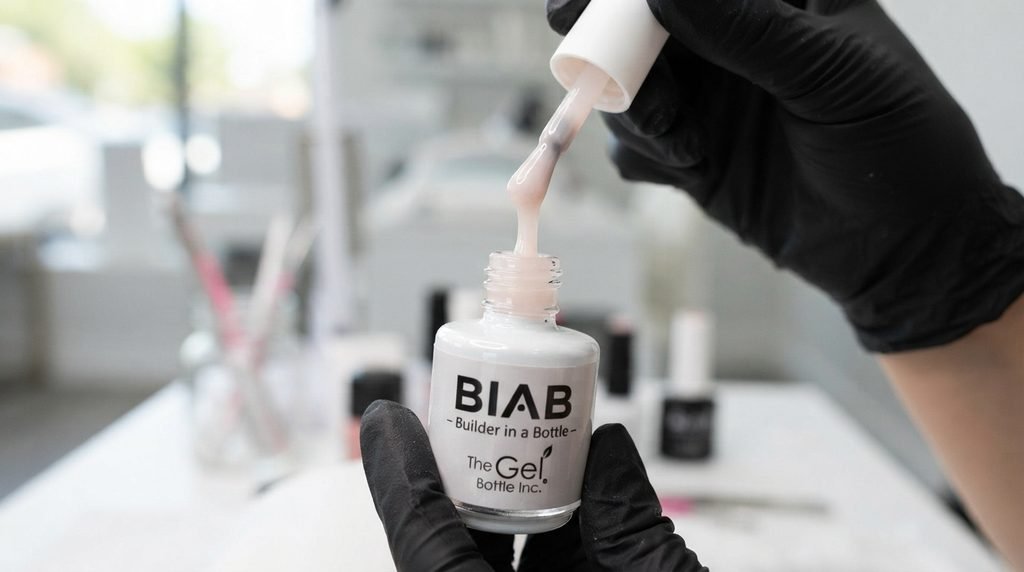
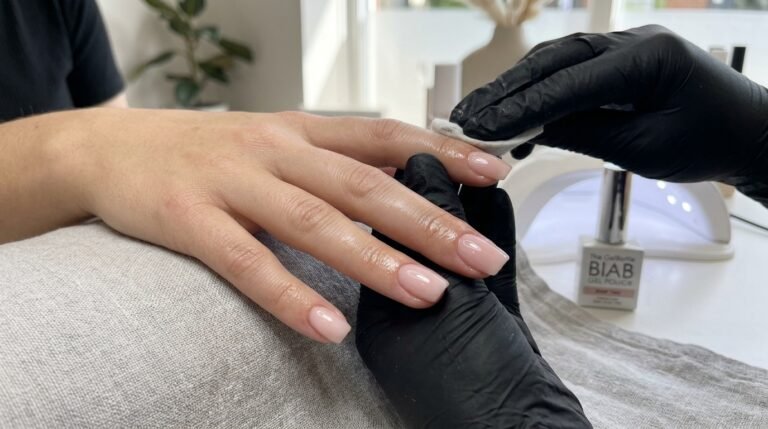
BIAB nails are natural nails that have been coated with a Builder in a Bottle gel to add structure, strength, and a smooth finish.
The product is generally thicker and more structured than ordinary gel polish. When applied correctly, it can create an apex, which is the slightly raised area that helps support the nail’s structure.
Think of it this way:
- Regular nail polish: mainly colour
- Gel polish: colour + longer-lasting finish
- BIAB: structure + strength + colour/finish, depending on the product
- Extensions: add artificial length to the natural nail
BIAB can therefore sit somewhere between a regular gel manicure and a traditional nail enhancement.
However, the exact features depend on the specific BIAB formula. Some products are designed mainly for natural nail overlays, while others can be used for extensions or repairs.
Why Are BIAB Nails So Popular?
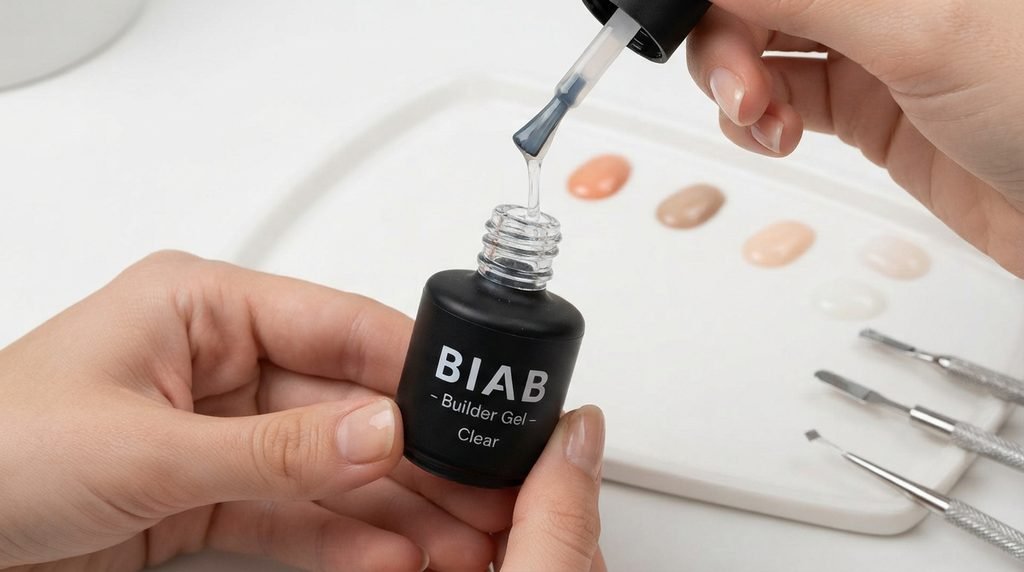
One reason BIAB manicures have become popular is that they can give natural nails a clean, strong, polished appearance without requiring long artificial extensions.
Imagine someone who constantly breaks a nail while doing everyday things. They may want longer nails, but traditional extensions may not be what they want.
A BIAB overlay can give the natural nail additional structure while allowing it to grow underneath.
For example, you might start with short natural nails. After several properly maintained appointments, your nails may appear longer simply because you have been able to keep them from breaking as easily.
That is one reason BIAB is often associated with the idea of a natural nail growth journey.
The GelBottle describes BIAB as a flexible builder system intended to help strengthen natural nails and reduce breakage.
BIAB Nails vs Gel Polish
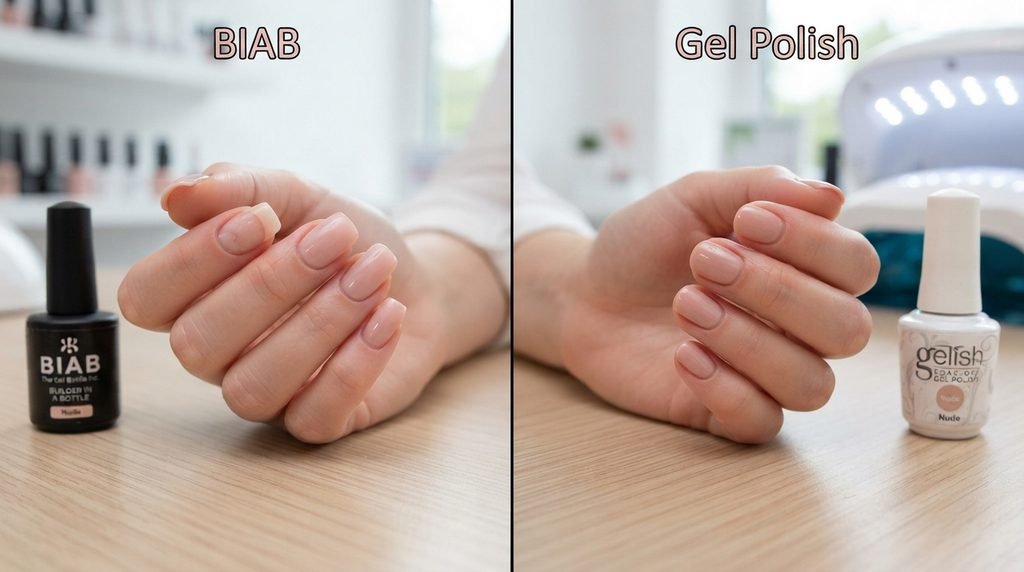
This is one of the most common questions beginners have.
Although both products are cured under a UV or LED nail lamp, they are not exactly the same.
Gel Polish
Gel polish is mainly used to provide:
- Colour
- Shine
- A smooth finish
- Longer wear than traditional nail polish
It is generally applied in relatively thin layers.
BIAB
BIAB is a builder gel, so it is designed to provide more structure.
It can be used to:
- Strengthen natural nails
- Create a natural nail overlay
- Build an apex
- Create certain short extensions
- Provide a base for gel colour, depending on the formula
The GelBottle specifically describes BIAB as a medium-viscosity builder gel that can be used for natural nail overlays and, with suitable formulas, extensions.
So, while both are gel systems, their main jobs are different.
BIAB vs Acrylic Nails
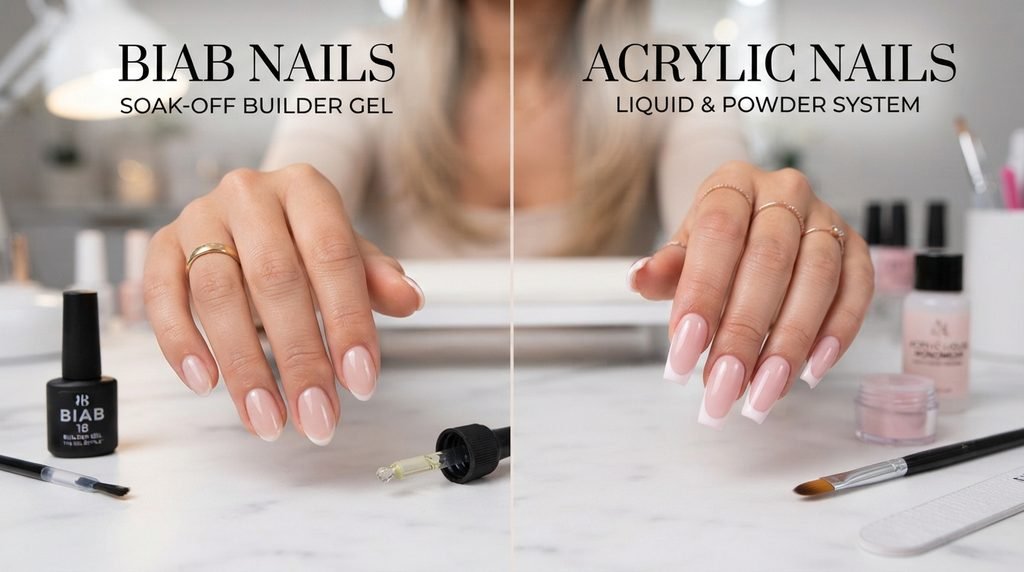
Another common comparison is BIAB vs acrylic nails.
Acrylic systems use a liquid and powder system that creates a hard enhancement over the nail. BIAB, on the other hand, is a gel-based system.
In simple terms:
| Feature | BIAB | Acrylic |
|---|---|---|
| Main purpose | Strength and structure | Strength, structure and extensions |
| Product type | Builder gel | Liquid + powder |
| Natural nail overlays | Yes | Yes |
| Extensions | Some BIAB formulas | Yes |
| Appearance | Often natural-looking | Can be natural or dramatic |
| Removal | Depends on formula | Usually filed down |
| Flexibility | Many BIAB formulas are relatively flexible | Generally more rigid |
The important point is that not all BIAB products behave exactly the same way.
Some are soak-off systems, while others are file-off systems. Therefore, always follow the manufacturer’s instructions for the exact product you are using.
What Are the Benefits of BIAB Nails?
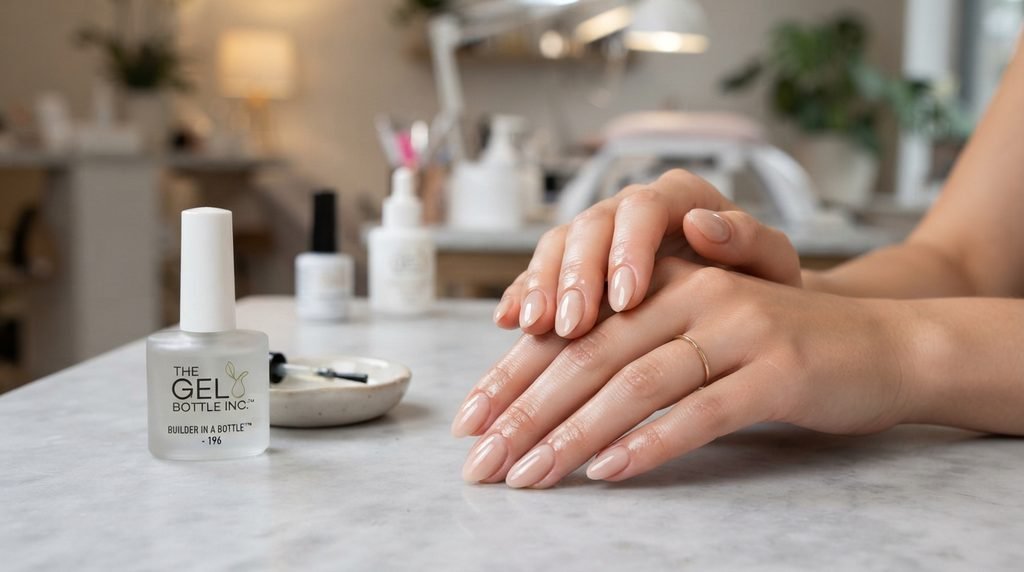
There are several reasons people choose BIAB nail treatments.
1. They Can Add Strength
If your natural nails are weak or break easily, a correctly applied builder gel overlay can provide additional support.
This doesn’t magically repair damaged nails, but it can create a protective layer over the natural nail.
2. They Can Help You Keep Your Natural Length
Many people struggle to grow their nails because the free edge keeps breaking.
A structured overlay may help reduce everyday breakage, allowing the natural nail underneath to grow.
The goal isn’t necessarily to make your nails extremely long. Instead, it is often about keeping the length you naturally grow.
3. They Can Look Natural
One of the biggest attractions of natural BIAB nails is their appearance.
Soft nude, pink, milky, and neutral BIAB shades can give you a clean manicure without looking overly artificial.
4. They Can Be Used With Nail Colour
Depending on the formula, BIAB can be worn on its own or followed by gel colour.
Some BIAB products are already available in shades that can be used as the finished colour. Others are clear and designed to sit underneath another gel colour.
5. They Offer Different Formulas
Modern BIAB systems are not limited to one formula.
For example, The GelBottle’s current BIAB information includes different formulations such as Original, File-Off, HEMA-Free, All-In-One, and Six-In-One options.
That means you can choose a system based on the desired application and nail needs rather than treating every builder gel as identical.
How Are BIAB Nails Applied?
If you’ve never had a BIAB manicure before, the process can look complicated.
In reality, the basic idea is straightforward, although professional application requires proper training and product-specific knowledge.
Here’s a simplified overview.
Step 1: Prepare the Natural Nails
The nail technician first prepares the natural nail.
This can include:
- Cleaning the nail
- Removing existing product
- Gently preparing the cuticle area
- Shaping the free edge
- Removing surface debris
- Preparing the nail according to the product manufacturer’s instructions
Proper preparation is important because product adhesion depends heavily on correct preparation.
Step 2: Apply the Appropriate Base
This step depends on the specific BIAB formula.
Some BIAB products already contain a built-in base system and can be applied directly to the prepared natural nail.
Other formulas require a separate base product first.
For example, The GelBottle states that some of its Original Cover Nude BIAB products contain primer and base within the formula, while certain Clear, White, and Milky formulas require Rubber Base underneath.
This is why copying an application routine from one BIAB brand to another isn’t always a good idea.
Step 3: Apply the BIAB
The builder gel is carefully applied to the nail.
The technician controls the amount of product and distributes it across the nail to create the desired structure.
One important area is the apex.
The apex provides structure around the nail’s stress area, helping create a balanced overlay.
The GelBottle describes the BIAB bead as a controlled amount of builder gel used to build structure and strength, particularly around the apex.
Step 4: Cure the Product
The nail is placed under the correct UV/LED nail lamp for the manufacturer’s recommended curing time.
This step matters.
Builder gel should not simply be applied and assumed to be cured because the surface looks hard.
NailKnowledge explains that thicker applications can increase the risk of under-curing and heat spikes, which is why the correct application method and product instructions matter.
Step 5: Refine the Shape
Depending on the system and technique, the nail may be refined after curing.
The technician checks:
- Sidewalls
- Free edge
- Apex
- Surface smoothness
- Overall thickness
The goal is to create a strong but balanced nail rather than simply making the nail as thick as possible.
Step 6: Add Colour or Top Coat
Finally, you can leave the BIAB in its natural shade or add gel polish.
A top coat is then used when appropriate to create the final shine and finish.
Can You Do BIAB Nails at Home?
Yes, BIAB products are available for home users, but that does not mean the process is risk-free or that every beginner should immediately start applying builder gel without training.
The most important thing is learning the correct application and curing process.
If you’re considering a BIAB nail kit, look for a kit that clearly explains:
- Which lamp should be used
- How the product should be applied
- How long it needs to cure
- Whether a base coat is required
- Whether the product is soak-off or file-off
- How it should be removed
- Whether professional training is recommended
A good product is only part of the equation. Correct preparation, application, curing, and removal are equally important.
If you’re completely new to builder gel, learning from a qualified nail professional is a sensible way to understand the technique before experimenting at home.
How Long Do BIAB Nails Last?
The exact wear time depends on the product, application quality, nail growth, lifestyle, and aftercare.
Some BIAB systems are marketed as lasting for several weeks when properly applied and maintained. For example, The GelBottle’s consumer information states that its BIAB can last up to four weeks.
However, that doesn’t mean you should simply leave the same set untouched for four weeks.
As your natural nails grow, the product moves away from the cuticle area. The balance and structure of the nail can also change.
Regular maintenance is therefore important.
How Do You Maintain BIAB Nails?
Good aftercare can make a noticeable difference.
Keep Your Nails Clean
Clean your nails regularly and avoid allowing moisture or debris to remain trapped around the product.
Use Cuticle Oil
A good cuticle oil can help keep the skin around your nails moisturised.
Apply it regularly, especially if your hands are frequently exposed to water or cleaning products.
Don’t Use Your Nails as Tools
This is a simple rule that many people ignore.
Don’t use your nails to:
- Open cans
- Scrape labels
- Lift heavy objects
- Pick at hard surfaces
- Pry things open
Even strong builder gel cannot make a nail completely unbreakable.
Wear Gloves for Household Cleaning
Frequent exposure to water and cleaning chemicals can be hard on your hands and manicure.
Wearing gloves while cleaning can help protect both your skin and your manicure.
How Is BIAB Removed?
This depends on the exact BIAB formula.
Some builder gels are soak-off, while others are file-off products.
For example, The GelBottle identifies different BIAB formulations with different removal methods. Its current product information lists soak-off options, while its application guide identifies certain File-Off BIAB formulas separately.
This is extremely important:
Never assume that every product labelled BIAB can be removed in the same way.
If your product is designed to soak off, follow its recommended removal process.
If it is file-off, it should be professionally filed down according to the manufacturer’s instructions.
Never Peel BIAB Off
This is one of the biggest mistakes you can make.
If the product starts lifting, don’t pull it off with your fingers.
Peeling or picking can take layers of the natural nail with it.
Instead, have the product properly removed or follow the exact removal instructions for your specific system.
Are BIAB Nails Good for Weak Nails?
This depends on why the nails are weak and what condition they are in.
BIAB can provide a strengthening overlay, and builder gel systems are often chosen by people who want to reduce everyday breakage.
However, BIAB is not a treatment for every nail problem.
If your nails are painful, severely damaged, infected, discoloured, or changing unexpectedly, it is better to address the underlying issue rather than simply covering it with product.
For ordinary nails that are simply thin or prone to everyday breakage, a properly applied builder-gel overlay may be a useful cosmetic option.
BIAB Nails: Common Mistakes to Avoid
Even though BIAB looks simple on social media, there are several mistakes beginners should avoid.
Applying Too Much Product
More product does not automatically mean stronger nails.
NailKnowledge notes that excessive thickness can increase the risk of under-curing and heat spikes and that the structure should be appropriate for the natural nail.
Getting Gel on the Skin
Builder gel should be kept off the surrounding skin.
Repeated skin exposure to uncured gel products can be a concern, so careful application and proper curing are important.
Using the Wrong Lamp
Don’t assume that any UV/LED lamp will work perfectly with any gel.
Use the lamp and curing instructions recommended by the product manufacturer.
Picking or Peeling
If your BIAB starts lifting, don’t pick it.
Have it repaired or removed correctly.
Ignoring the Product Instructions
This is perhaps the easiest mistake to avoid.
Different BIAB products have different formulas.
One may require a base coat while another may not. One may soak off while another may need filing.
Always check the instructions for the exact product you’re using.
What Should You Look for When Buying BIAB?
If you’re planning to buy a BIAB gel, don’t choose a product simply because the bottle looks attractive or because it is popular on social media.
Instead, check the following.
1. Clear Product Information
The manufacturer should explain exactly what the product is designed for.
2. Application Instructions
You should be able to find clear information about preparation, application, and curing.
3. Removal Instructions
Check whether the product is soak-off or file-off.
4. Compatible Lamp
Make sure the recommended curing lamp is clearly stated.
5. Formula Information
Look for information about ingredients and the specific formulation.
For example, some modern BIAB systems are available in HEMA-free or TPO-free formulations. The GelBottle has also documented changes to some of its BIAB formulations and advises customers to check the individual product page for the exact formula.
6. A Trusted Manufacturer
Buying from an established manufacturer or authorised retailer gives you access to clearer product information, application guidance, and support.
That can make a big difference when you’re learning.
Is BIAB Worth Trying?
For someone who wants a natural-looking manicure with extra structure, BIAB can be an appealing option.
It combines the clean appearance of a polished manicure with the structural benefits of a builder-gel overlay.
It can be particularly attractive if you:
- Want to grow your natural nails
- Experience frequent breakage
- Prefer shorter natural-looking nails
- Like nude or milky nail colours
- Want an alternative to traditional extensions
- Prefer a structured manicure
However, the result depends heavily on the product and application technique.
A good BIAB manicure isn’t simply about putting thick gel on the nail. The nail needs to be prepared correctly, the product needs to be applied in an appropriate structure, and it needs to be cured correctly.
BIAB Nails Step-by-Step: A Beginner’s Checklist
If you’re thinking about trying BIAB for the first time, use this simple checklist.
Before Application
- Check the condition of your natural nails.
- Choose a reputable BIAB product.
- Read the manufacturer’s instructions.
- Check whether a base coat is required.
- Check the recommended lamp.
- Confirm the curing time.
- Check the removal method.
During Application
- Prepare the natural nail correctly.
- Avoid applying product to the surrounding skin.
- Apply the correct amount of product.
- Build an appropriate structure.
- Pay attention to the apex.
- Cure according to the manufacturer’s instructions.
- Check the finished shape.
After Application
- Keep your nails clean.
- Use cuticle oil regularly.
- Wear gloves during household cleaning.
- Don’t use your nails as tools.
- Don’t pick or peel lifting product.
- Arrange maintenance when needed.
- Remove the product using the correct method.
Frequently Asked Questions About BIAB Nails
What are BIAB nails in simple terms?
BIAB nails are natural nails coated with Builder in a Bottle, a type of builder gel designed to add structure and strength. Depending on the formula, BIAB can also be used for certain extensions and repairs.
Is BIAB the same as gel polish?
No. Gel polish is mainly designed for colour and shine, while BIAB is a builder gel designed to provide additional structure and strength.
Can BIAB help natural nails grow?
BIAB does not directly make the nail grow faster. However, by providing a protective overlay and reducing everyday breakage, it may help some people retain more of their natural length.
Can you put gel polish over BIAB?
Yes, depending on the BIAB system. Many builder-gel systems can be used underneath gel colour. Some BIAB shades can also be worn alone.
Can BIAB create extensions?
Some BIAB formulas can be used for short extensions or other extension systems, but not every BIAB product is designed for this purpose. Always check the manufacturer’s instructions.
Can BIAB nails be soaked off?
Some can, but not all.
The removal method depends on the specific formula. Always check whether your product is soak-off or file-off before attempting removal.
How often should BIAB be maintained?
Maintenance depends on nail growth, product condition, and the manufacturer’s recommendations. Don’t wait until the product has significant lifting or the nail structure becomes unbalanced.
Is BIAB suitable for beginners?
The concept is beginner-friendly, but professional-quality application requires practice and an understanding of nail preparation, product control, curing, structure, and safe removal.
Final Thoughts: What’s BIAB Nails Really About?
So, what’s BIAB nails?
In simple terms, BIAB nails are natural nails enhanced with Builder in a Bottle, a builder-gel system designed to add structure and strength while maintaining a relatively natural appearance.
The biggest attraction is that you don’t necessarily need dramatic extensions to get a stronger, polished manicure. With the right product and proper application, BIAB can become part of a natural nail maintenance routine.
However, don’t choose a BIAB product based only on a social-media trend. Look at the formula, application instructions, curing requirements, removal method, and manufacturer support.
If you’re buying your first BIAB nail kit, investing in a reputable product with clear instructions can give you much more confidence than choosing the cheapest bottle available.
And if you’re having BIAB applied professionally, ask your nail technician which formula they use, how it should be maintained, and how it will be removed.
Ultimately, the best BIAB manicure is not simply the thickest or longest one. It is a properly prepared, correctly structured, appropriately cured, and well-maintained manicure that suits your natural nails and your lifestyle.
With the right approach, BIAB can be a simple way to enjoy stronger-looking, neat, natural-looking nails without immediately committing to long artificial extensions.