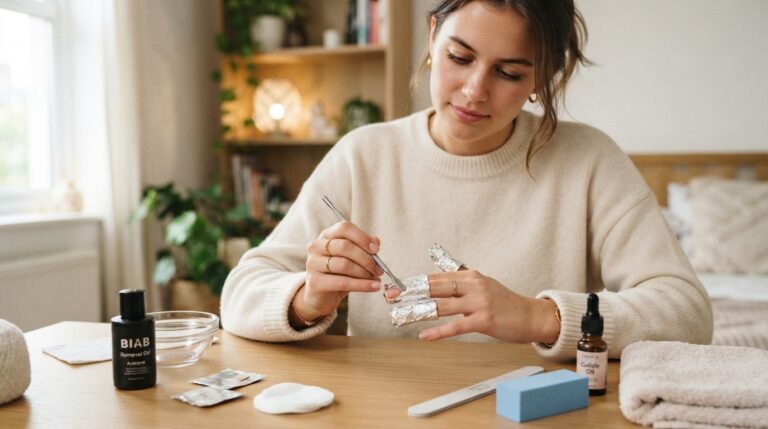
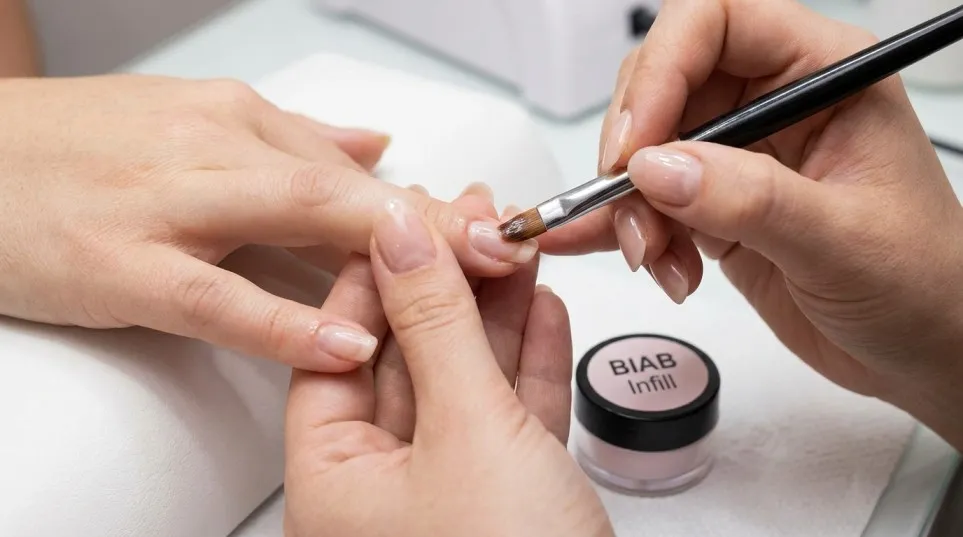
BIAB Infill: How Often, UK Cost & What Happens
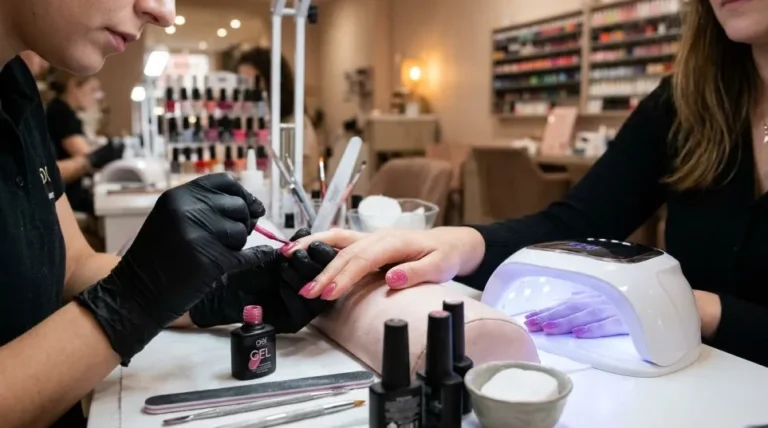
What is a BIAB infill? A BIAB infill fills the regrowth gap at the base of your nails, usually every 3-4 weeks. Instead of removing everything, your nail tech files the old BIAB down, keeps a thin base layer and applies fresh gel on top, so your natural nails stay protected and keep growing.
If you love the natural, glossy look of BIAB nails, you probably want to keep them looking fresh for as long as possible. However, as your natural nails grow, a gap begins to appear near the cuticles. Your manicure may also lose some of its original shape and balance. This is where a BIAB infill can help.
A BIAB infill refreshes your existing manicure by removing excess product, preparing the new nail growth and applying fresh builder gel where needed. Instead of removing the entire set every time, a nail technician can often keep a thin, well-bonded layer of the existing BIAB and rebuild the nail structure.
Whether you are new to builder gel or have been getting BIAB manicures for months, understanding the infill process can help you maintain beautiful nails and make better decisions about nail care.
In this guide, you will learn what a BIAB infill is, when to book one, how the process works, how much it may cost, and how to care for your nails between appointments.
What Is a BIAB Infill?
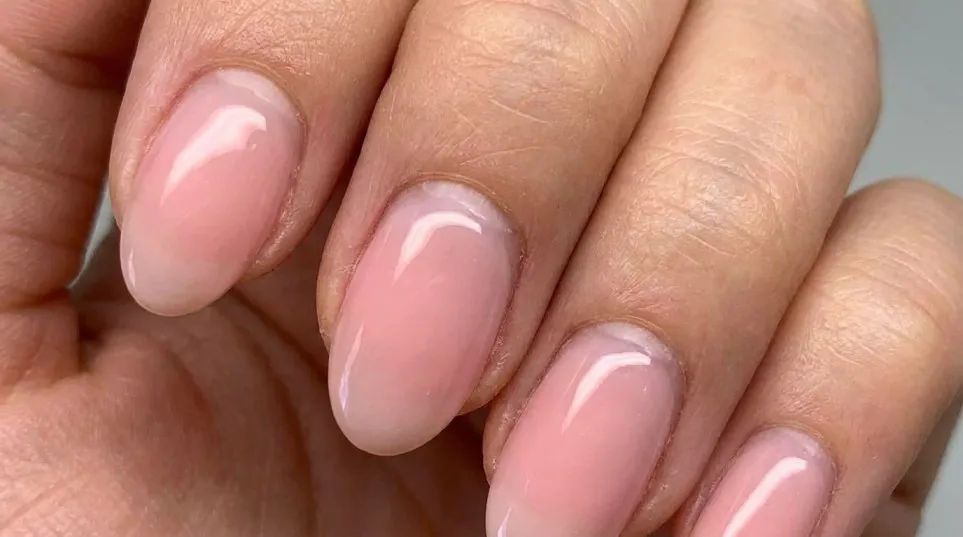
A BIAB infill is a nail maintenance treatment in which fresh builder gel is applied to the regrowth area of an existing BIAB manicure. The nail technician files down the old product, removes any lifting, prepares the natural nail that has grown out and restores the structure of the manicure.
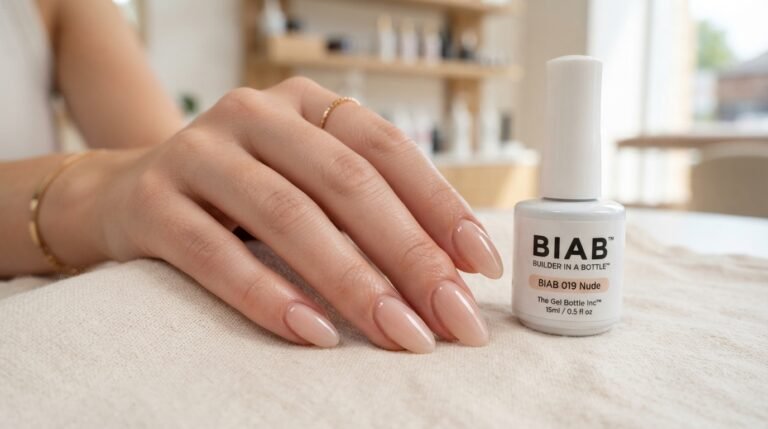
BIAB stands for Builder in a Bottle. It is a type of builder gel designed to add strength and structure to natural nails. You can learn more about the treatment in this complete guide to BIAB nails.
As your nails grow, the original BIAB moves further away from the cuticle. The nail can begin to look uneven, and the strongest part of its structure may no longer sit in the ideal position.
A professional BIAB refill helps correct this by reshaping the existing product and adding fresh builder gel where required.
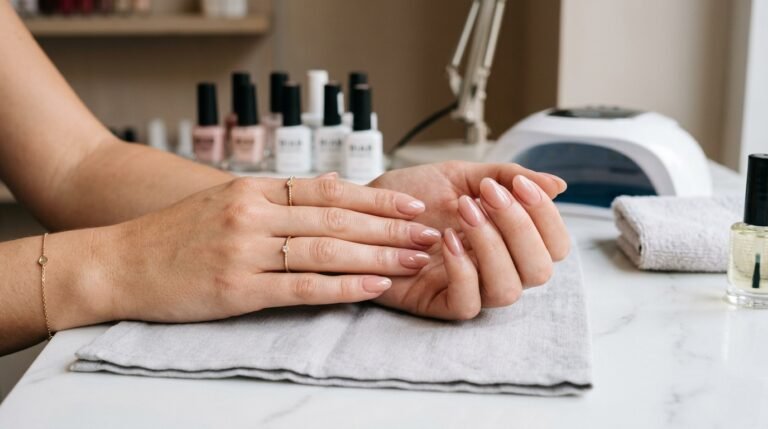
For example, imagine that you had a beautiful nude BIAB manicure three weeks ago. Your nails are still strong, but you can now see a clear gap near the cuticles. Rather than starting from scratch, your nail technician may be able to refresh the existing set with an infill.
However, an infill is suitable only when the existing product and natural nails are in good condition.
BIAB Infill vs Full BIAB Removal
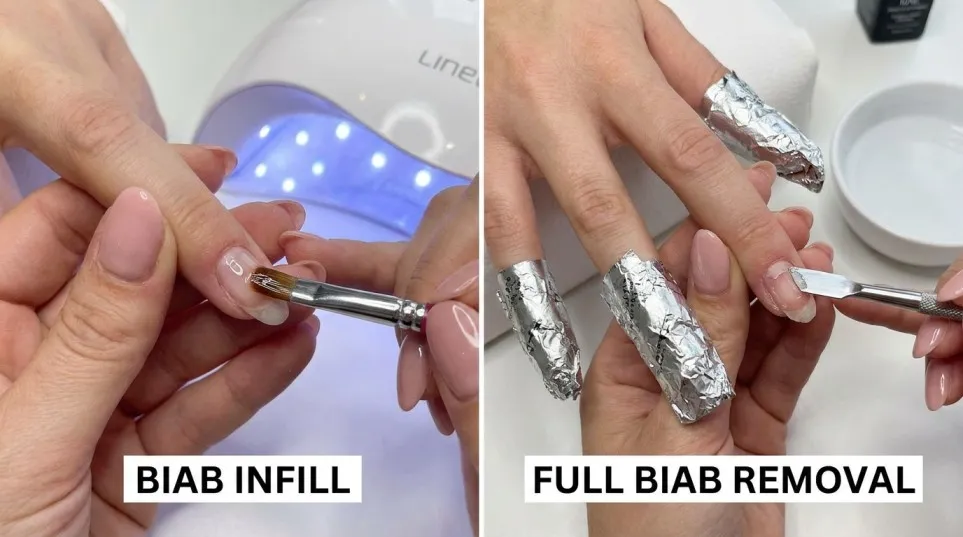
One of the most common questions is whether BIAB needs to be removed completely before every new application.
The answer is no. Depending on the product system and the condition of your nails, you may be able to have an infill instead.
Here is how the two treatments compare.
| Feature | BIAB Infill | Full BIAB Removal |
|---|---|---|
| Main purpose | Maintain an existing BIAB manicure | Remove the existing product |
| Existing BIAB | A sound, bonded layer may remain | Removed according to the product instructions |
| Nail preparation | New growth and existing product are prepared | Natural nail is exposed and assessed |
| Time required | Often shorter | May take longer |
| Best for | Healthy, stable existing sets | Significant lifting, damage or a complete change |
| Cost | Often less expensive | May cost more when removal and a new set are needed |
An infill can reduce the need for repeated complete removal. Nevertheless, it is not automatically the right choice for every appointment.
If your BIAB has extensive lifting, cracks, trapped debris, or a damaged natural nail, your technician may recommend removing the product and assessing the nail before applying anything new.
For further information, read this professional BIAB removal guide.
When Should You Get a BIAB Infill?
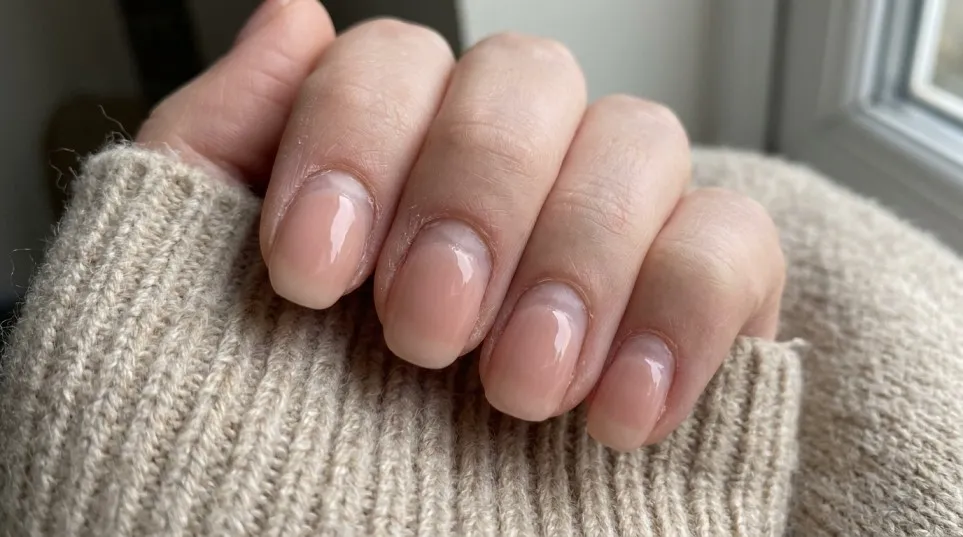
Most people book a BIAB nail infill approximately every two to three weeks, although some may need an appointment sooner or later. The ideal timing depends on how quickly your nails grow, the length of your nails, your daily activities and the condition of the existing product.
Waiting too long can allow the nail structure to become unbalanced as the natural nail grows.
Here are some signs that you may need a refill.
1. You Can See New Nail Growth
The clearest sign is a visible gap between your cuticle area and the BIAB product.
This is normal nail growth. However, as the gap becomes larger, the manicure may look less tidy and the product’s original balance changes.
2. Your Nails Look Longer Than Expected
BIAB supports your natural nails, but your nails continue to grow underneath it.
If you prefer short, neat nails, an infill appointment gives your technician an opportunity to reduce the length and restore your preferred shape.
3. Your Nail Shape Has Changed
A well-structured BIAB overlay has a balanced profile. As your natural nail grows, the position of the thicker supporting area can shift towards the tip.
A professional infill can restore the appropriate shape and balance for your nail length.
4. Your Manicure Has Lost Its Fresh Appearance
Perhaps you love your BIAB colour, but the regrowth makes the manicure look unfinished.
An infill can refresh the appearance without necessarily requiring a completely new set or a different colour.
5. Your Nails Need Reshaping
If the free edges have become uneven or your nails are catching on clothing, mention this at your appointment.
Your technician can assess the length and shape before deciding whether an infill is suitable.
Important: Do not wait for your next routine appointment if you notice significant lifting, pain, redness, swelling or a change in nail colour. Seek professional assessment instead of covering the problem with fresh gel.
How Long Does a BIAB Infill Take?
A typical BIAB infill appointment may take around 45–90 minutes, depending on the nail technician, the amount of existing product, the chosen colour and whether nail art is included.
A straightforward refill on short natural nails may take less time than a set that needs extensive reshaping or repairs.
Your appointment may include:
- Removing the old top coat and colour.
- Checking the existing BIAB for lifting or damage.
- Preparing the natural nail regrowth.
- Rebuilding the BIAB structure.
- Applying colour or nail art, if requested.
- Sealing the manicure with a suitable top coat.
For this reason, it is worth allowing enough time rather than choosing a very short appointment.
Step-by-Step Guide to a BIAB Infill
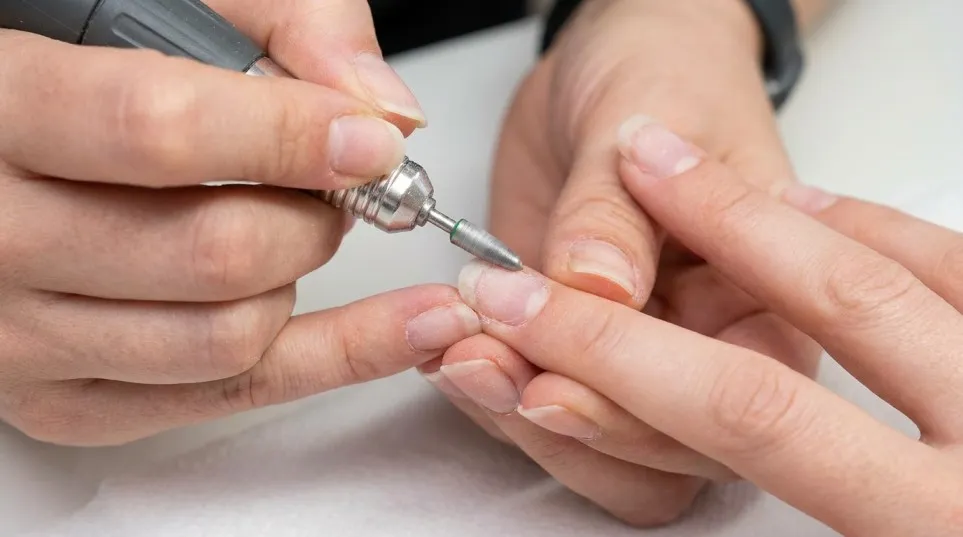
A professional BIAB infill involves several important stages. Each stage helps create a neat finish while reducing the risk of damage to the natural nail.
The following guide explains what normally happens during an appointment.
Step 1: Check the Existing BIAB
Before applying fresh product, the technician should inspect every nail.
They will look for lifting, cracks, broken edges, unusual discolouration and signs of natural nail damage.
If the existing BIAB is firmly attached and the nail is healthy, an infill may be possible. If the product has lifted significantly or the natural nail is damaged, the technician may need to remove more of the product or recommend a different treatment.
Never apply fresh gel over lifted product simply to hide the gap.
Step 2: Remove the Old Top Coat and Colour
The technician uses a suitable hand file or an e-file, if appropriately trained, to reduce the old top coat and colour.
The aim is to remove unwanted bulk and prepare the existing product for the new application.
This step requires care because excessive filing can thin the natural nail. A skilled technician knows how to distinguish the remaining builder gel from the natural nail plate.
Step 3: Remove Any Lifting Product
Any lifted or poorly bonded product must be removed safely.
Fresh BIAB should not be placed over a pocket where the old product has separated from the nail. Doing so may trap debris or moisture and make the problem worse.
The technician should remove only what is necessary and assess whether the remaining product is suitable for an infill.
Step 4: Prepare the New Nail Growth
The new growth near the cuticle needs careful preparation so the fresh BIAB can adhere properly.
Depending on the product system, preparation may include gently managing the cuticle area, removing surface shine where instructed, and cleansing the nail.
The natural nail should not be aggressively filed. Excessive preparation can leave the nail thin, sore and more vulnerable to breakage.
Step 5: Apply Fresh BIAB
The technician applies the appropriate builder gel to the prepared nail and blends it with the existing product.
The amount of gel and the placement depend on the nail’s length, shape and structural needs.
A good application should look smooth and balanced. The product must not flood the cuticles or touch the surrounding skin.
Step 6: Cure the Gel Correctly
BIAB is cured under the UV or LED lamp specified by the product manufacturer.
The correct lamp, curing time and application thickness matter because gel that is not properly cured can increase the risk of skin sensitisation and allergic reactions.
Curing times vary between products, so there is no single time that works for every BIAB system.
Step 7: Refine the Shape
After curing, the technician checks the nail profile, sidewalls and free edge.
They may refine the shape to make the nails look even and restore the intended structure.
This is especially important for longer nails, where poor balance can increase the risk of breakage.
Step 8: Add Colour and Top Coat
You can keep your original shade, choose a new BIAB colour if the product system allows it, or add gel polish or nail art.
Popular choices include milky pink, soft nude, sheer beige, French tips and glossy neutral shades.
The technician finishes with the appropriate top coat and cures it according to the manufacturer’s instructions.
Step 9: Finish With Cuticle Oil
Once the manicure is complete, cuticle oil and hand cream can help condition the surrounding skin.
Your new BIAB infill should look neat, smooth and balanced, with no product touching the skin.
For more information about professional builder gel application, consult The GelBottle’s BIAB application guide.
Can You Do a BIAB Infill at Home?
Yes, some experienced users maintain their own BIAB manicures at home. However, performing an infill safely requires more than simply filling the visible gap.
You need to recognise lifting, prepare the nail correctly, apply the correct amount of builder gel and use a compatible curing lamp. You must also understand when an infill is unsuitable.
If you are a complete beginner, professional application is the safer starting point.
What Do You Need for a BIAB Infill?
Depending on the product system, a trained nail technician may use:
- A compatible BIAB builder gel.
- Suitable nail files and buffers.
- A professional cuticle preparation kit.
- The recommended UV or LED lamp.
- A compatible cleanser and nail preparation products.
- A suitable top coat.
- Cuticle oil and hand cream.
Not every BIAB system uses the same preparation products or removal method. Always follow the instructions supplied by the manufacturer.
Important Safety Advice for Home Use
Avoid allowing uncured gel to touch your skin. Repeated skin exposure to uncured gel products can cause an allergy to acrylates or related ingredients.
Do not try to cure gel using an ordinary household light or an unverified lamp. The lamp must be suitable for the particular product.
If you notice burning, persistent itching, redness, swelling or blistering, stop using the product and seek appropriate medical advice.
You can browse BIAB and builder gel products on Amazon UK to compare available options. Before buying, check the brand, ingredients, lamp compatibility, instructions and whether the product is intended for professional or home use.
Buying a complete kit does not replace proper training or safe application techniques.
How Much Does a BIAB Infill Cost?
The cost of a BIAB infill varies according to the salon, location, technician’s experience, product brand and additional services.
In the UK, a basic infill may cost approximately £25–£50 or more. Detailed nail art, repairs, longer nails or extra removal services can increase the total.
These are general estimates rather than verified prices for a specific salon.
Before booking, check whether the quoted price includes:
- Removal of the old colour.
- Repair of a broken nail.
- A new BIAB shade.
- Gel polish or French tips.
- Nail art.
- Removal of an incompatible product.
It is also sensible to ask whether the salon accepts infills from another technician or requires a fresh set first.
A slightly more expensive appointment with an experienced nail technician may be better value than choosing a cheap service that does not properly assess your existing nails.
What Is the Difference Between BIAB Infill and BIAB Rebalance?
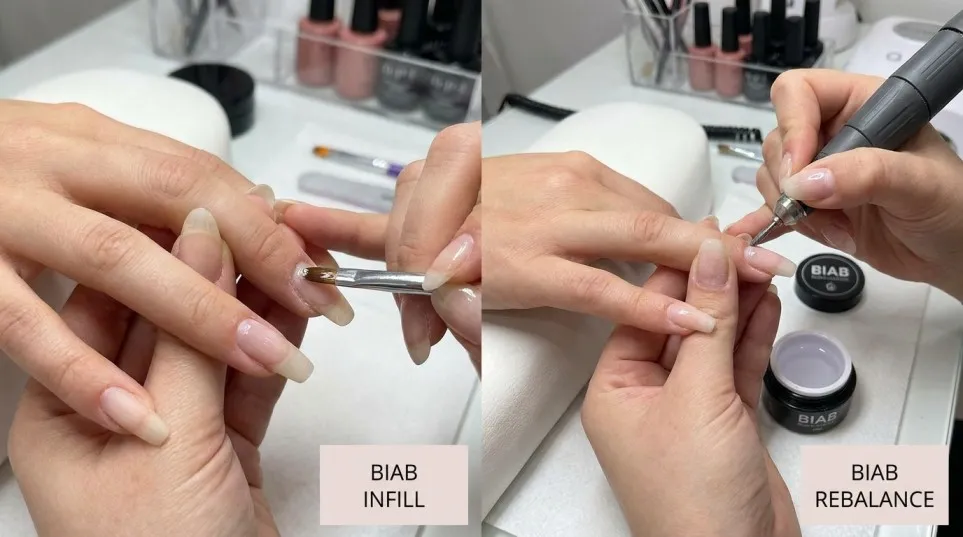
The terms BIAB infill and BIAB rebalance are often used for similar maintenance appointments, but their exact meaning can vary between salons.
An infill generally refers to refreshing the grown-out area with fresh builder gel.
A rebalance places greater emphasis on restoring the nail’s overall structure as it grows. This may involve reducing excess bulk, correcting the apex and adjusting the shape.
For example, a short, natural-looking manicure may need only a simple infill. A longer nail that has grown significantly may need more structural correction.
When booking, explain what you need rather than relying only on the service name. Your technician can then decide how much work is required.
BIAB Infill vs Gel Polish Infill
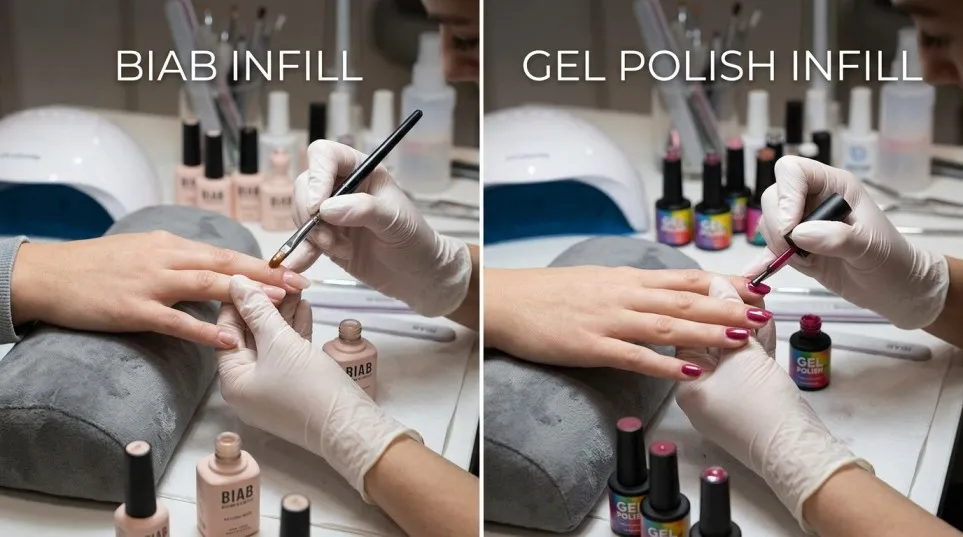
Although both treatments involve maintaining a manicure, they are not exactly the same.
BIAB is a builder gel used to create structure and support, while ordinary gel polish is mainly designed to add colour and a finished appearance.
A BIAB infill can involve rebuilding the structure of the existing overlay. A gel polish refresh generally focuses on colour and the condition of the underlying base.
If your natural nails are weak or you want a structured overlay, BIAB may be an option worth discussing with a qualified nail technician. However, it is not guaranteed to prevent breakage, and the right treatment depends on your nails and the product system.
How to Make Your BIAB Infill Last Longer
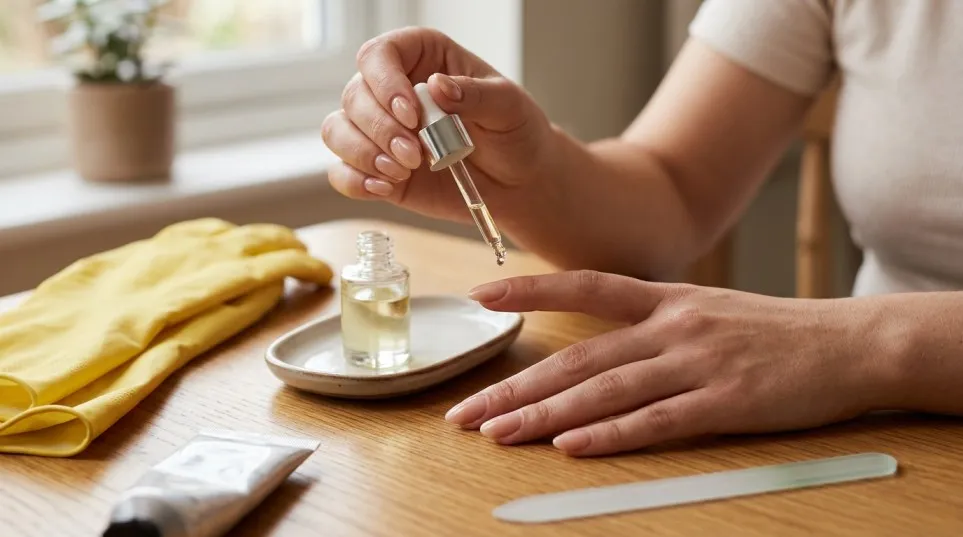
A well-applied infill still needs proper aftercare. Small daily habits can help keep your manicure looking neat between salon appointments.
1. Apply Cuticle Oil Regularly
Use cuticle oil around the nails to condition the surrounding skin.
You can find a range of options through Amazon UK’s cuticle oil search.
2. Avoid Picking or Peeling the Gel
It can be tempting to pull at a loose corner of BIAB, especially when you are busy. However, peeling the product can remove layers of your natural nail and leave it thin or weak.
Arrange a professional repair or removal instead.
3. Wear Gloves for Household Cleaning
Cleaning products and frequent exposure to water can affect your hands and the appearance of your manicure.
Wearing suitable gloves when washing dishes or using cleaning chemicals can help protect your skin and nails.
4. Do Not Use Your Nails as Tools
Opening tins, scraping labels and forcing objects apart can put unnecessary pressure on the nail.
Use the appropriate tool instead of relying on your nails.
5. Keep Your Appointments Regular
Book your next appointment according to your nail growth and the condition of the product.
For many people, a two-to-three-week interval is a reasonable starting point. Your technician may recommend a different schedule based on your nail length and the BIAB system used.
6. Pay Attention to Lifting
If the product separates from the nail, do not glue it back down or cover it with fresh gel.
A lifted area needs proper assessment because it can collect debris and moisture. Seek professional advice rather than waiting for your next routine appointment.
Common BIAB Infill Mistakes to Avoid

Even a small mistake can affect the finish and condition of your manicure.
Filing too aggressively: Excessive filing can damage the natural nail plate. Only the required amount of existing product should be removed.
Applying gel over lifting: This can hide a problem instead of correcting it.
Allowing gel onto the skin: Product contact with the skin should be avoided, especially before curing.
Using the wrong lamp: A lamp that is not compatible with the product may fail to cure it properly.
Waiting too long between appointments: Excessive regrowth can change the balance of the nail and increase the risk of breakage.
Ignoring discomfort: Pain, persistent redness, swelling or unusual nail discolouration should not be treated as normal parts of a manicure.
The best results come from correct preparation, suitable products, proper curing and regular assessment of nail health.
Is a BIAB Infill Worth It?
For many people, yes. A BIAB infill can be a practical way to maintain a manicure without removing the entire overlay at every appointment.
It can help you:
- Maintain a neat appearance as your nails grow.
- Refresh the shape and length of your nails.
- Keep a suitable existing BIAB layer in place.
- Change your colour or add nail art when appropriate.
- Reduce the need for repeated complete removal.
However, an infill is not always the best option. If your nails are damaged or the existing product has extensive lifting, a professional may recommend removal and a fresh application.
Choosing the right service for your nail condition is more important than simply extending the life of a manicure.
Frequently Asked Questions About BIAB Infill
These answers cover common questions people ask about BIAB refills, including timing, cost, removal and aftercare.
Related BIAB Guides
- November BIAB Nails: 20 Beautiful Designs, Colours and Trends to Try
- November BIAB Nail Ideas: 20 Beautiful Designs, Colours and Trends to Try
- What Is BIAB? A Complete Guide to BIAB Nails, Benefits, Application and Aftercare
- Biab Nail Ideas: 25 Beautiful BIAB Nail Ideas for Every Style
Frequently Asked Questions
A BIAB infill is a maintenance treatment in which fresh builder gel is applied to the regrowth area of an existing BIAB manicure. The technician removes unsuitable or lifted product, prepares the nail and restores the manicure’s structure.
Many people book an infill every two to three weeks. The right schedule depends on nail growth, nail length, the condition of the existing BIAB and your technician’s advice.
Yes. If the existing product is healthy and firmly attached, your technician may leave a thin, bonded layer and apply fresh BIAB over the prepared nail. Extensive lifting, damage or an unsuitable product system may require more complete removal.
A basic BIAB infill may cost around £25–£50 or more in the UK. Prices depend on the salon, location, repairs, colour choices and nail art. Always check the salon’s current price list.
A basic BIAB infill may cost around £25–£50 or more in the UK. Prices depend on the salon, location, repairs, colour choices and nail art. Always check the salon’s current price list.
A typical appointment may take approximately 45–90 minutes. Simple refills can be quicker, while repairs, reshaping and detailed nail art can take longer.
Yes, in many cases. Your technician can remove the old colour and apply a new shade if the existing structure is suitable and the product system allows it. Some colour changes require additional filing or removal.
Neither option is always better. An infill is useful when the existing BIAB is stable and the natural nail is healthy. A fresh set may be more appropriate when there is significant lifting, damage, a major shape change or a need to remove the existing product.
It depends on the location and severity of the break. A technician may be able to repair minor damage, but a painful, deeply split or injured nail needs appropriate assessment. Do not cover an injury with builder gel.
A properly performed infill does not automatically damage natural nails. However, aggressive filing, poor preparation, incorrect curing and repeated picking can cause damage. Professional technique and suitable aftercare are important.
It is possible, but beginners should be cautious. Correct product selection, nail preparation, curing and recognition of lifting are essential. Professional application is a sensible option if you lack the necessary training.
Yes, an infill every two weeks may suit people whose nails grow quickly or whose manicure needs more frequent maintenance. Your technician can help you choose an appropriate schedule.
Do not pick, peel or cover the lifted area with fresh gel. Arrange a professional assessment and have the unsuitable product removed safely. Seek medical advice if you notice pain, swelling, redness or unusual discolouration.
Final Thoughts
A BIAB infill is a useful way to maintain a neat, strong-looking manicure as your natural nails grow. Rather than automatically removing the entire set, a qualified nail technician can assess the existing product, prepare the regrowth and restore the nail’s shape when an infill is appropriate.
For the best results, choose a suitable maintenance schedule, avoid picking at your gel, use cuticle oil regularly and never ignore lifting or nail discomfort.
If you are considering your first BIAB manicure, start with a qualified nail technician who understands the product system and can explain the maintenance process. If you already wear BIAB, ask whether your current set is suitable for an infill at your next appointment.
The key is simple: maintain your BIAB carefully, prioritise nail health and choose an infill or fresh set based on the actual condition of your nails.